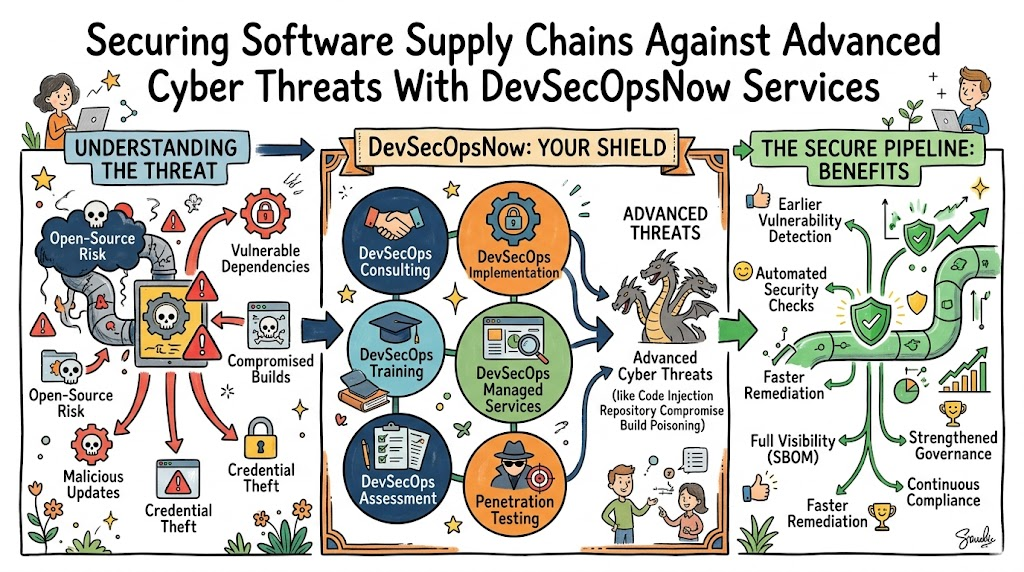
Modern software engineering organizations rely on high-speed delivery models to push code into production continuously. The widespread adoption of cloud-native infrastructure, microservices, containerization with Kubernetes, complex application programming interfaces, open-source dependencies, and automated continuous integration and continuous delivery pipelines has dramatically accelerated deployment velocity. However, this increased architectural complexity introduces expanding attack surfaces that traditional, late-stage security testing cannot safely protect. Performing manual security reviews or perimeter scans right before release creates severe delivery bottlenecks, exposes production systems to undetected vulnerabilities, and increases remediation costs exponentially. Implementing a robust framework through DevSecOpsNow solves these operational friction points by integrating automated security controls, real-time feedback loops, and shared governance directly throughout every phase of the software development lifecycle.
Understanding DevSecOps
DevSecOps represents the natural evolution of DevOps by embedding security practices directly into the software development and operations lifecycle rather than treating security as an isolated, end-stage gateway. It shifts security left, moving risk identification closer to code creation where remediation is faster, cheaper, and far less disruptive to engineering momentum. This approach relies heavily on automated scanning mechanisms, continuous monitoring, and policy-as-code frameworks embedded directly inside CI/CD pipelines to evaluate every code change automatically. Developers receive immediate feedback within their native environments through tools like Static Application Security Testing, Dynamic Application Security Testing, Software Composition Analysis, secrets scanning, Infrastructure as Code analysis, container image verification, and Software Bill of Materials generation. By standardizing continuous security automation, organizations cultivate shared accountability between development, security, and operations teams without sacrificing release speed or system stability.
Why Organizations Are Adopting DevSecOps
Modern software platforms rely on interconnected ecosystems combining Git repositories, automated CI/CD runners, Docker containers, Kubernetes orchestrators, Terraform scripts, and multi-cloud providers like AWS, Azure, and Google Cloud. Modern applications pull heavily from open-source libraries and external artifact registries connected through sprawling microservices and APIs. Managing security manually across this dynamic infrastructure is nearly impossible. Organizations adopt DevSecOps to establish continuous security visibility and automated testing across all layers of their technology stack. By embedding security early, engineering teams catch vulnerabilities before code reaches production, significantly reducing mean time to remediate critical flaws. Automated testing streamlines compliance reporting, reduces manual audit overhead, and fosters cross-functional collaboration between developers and security engineers. Ultimately, this proactive operational posture prevents high-profile breaches, hardens supply chain integrity, and protects brand reputation while maintaining continuous release cadences.
DevSecOps Consulting Services
Navigating the transition toward an integrated security model requires strategic planning, architecture design, and process alignment across engineering departments. Leveraging professional DevSecOps Consulting Services provides organizations with an objective analysis of their existing engineering workflows, toolchains, CI/CD pipelines, cloud architectures, and governance models. Experienced security architects evaluate current maturity levels, identify dangerous coverage gaps, and design a customized transformation roadmap tailored to business objectives and regulatory compliance frameworks. Consulting engagements focus heavily on tool selection, cloud security postures, Kubernetes hardening, and establishing practical policy-as-code standards that minimize developer friction. Organizations typically require external consulting expertise when scaling engineering teams, migrating legacy workloads to native cloud environments, recovering from security incidents, or preparing for strict compliance audits. A structured consulting strategy ensures that technical transformations remain aligned with business goals while establishing scalable defense mechanisms.
DevSecOps Implementation Services
Transitioning from a strategic security vision to daily operational reality requires direct engineering execution across pipelines, repositories, and hosting platforms. Comprehensive DevSecOps Implementation Services focus on configuring, integrating, and fine-tuning security tools directly into existing software delivery workflows. Technical specialists configure automated scanning hooks, define granular threshold policies, establish centralized dashboarding, and build automated triage mechanisms that prevent build failures from false positives. By embedding static analysis, dynamic scanning, dependency tracking, secrets detection, infrastructure validation, and container inspection directly into developer platforms, teams achieve frictionless protection without manual intervention.
Static Application Security Testing – SAST
Static Application Security Testing inspects source code, binary files, and application logic for hidden security flaws and coding bugs without executing the program. Integrating SAST engines directly into Git repositories and pull request workflows allows developers to identify SQL injections, cross-site scripting, and buffer overflows as they write code. Modern SAST tools deliver real-time inline feedback inside code editors, preventing insecure code from ever merging into main development branches.
Dynamic Application Security Testing – DAST
Dynamic Application Security Testing evaluates running applications from an outside-in perspective, simulating real-world attacker techniques against staging or test environments. DAST identifies runtime vulnerabilities, broken authentication flows, server misconfigurations, memory leaks, and web application exposure points that static code analysis cannot detect. Automated DAST scans execute during pipeline deployment phases to validate application security postures before traffic hits production environments.
Software Composition Analysis – SCA
Software Composition Analysis scans third-party open-source components, frameworks, and transitively inherited libraries used within application codebases. SCA tools continuously cross-reference project dependencies against known vulnerability databases, licensing registries, and exploit lists. Automated SCA alerts engineering teams to outdated packages, severe vulnerabilities, and legal licensing risks, allowing developers to patch or update third-party code before building deployment artifacts.
Secrets Scanning
Secrets scanning continuously inspects source code, commit histories, configuration files, build logs, and container layers for exposed credentials. It identifies hardcoded passwords, API keys, SSH keys, private certificates, and cloud provider access tokens before code is pushed to remote repositories. Automated secrets prevention mechanisms block commits containing exposed credentials and automatically trigger key revocation workflows to mitigate credential leak risks.
Infrastructure as Code Security
Infrastructure as Code security tools analyze provisioning scripts written in Terraform, CloudFormation, ARM templates, or Ansible prior to cloud deployment. These security engines detect structural misconfigurations, overly permissive access control policies, unencrypted storage buckets, and open network ports. Enforcing IaC security early in the deployment pipeline ensures cloud infrastructure is provisioned according to strict baseline security policies.
Container Security
Container security focuses on hardening containerized applications from base image creation through registry storage and production execution. Automated scanning engines inspect container images for OS package vulnerabilities, malware, embedded secrets, and misconfigured user permissions. Enforcing base image signature validation, private registry access controls, and runtime security shields ensures that only verified, secure containers execute within production environments.
Kubernetes Security
Managing distributed container workloads at scale introduces unique operational challenges that require specialized Kubernetes Security Consulting Services. Securing a Kubernetes cluster requires defense-in-depth across the API server, control plane, worker nodes, ingress controllers, and runtime workloads. Security specialists establish strict role-based access control policies, enforce explicit network segmentation, and configure admission controllers to validate incoming manifest requests automatically. Additionally, cluster hardening involves encrypting secrets at rest, enforcing pod security standards, isolating tenant workloads, and continuously monitoring cluster audit logs for suspicious behaviors.
RBAC
Role-Based Access Control restricts API access within Kubernetes clusters by binding granular permissions to specific users, service accounts, and system groups. Implementing principle-of-least-privilege RBAC prevents unauthorized cluster modifications, lateral movement, and administrative privilege escalation across namespaces.
Network Policies
Kubernetes Network Policies act as internal firewalls, controlling traffic flow between pods, services, and external networks based on specific labels and namespaces. Enforcing default-deny network rules restricts unauthorized inter-pod communications, isolating compromised workloads and preventing lateral attacker movement across cluster infrastructure.
Admission Controls
Admission controllers act as gatekeepers, inspecting and validating API requests before objects are persisted into cluster state storage. Using tools like Open Policy Agent or Kyverno, admission controllers block non-compliant pods, enforce resource limits, and prevent root-level execution across environments.
Secrets Management
Kubernetes secrets management secures sensitive configuration data such as API tokens, passwords, and TLS certificates used by running applications. Integrating external key management vaults ensures credentials remain encrypted both in transit and at rest, eliminating plain-text secrets exposure inside cluster manifests.
Container Image Security
Container image security ensures that cluster workloads execute exclusively from verified, signed, and vulnerability-scanned image registries. Enforcing automated image verification mechanisms prevents unauthorized or modified container images from being deployed into production Kubernetes clusters.
Kubernetes Configuration Security
Configuration security involves auditing cluster manifests, Helm charts, and control plane settings for architectural misconfigurations and security drift. Automated scanning tools validate cluster deployment settings against established CIS benchmarks, preventing insecure workload configurations from entering production systems.
Runtime Security
Runtime security provides continuous monitoring of running container environments to detect anomalous behavior, process injections, and file system alterations. Advanced runtime agents leverage eBPF technology to trace system calls, instantly alerting security teams to malicious execution events in real time.
Cluster Access Management
Cluster access management controls administrative access to Kubernetes API servers through single sign-on integration, short-lived tokens, and multi-factor authentication. Restricting direct cluster access and logging administrative sessions ensures complete auditability and reduces exposure to unauthorized access attempts.
Cloud Security
Protecting cloud-native platforms across AWS, Azure, Google Cloud, or hybrid environments demands specialized Cloud Security Consulting Services to maintain posture control and prevent data exposure. Modern cloud security centers on identity management, infrastructure immutability, continuous posture monitoring, and strong data protection baselines. Cloud security specialists help enterprises design multi-account governance architectures, establish strict network perimeters, automate configuration management, and implement centralized logging solutions. Aligning cloud infrastructure with zero-trust architecture principles ensures that workloads remain resilient against credential compromises, misconfigurations, and external attack vectors.
Identity and Access Management
Identity and Access Management controls entity permissions across cloud resources, enforcing multi-factor authentication, least-privilege access, and role assumption policies. Centralized IAM configuration prevents credential exposure, tracks user activity, and eliminates dormant accounts across cloud environments.
Cloud Network Security
Cloud network security establishes secure perimeters using virtual private clouds, network security groups, micro-segmentation, and web application firewalls. Segmenting cloud networks isolates sensitive workloads, controls ingress and egress traffic, and mitigates unauthorized external connectivity.
Cloud Configuration Security
Cloud configuration security continuously monitors cloud assets for dangerous drift, open storage buckets, and unencrypted management interfaces. Automated configuration management tools remediate misconfigurations instantly, keeping cloud environments compliant with established enterprise baseline standards.
Encryption
Cloud encryption protects sensitive data at rest and in transit across storage services, databases, and network backbones using robust cryptographic keys. Managing encryption keys through dedicated Cloud KMS platforms ensures complete control over data visibility and regulatory compliance adherence.
Logging and Monitoring
Centralized cloud logging captures API calls, network flow logs, system events, and administrative access records across all account environments. Integrating log streams into centralized SIEM platforms provides real-time monitoring, security event correlation, and forensic auditing capabilities.
Infrastructure as Code Security
Applying security automation to IaC templates ensures that cloud infrastructure provisioned through automated code pipelines strictly adheres to security policies. Pre-deployment template validation prevents misconfigured storage, insecure firewall rules, and weak encryption settings from reaching production.
Workload Security
Workload security protects virtual machines, serverless functions, and container instances running across cloud infrastructure from exploit attempts. Deploying endpoint detection, automated patching, and file integrity monitoring shields cloud compute assets from runtime operational threats.
Cloud Security Posture Management
Cloud Security Posture Management platforms continuously audit multi-cloud environments against compliance frameworks, industry standards, and security baselines. CSPM tools deliver centralized visibility, automated risk scoring, and prioritized remediation guidance to cloud security operations teams.
Software Supply Chain Security Services
Modern software products rely on complex webs of open-source dependencies, external build scripts, third-party plugin ecosystems, and automated build platforms. Utilizing dedicated Software Supply Chain Security Services helps organizations defend their development ecosystem against dependency confusion attacks, malicious package injections, build pipeline tampering, and compromised upstream dependencies. Security specialists audit build environments, configure artifact integrity verification tools, implement cryptographic code signing, and establish secure private package repositories. Securing every touchpoint from developer code commits to final binary deployment guarantees that released software remains authentic and untampering.
Understanding Software Bill of Materials
A Software Bill of Materials acts as a complete, structured inventory of all software components, modules, open-source libraries, and dependencies included within a application release. Generating automated SBOMs in standardized formats like CycloneDX or SPDX provides complete visibility into internal software supply chains. Organizations require SBOMs to quickly identify exposed systems when new zero-day vulnerabilities emerge in widely used open-source libraries. Furthermore, maintaining granular component inventories streamlines compliance auditing, simplifies license management, and helps security teams assess structural risk profiles across enterprise software applications.
CI/CD Pipeline Security
Continuous integration and delivery pipelines serve as critical control centers for modern engineering operations, making them high-value targets for malicious actors. Hardening pipeline environments requires protecting build runners, enforcing strict branch protection rules, managing pipeline secrets securely, and implementing explicit approval gates for production releases. Compromised CI/CD platforms can allow attackers to inject malicious code directly into production software releases without touching source repositories. Implementing robust access controls, isolated ephemeral build environments, signed commit verification, and immutable build logs ensures that automated pipelines maintain complete operational integrity.
Policy-as-Code
Policy-as-code automates security and compliance governance by defining access rules, configuration baselines, and deployment constraints as executable code files. Tools like Open Policy Agent validate infrastructure configurations, container manifests, and pipeline scripts against centralized policy repositories automatically. Common automated policy examples include:
- Preventing container execution under root administrative user permissions.
- Requiring mandatory encryption for all provisioned cloud storage services.
- Restricting container image pulls exclusively to approved, scanned corporate registries.
- Enforcing explicit Kubernetes CPU and memory resource constraints on all workloads.
- Blocking cloud network security groups from opening administrative ports to public networks.
Automating policy enforcement eliminates subjective manual reviews, speeds up developer feedback, guarantees consistent governance across multi-cloud environments, and simplifies regulatory auditing procedures.
DevSecOps Assessment Services
Determining an organization’s security maturity requires evaluating technical capabilities, workflow efficiency, tool adoption, and team culture. Utilizing professional DevSecOps Assessment Services provides a comprehensive review of application architecture, CI/CD pipeline automation, cloud posture, dependency management, and developer practices. Assessment specialists conduct thorough gap analyses, evaluate tool integration depth, and benchmark security maturity against recognized industry frameworks. The resulting deliverable provides leadership with an actionable, prioritized transformation roadmap that balances risk reduction with engineering productivity.
DevSecOps Maturity Model
Achieving DevSecOps excellence is an iterative journey that progresses through distinct maturity stages as organizations automate controls and refine operational processes.
| Level | Characteristics |
| Initial | Mostly manual security reviews, siloed security teams, late-stage testing, high vulnerability backlog. |
| Developing | Basic security scanning introduced, ad-hoc SAST/SCA testing, limited pipeline integration, manual triage. |
| Integrated | Automated scanning built into CI/CD pipelines, centralized risk reporting, standardized tools across teams. |
| Automated | Comprehensive policy-as-code, automated triage gates, IaC and container security, quick developer feedback. |
| Optimized | Continuous measurement, automated remediation workflows, advanced runtime security, strong DevSecOps culture. |
Progressing through this maturity model requires balancing people, processes, technology, governance, and collaboration rather than relying solely on purchasing new security tools.
Vulnerability Management
Effective vulnerability management in a modern DevSecOps framework requires an automated, risk-based lifecycle that spans discovery, validation, classification, prioritization, assignment, remediation, verification, reporting, and continuous monitoring. Simply generating endless lists of security findings creates alert fatigue and slows down engineering velocity without significantly improving security postures. Prioritizing remediation effort requires evaluating specific risk factors, including CVSS severity scores, real-world exploitability metrics, application internet exposure, business criticality, and data sensitivity. Focus engineering resources on high-impact vulnerabilities that present active exploitation vectors while maintaining realistic remediation SLAs for lower-risk findings.
DevSecOps Managed Services
Managing complex security platforms, maintaining automated scanning engines, tuning policy rules, and supporting developer remediation efforts can strain internal security teams. Engaging DevSecOps Managed Services provides organizations with dedicated, ongoing security engineering support to manage and optimize their DevSecOps ecosystem continuously. Managed service providers oversee platform maintenance, monitor pipeline security alerts, tune scanning rule sets, manage vulnerability backlogs, update compliance policies, and assist developers with remediation guidance. This continuous operational support enables internal engineering teams to focus on core product development while maintaining robust, enterprise-grade security posture control.
Penetration Testing Services
While automated scanning tools excel at detecting known vulnerabilities and misconfigurations at scale, they cannot replace human critical thinking and creative exploit chaining. Combining automated pipeline security controls with professional Penetration Testing Services provides comprehensive defense validation across applications, APIs, cloud environments, container registries, and Kubernetes clusters. Expert ethical hackers conduct controlled manual security testing to identify complex business logic flaws, authorization bypasses, multi-step exploit chains, and zero-day vulnerabilities that automated tools miss. Regular penetration testing validates the effectiveness of automated pipeline defenses and ensures system resilience against advanced attacker techniques.
DevSecOps Training
Building a sustainable secure engineering culture requires upskilling technical staff on modern security principles, automation tools, and remediation practices. Comprehensive DevSecOps Training programs equip individual engineers with practical knowledge covering secure SDLC workflows, CI/CD security automation, SAST/DAST analysis, container security, secrets management, IaC validation, and policy-as-code enforcement. Hands-on training empowers developers and DevOps engineers to identify vulnerabilities early, interpret scanning results accurately, and write secure code by default, significantly reducing the volume of security issues entering delivery pipelines.
Corporate DevSecOps Training
Enterprises scaling secure engineering practices across multiple teams benefit from structured Corporate DevSecOps Training customized to their specific technology stack, workflows, and operational requirements. Role-based learning tracks tailor instruction for distinct engineering disciplines:
- Software Developers: Secure coding practices, SAST triage, open-source dependency risk management, and local secrets prevention.
- DevOps & Platform Engineers: Pipeline security automation, CI/CD hardening, policy-as-code, and secrets vault management using Jenkins, GitHub Actions, or GitLab CI/CD.
- Cloud & Kubernetes Engineers: Infrastructure as Code scanning with Terraform, cloud security configuration across AWS/Azure/GCP, and container security.
- Security Engineers & Architects: Security tool integration, custom rule development in SonarQube, policy orchestration, and automated triage workflows.
- Engineering Leaders: Security metrics analysis, governance risk alignment, security culture transformation, and release gate management.
Customized corporate training programs utilizing real-world hands-on labs bridge the gap between security theory and practical, daily engineering execution.
Example DevSecOps Pipeline
An integrated DevSecOps delivery pipeline automates security verification at every stage of the software delivery lifecycle, preventing vulnerabilities from advancing toward production environments.
Developer Commit ➔ Secrets Scan ➔ SAST ➔ Dependency Scan ➔ Build ➔ Container Scan ➔ IaC Scan ➔ Test Deployment ➔ DAST ➔ Policy Validation ➔ Production ➔ Runtime Monitoring
- Developer Commit: Code is committed to a local Git branch triggering pre-commit security checks.
- Secrets Scan: Automated agents scan commits to prevent exposed API keys and passwords from entering repositories.
- SAST: Static analysis inspects source code for security defects and coding flaws inline.
- Dependency Scan: SCA engines check open-source packages against vulnerability databases.
- Build: Application binaries and deployment artifacts are compiled in isolated runner environments.
- Container Scan: Built container images are inspected for system package vulnerabilities and misconfigurations.
- IaC Scan: Infrastructure templates are validated against security baseline policies before resource creation.
- Test Deployment: Hardened artifacts are deployed into isolated staging environments for dynamic validation.
- DAST: Dynamic scanners execute real-world attack simulations against running application staging endpoints.
- Policy Validation: Policy-as-code engines evaluate overall deployment compliance before approving releases.
- Production: Validated, cryptographically signed artifacts are deployed into production environments.
- Runtime Monitoring: eBPF agents and SIEM tools monitor production workloads continuously for anomalous activities.
DevSecOps Implementation Roadmap
Successfully implementing DevSecOps across an enterprise requires a structured, phased approach that builds security capability incrementally without disrupting delivery velocity.
- Phase 1 – Assessment & Alignment: Evaluate existing engineering workflows, identify critical security gaps, select appropriate toolsets, and define security governance baselines.
- Phase 2 – Foundation & Secrets Control: Implement automated secrets scanning across code repositories, establish secure secrets management vaults, and enforce basic Git branch protection controls.
- Phase 3 – Pipeline Integration: Integrate automated SAST and SCA scanning tools directly into primary CI/CD pipelines with non-blocking alerts to build baseline visibility.
- Phase 4 – Infrastructure & Container Hardening: Introduce IaC scanning for cloud provisioning scripts and automated container image inspection within container registries.
- Phase 5 – Policy Automation & DAST: Deploy policy-as-code frameworks to enforce compliance gates automatically and implement automated DAST testing in staging environments.
- Phase 7 – Runtime Defense & Observability: Deploy runtime security monitoring across Kubernetes clusters and cloud environments while centralizing security logging into SIEM platforms.
- Phase 8 – Continuous Optimization: Fine-tune security scanner rules to reduce false positives, automate vulnerability triage workflows, and optimize developer feedback loops continuously.
Common DevSecOps Challenges
Engineering organizations often encounter operational friction when adopting integrated security models, but practical strategies can overcome these common hurdles.
- Security Alert Overload: Excessive false positives paralyze developers; resolve this by fine-tuning scanning rulesets and establishing high-severity blocking thresholds initially.
- Developer Resistance: Security controls perceived as delivery blockers cause friction; overcome this by embedding inline feedback into native IDEs and Git pull requests.
- Tool Fragmentation: Managing disparate security tools creates operational silos; streamline operations by adopting centralized security posture management platforms.
- Lack of Security Ownership: Developers assuming security is someone else’s job stall progress; build shared accountability through cross-functional security champion programs.
- Skills Gaps: Lack of cloud and automation expertise hinders execution; invest in hands-on, role-based corporate training programs across engineering teams.
- Poor Tool Integration: Standalone security tools fail to deliver value; ensure all security tools integrate seamlessly into existing CI/CD runners via APIs.
- Excessive Pipeline Delays: Slow security scans bottleneck release pipelines; optimize execution times by running heavy scans asynchronously or during night builds.
- Inconsistent Security Policies: Divergent policies across multi-cloud environments create gaps; enforce centralized policy-as-code standards across all infrastructure layers.
DevSecOps Metrics
Tracking performance metrics helps engineering leaders evaluate security posture improvements, identify process bottlenecks, and optimize automation workflows effectively.
| Metric | Purpose |
| Mean Time to Remediate | Measures the average time required to patch and deploy fixes for discovered security vulnerabilities. |
| Critical Vulnerabilities | Tracks the volume of severe unresolved security findings present across production systems over time. |
| Security Test Coverage | Measures the percentage of active CI/CD pipelines containing automated security scanning controls. |
| Secrets Detected | Monitors the frequency of exposed credentials caught during pre-commit and pipeline scanning phases. |
| Dependency Risk | Tracks the proportion of application dependencies containing known, unpatched software vulnerabilities. |
| Policy Violations | Measures non-compliant infrastructure and container configurations blocked by automated policy controls. |
| Secure Deployment Rate | Tracks the percentage of application releases passing all automated security quality gates without overrides. |
Utilizing balanced security metrics encourages engineering teams to improve real-world security outcomes rather than simply generating meaningless scanning reports.
Choosing a DevSecOps Service Model
Selecting the appropriate service model depends on an organization’s internal technical maturity, existing headcount, business goals, and immediate security objectives.
- DevSecOps Consulting Services: Ideal for organizations needing strategic transformation roadmaps, tool evaluation, architecture design, or expert guidance during cloud migrations.
- DevSecOps Assessment Services: Best for enterprises seeking an objective benchmark of their current security posture, technical gaps, and prioritized risk management strategies.
- DevSecOps Implementation Services: Suited for teams requiring direct technical execution to integrate security tools, pipeline controls, IaC scanning, and container protection.
- DevSecOps Managed Services: Perfect for organizations looking to outsource ongoing security platform operations, scanner tuning, alert triage, and continuous platform maintenance.
- Cloud Security Consulting Services: Designed for businesses needing specialized architecture hardening across AWS, Azure, Google Cloud, IAM, and multi-cloud environments.
- Kubernetes Security Consulting Services: Necessary for engineering groups running microservices workloads requiring cluster hardening, RBAC design, and runtime security controls.
- Software Supply Chain Security Services: Critical for software vendors aiming to secure build platforms, generate SBOMs, and prevent dependency compromise attacks.
- Penetration Testing Services: Essential for enterprise teams seeking manual exploit validation across web applications, cloud systems, APIs, and infrastructure.
- DevSecOps Training: Beneficial for individual software engineers, DevOps practitioners, and security analysts looking to master hands-on security automation practices.
- Corporate DevSecOps Training: Custom-tailored for enterprise engineering departments looking to upskill developers, cloud engineers, and platform teams cohesively.
Frequently Asked Questions
1. What is the main difference between DevOps and DevSecOps?
DevOps focuses on automating software delivery to increase release velocity and operational stability. DevSecOps builds directly upon this foundation by integrating automated security controls, continuous scanning, and policy enforcement throughout the entire development lifecycle, ensuring speed does not compromise system security.
2. How does DevSecOps help reduce overall software development costs?
Identifying vulnerabilities during early development phases using automated SAST and secrets scanning costs significantly less to fix than remediating security flaws discovered in production or recovering from real-world data breaches, emergency patches, and regulatory compliance fines.
3. Will introducing DevSecOps scanning tools slow down CI/CD pipelines?
Properly configured DevSecOps pipelines do not slow down releases. By running fast, incremental scans during code commits and executing comprehensive, time-intensive testing asynchronously, engineering teams maintain continuous integration speed while retaining complete security visibility.
4. What is the role of Policy-as-Code in modern security automation?
Policy-as-code defines security rules, access constraints, and compliance requirements in version-controlled code files. Automated engines evaluate infrastructure templates and deployment manifests against these rules, automatically blocking non-compliant configurations before resources are provisioned in cloud environments.
5. Why is Software Supply Chain Security becoming a critical priority?
Modern applications rely heavily on open-source dependencies, third-party libraries, and external build pipelines. Securing software supply chains prevents malicious package injection, dependency confusion attacks, and unauthorized build tampering, guaranteeing that released software remains secure and untampered.
6. How does an SBOM improve security response times during zero-day vulnerabilities?
A Software Bill of Materials provides an exact, searchable inventory of all open-source libraries and transitive dependencies used within applications. When zero-day vulnerabilities emerge, teams query their SBOM inventory instantly to identify and patch affected systems within minutes.
7. What are the key areas involved in securing Kubernetes clusters?
Kubernetes security requires protecting the control plane, configuring role-based access controls, enforcing network policies between pods, securing container registries, managing API secrets, isolating workload permissions via admission controllers, and monitoring container processes continuously at runtime.
### 8. Can automated security scanning tools completely replace manual penetration testing?
No, automated scanners excel at detecting known vulnerabilities, misconfigurations, and syntax errors at scale, but they cannot evaluate complex business logic flaws, authorization bypasses, or multi-step exploit chains that human security experts discover during manual penetration testing.
9. How does DevSecOps support regulatory compliance frameworks like SOC 2 or ISO 27001?
DevSecOps automates continuous policy enforcement, maintains immutable audit logs of build approvals, tracks vulnerability remediation workflows, and enforces least-privilege access controls, providing clear, continuous evidence of security governance for internal and external auditors.
10. What is the best way to deal with security alert fatigue among developers?
Reduce alert fatigue by fine-tuning scanner rulesets, suppressing low-confidence findings, blocking builds only on critical or high-severity vulnerabilities, providing actionable remediation advice, and deploying centralized security management platforms that consolidate duplicate security alerts.
11. What skills do DevOps engineers need to transition into successful DevSecOps roles?
Engineers need strong foundations in CI/CD pipeline automation, cloud security baselines, containerization, Infrastructure as Code, basic application security principles, policy-as-code tools like OPA, secrets management systems, and practical knowledge of automated security scanning engines.
12. How should an enterprise begin its DevSecOps transformation journey?
Organizations should start by assessing current engineering workflows, securing low-hanging fruit like automated secrets scanning in Git, training engineering staff on secure coding baselines, and gradually embedding non-blocking security checks into CI/CD pipelines before enforcing blocking quality gates.
Conclusion
DevSecOps transforms modern software engineering by establishing continuous security integration, automated governance controls, and shared operational accountability throughout the application delivery lifecycle. Securing modern cloud platforms, microservices, Kubernetes clusters, and complex software supply chains demands proactive automated scanning, robust policy-as-code enforcement, risk-based vulnerability management, and continuous runtime observability. By combining strategic architecture planning with hands-on technical execution, robust training programs, and comprehensive testing methodologies, organizations build resilient engineering environments capable of shipping secure software rapidly without compromising operational agility or governance standards.
