Introduction
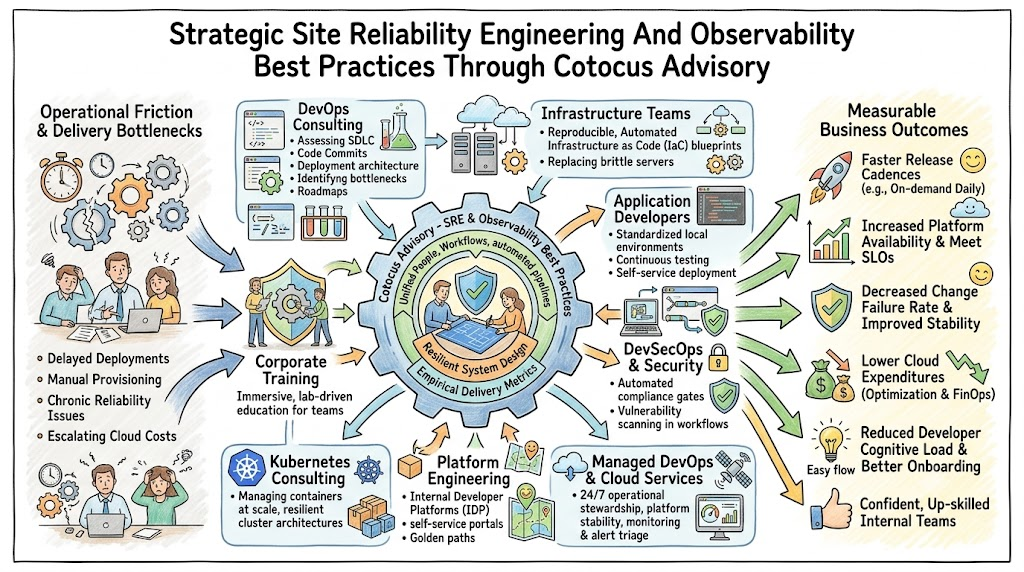
Modern enterprise software delivery grows more complicated every day because systems now span hybrid environments, distributed microservices, and rapidly shifting compliance mandates. Engineering leaders frequently run into friction like delayed release dates, fragile manual infrastructure provisioning, lingering security oversights, unmonitored cloud spend, and unexpected production downtime. Professional DevOps consulting cuts through this operational gridlock by aligning people, operational workflows, continuous automation, scalable architecture, unified security policies, and concrete business metrics. Adopting this holistic path transforms internal operations into an adaptable engine powered by integrated cloud systems, container platforms, proactive reliability practices, and focused technical development. Teams partnering with Cotocus leverage this holistic methodology to transform fragmented technical pipelines into standardized, dependable software delivery mechanisms that scale predictably across modern enterprises.
What Are DevOps Consulting Services?
Professional DevOps Consulting Services offer comprehensive technical guidance to help enterprises modernize their software delivery lifecycle from initial code commit to production monitoring. Rather than simply installing tools or writing automated scripts, experienced technical advisors evaluate architectural health, team structures, delivery handoffs, and feedback loops across the entire software delivery pipeline. These engagements carefully assess continuous integration, automated deployment workflows, Infrastructure as Code configurations, cloud platform governance, container platforms, pipeline security, observability stacks, release coordination, and overall developer friction. For example, a financial services enterprise struggling with bi-weekly release delays might assume their Jenkins runners need faster compute instances, but an objective architectural audit often reveals that manual database schema approvals and unautomated security ticket reviews are the actual bottlenecks. By addressing these foundational delivery constraints, consultants help engineering organizations replace manual toil with automated guardrails, stable environments, clear deployment visibility, and a measurably improved developer experience.
Why Do Businesses Need DevOps Consulting?
Growing engineering teams inevitably face operational hurdles as legacy architectures collision with aggressive business timelines and distributed team structures. Organizations frequently run into these distinct, high-impact technical friction points:
- Manual deployments requiring off-hours weekend coordination and extensive human intervention.
- Dragged-out release cycles stretching feature delivery from days into several unpredictable months.
- Infrastructure inconsistency across staging and production creating hard-to-reproduce application defects.
- Poor observability stacks leaving operations teams blind during sudden production service interruptions.
- Security reviews acting as end-of-cycle roadblocks that stall delivery schedules indefinitely.
- Cloud platform complexity that drives uncontrolled monthly spending and sprawling, unmanaged assets.
- Kubernetes adoption hurdles where complex networking, ingress, and persistent storage stall platform rollouts.
- Critical internal engineering skills shortages across modern automation, containerization, and cloud platforms.
- Chronic application reliability problems leading to broken client trust and violated SLAs.
- Tool sprawl caused by isolated teams adopting disjointed delivery software without architectural alignment.
Engaging seasoned consultants provides the outside technical objectivity and deep architectural experience necessary to dismantle these chronic roadblocks systematically through standardized patterns and actionable remediation plans.
How Does a DevOps Consulting Engagement Work?
Assess the Current Environment
The engagement kicks off with an extensive, data-driven analysis of your entire software delivery lifecycle, architecture topologies, and organizational dynamics. Senior advisors review your cloud architecture diagrams, deployment scripts, security controls, and operational workflows while conducting interviews with development, operations, and QA leads to evaluate day-to-day engineering friction. This stage maps the flow of a single code commit all the way to live production instances, uncovering hidden handoffs, unmanaged dependencies, and undocumented manual interventions. By capturing baseline operational metrics such as current build durations, environment provisioning times, failure frequencies, and developer idle time, the team establishes an honest benchmark that forms the objective foundation for all future architectural improvements.
Identify Delivery Bottlenecks
Once the operational assessment wraps up, consultants analyze the gathered system data to isolate the root causes holding back release velocity and system reliability. Instead of treating superficial symptoms like slow continuous integration builds, advisors examine the complete value stream to locate systemic process constraints, fragile automated test suites, or excessive manual validation gates. For instance, teams frequently discover that while automated unit testing completes within five minutes, manual security sign-offs and unautomated environment provisioning tie up software releases for three weeks. Pinpointing these exact organizational and architectural bottlenecks ensures that engineering resources focus exclusively on high-impact optimizations rather than marginal, low-value tweaks.
Create a DevOps Roadmap
With foundational constraints clearly identified, consultants build a phased, realistic execution roadmap tailored directly to your technical maturity and strategic business timelines. This delivery plan outlines prioritized technical initiatives, sequencing foundational infrastructure modernization ahead of advanced workflow automation so engineering teams avoid unnecessary operational disruption. The roadmap defines explicit architectural milestones, implementation ownership, required tooling migrations, testing strategies, security integration points, and concrete baseline targets across deployment frequency and change failure rates. Presenting these initiatives in iterative phases gives leadership complete clarity on technical dependencies, resource allocations, budget expectations, and the operational outcomes expected across each milestone.
Implement Improvements
During the execution phase, consultants partner closely with your internal platform, development, and operations teams to build out the designated infrastructure and automation frameworks. This hands-on work involves writing modular Infrastructure as Code blueprints, assembling secure continuous integration pipelines, deploying container platforms, and embedding automated security testing directly into existing developer workflows. Rather than working in isolation, the advisory team uses pair programming, technical workshops, and detailed architectural documentation to ensure your internal engineers thoroughly understand every platform enhancement. Progress moves forward through iterative production-ready increments, allowing your business to realize immediate workflow improvements while continuously validating pipeline stability in real-world scenarios.
Measure Results
The final stage of the engagement validates the operational impact of the delivered automation against the original baseline benchmarks. Consultants implement automated dashboards that continuously track critical DORA metrics alongside foundational infrastructure performance indicators to maintain continuous visibility over system health. Technical leads observe improvements across key delivery metrics including:
- Deployment frequency tracking how often code successfully ships to production environments.
- Lead time for changes measuring the duration between code commit and production release.
- Change failure rate calculating the percentage of deployments causing production service degradation.
- Mean time to recovery recording how quickly teams restore availability after an outage.
- Overall service availability measuring system uptime against defined availability targets.
- Build and automated test suite duration verifying accelerated feedback loops for developers.
- Infrastructure provisioning time assessing the velocity of spin-up workflows for temporary environments.
Evaluating these data points ensures the engineering organization sustains high delivery velocity and platform resilience over the long term.
Managed DevOps Services: What Do They Cover?
While targeted consulting engagements solve immediate architectural challenges and establish roadmaps, Managed DevOps Services provide dedicated, continuous operational support for enterprises that prefer to focus their internal staff on core product features. These comprehensive services provide 24/7 technical guardianship over complex multi-cloud environments, automated delivery pipelines, Kubernetes platforms, and reliability operations. Specialized operational engineers assume direct responsibility for proactive cluster maintenance, automated security patching, performance monitoring, pipeline maintenance, and real-time production incident remediation. This model serves as an ideal solution for scaling businesses that lack the internal headcount to sustain round-the-clock infrastructure rotations or organizations navigating sudden technical growth.
| Area | Typical Responsibility |
| CI/CD Pipelines | Maintaining workflow runners, optimizing automated build caching, updating deployment steps, and resolving pipeline failures. |
| Infrastructure | Managing Infrastructure as Code repositories, provisioning environments, applying configuration updates, and maintaining cloud parity. |
| Monitoring & Observability | Configuring metric agents, tuning alert thresholds, building operational dashboards, and managing log aggregation platforms. |
| Deployment Operations | Orchestrating automated blue-green or canary releases, managing rollback routines, and verifying post-deployment health checks. |
| Cloud Governance | Enforcing least-privilege IAM policies, auditing resource utilization, applying security patches, and optimizing cloud spending. |
| Incident Response | Providing round-the-clock on-call coverage, triaging infrastructure anomalies, mitigating outages, and driving blameless postmortems. |
| Automation Engineering | Developing custom operational scripts, automating database backup workflows, and building self-healing system routines. |
| Security & Compliance | Scanning base container images, auditing network security groups, rotating encryption keys, and remediating platform vulnerabilities. |
Cloud Consulting Services: Building the Right Foundation
Modern Cloud Consulting Services guide organizations through the critical architectural decisions required to design resilient, performant, and cost-effective environments across AWS, Microsoft Azure, and Google Cloud. Professional cloud advisors evaluate networking topologies, VPC configurations, identity and access management hierarchies, encryption protocols, and disaster recovery runbooks to ensure environments remain completely secure as traffic expands. Central to every successful cloud strategy is a fundamental guiding question: What business outcome should the cloud architecture improve? By orienting architectural choices around specific business goals—such as reducing global latency, accelerating market expansion, meeting strict compliance standards, or cutting operational overhead—consultants prevent costly over-engineering. Enforcing Infrastructure as Code through tools like Terraform or OpenTofu guarantees that these well-architected cloud foundations remain auditable, repeatable, and completely free from manual configuration drift.
Cloud Migration Services: Moving Without Creating New Problems
Moving enterprise workloads to the cloud requires an organized, multi-phase execution strategy to prevent costly downtime, performance regressions, and architectural vulnerabilities. Professional Cloud Migration Services manage the entire journey through structured discovery, automated workload mapping, target architecture blueprinting, zero-downtime data replication, robust integration testing, and production cutover execution. Technical teams carefully categorize internal applications against primary modernization strategies: rehosting rapidly moves virtual machines via lift-and-shift patterns with minimal code changes; replatforming updates underlying managed services like container runtimes or cloud databases without restructuring application code; and refactoring entirely re-architects core services into modular, cloud-native microservices. Systematically matching each application to its optimal migration pattern allows organizations to modernize legacy systems smoothly while preserving complete business continuity.
Real-Life Cloud Migration Scenario
An established logistics company managing internal supply chain systems ran into severe scalability constraints, as their aging on-premise hardware repeatedly crashed under unpredictable holiday shipping volumes. The primary technical bottleneck centered on a monolithic inventory tracking application tied directly to an unmanaged database that lacked automated failover and read scaling. During initial technical investigations, migration specialists discovered tightly coupled local file dependencies and hard-coded network addresses that prevented a basic lift-and-shift approach. The advisory team implemented a replatforming strategy by containerizing the core inventory service, migrating data to a high-availability cloud database with automated multi-zone replication, and offloading static tracking assets to managed cloud object storage. This decoupled cloud architecture completely eliminated holiday service disruptions, reduced database maintenance overhead by 80%, and allowed development teams to release tracking updates weekly instead of quarterly.
Kubernetes Consulting Services: Managing Containers at Scale
Adopting container orchestration at an enterprise level requires deep operational rigor, making specialized Kubernetes Consulting Services vital for avoiding complex architectural missteps. Senior container specialists help engineering leaders determine whether Kubernetes is genuinely appropriate for their operational footprint or if lightweight serverless platforms better serve their immediate architectural needs. For organizations managing distributed microservice architectures, consultants design, deploy, secure, and operate managed clusters across Amazon EKS, Azure AKS, and Google Cloud GKE. This advisory work covers mission-critical infrastructure components including secure container networking, ingress controllers, persistent storage drivers, GitOps release workflows, auto-scaling configurations, robust cluster monitoring, and pod-level resource limits to prevent runaway cloud bills. Focusing strictly on operational necessity ensures organizations build resilient, production-grade container platforms without getting buried under unnecessary orchestration complexity.
DevSecOps Consulting Services: Making Security Part of Delivery
Modern software security can no longer operate as an isolated validation gate that blocks deployments right before scheduled production releases. Specialized DevSecOps Consulting Services resolve this friction by embedding automated security tooling and compliance verification directly into the continuous integration and deployment lifecycle. Implementing shift-left security practices allows developers to catch software vulnerabilities, insecure third-party dependencies, exposed API keys, and misconfigured infrastructure files right inside their daily IDE workflows and pull requests. Technical consultants implement automated static code analysis, software composition analysis, container image vulnerability scanning, dynamic testing, and policy-as-code frameworks that enforce organizational guardrails automatically. By turning security policies into automated pipeline gates, businesses maintain rigorous regulatory compliance and harden their cloud workloads without slowing down engineering release velocity.
SRE Consulting Services: Improving Reliability
Site Reliability Engineering applies software engineering mindsets directly to infrastructure operations, helping enterprises systematically balance rapid feature delivery with rock-solid system stability. Professional SRE Consulting Services guide organizations in establishing actionable Service Level Indicators (SLIs) and clear Service Level Objectives (SLOs) that accurately reflect real user happiness rather than arbitrary infrastructure metrics. Teams establish explicit error budgets, creating transparent, data-driven agreements between product managers and developers regarding when to prioritize new features versus when to focus on platform reliability. Consider an enterprise e-commerce platform that experiences frequent checkout service degradations during flash sales; traditional operations teams usually restart servers repeatedly, whereas an SRE engagement traces deep telemetry traces to identify downstream database connection pool exhaustion. Resolving these architectural bottlenecks through automated capacity scaling, improved observability stacks, chaos testing, and blameless postmortems transforms incident management from stressful firefighting into predictable operational engineering.
Platform Engineering Consulting Services
As engineering departments scale toward hundreds of developers, maintaining release velocity without overwhelming developers with operational tasks requires a dedicated platform approach. Professional Platform Engineering Consulting Services assist enterprises in designing and deploying custom Internal Developer Platforms (IDPs) that abstract underlying cloud and Kubernetes complexity behind standardized self-service workflows. Platform specialists establish validated golden paths, reusable infrastructure templates, and centralized deployment pipelines that allow software engineers to spin up compliant environments independently in minutes without filing operations tickets. For example, rather than an engineer spending days writing raw cloud networking and container manifests, they submit a simple configuration file through a developer portal that automatically provisions an isolated staging environment with logging, monitoring, and security guardrails pre-configured. This self-service foundation drastically lowers developer cognitive fatigue, enforces architectural consistency across microservices, and frees platform teams to focus on strategic operational capabilities.
Corporate DevOps Training
Building resilient, automated software delivery systems requires continuous upskilling across internal engineering teams so they can confidently run and maintain modern architectures. High-impact Corporate DevOps Training programs deliver comprehensive, hands-on learning curricula specifically customized to reflect your enterprise’s actual production tech stack and real-world delivery workflows. Rather than sitting through generic, tool-focused video tutorials, engineers work inside interactive sandbox labs, debugging simulated production outages, writing Infrastructure as Code templates, optimizing CI/CD pipelines, securing containers, and deploying microservices. Tailoring educational modules around continuous deployment, cloud-native administration, Kubernetes operations, DevSecOps scanning, and SRE incident management ensures development and operations teams gain immediate, practical competencies that translate directly into cleaner code commits, faster troubleshooting, and self-sufficient platform ownership.
Comparison of DevOps Services
| Service | Primary Goal | Best Suited For |
| DevOps Consulting Services | Optimize the software delivery lifecycle through assessment, roadmap planning, and automation architecture. | Organizations facing delivery bottlenecks, slow release cadences, or fragmented development workflows. |
| Managed DevOps Services | Deliver 24/7 proactive management, maintenance, monitoring, and operational support for cloud infrastructure. | Growing companies needing dedicated operational coverage without expanding internal engineering headcount. |
| Cloud Consulting Services | Design resilient, secure, scalable, and cost-efficient architectures across major cloud platforms. | Businesses planning new cloud deployments, multi-cloud strategies, or comprehensive architectural modernizations. |
| Cloud Migration Services | Modernize and transfer legacy workloads, databases, and enterprise applications to cloud platforms securely. | Enterprises moving on-premise data centers or monolithic architectures to scalable cloud environments. |
| Kubernetes Consulting Services | Architect, secure, scale, and optimize container platforms across managed enterprise clusters. | Teams managing distributed microservices requiring automated scaling, orchestration, and resilient container platforms. |
| DevSecOps Consulting Services | Integrate security, automated vulnerability scanning, and compliance validation directly into CI/CD pipelines. | Organizations with strict regulatory requirements or companies experiencing friction between security and delivery teams. |
| SRE Consulting Services | Enhance application availability, establish actionable SLOs, and build proactive incident response automation. | Platforms facing unexpected downtime, scaling issues, broken user trust, or reactive operational firefighting. |
| Platform Engineering Consulting Services | Build internal developer platforms, self-service infrastructure, and reusable deployment golden paths. | Mid-to-large engineering departments struggling with high developer cognitive load and inconsistent environment setups. |
| DevOps Outsourcing Services | Provide experienced DevOps, cloud, platform, and reliability engineers to expand delivery capacity. | Companies needing immediate technical skills to accelerate transformation projects without long hiring delays. |
| Corporate DevOps Training | Upskill internal development and operations teams through practical, hands-on labs based on real architectures. | Enterprises seeking to build long-term internal technical capabilities across modern cloud-native practices. |
How to Choose the Right DevOps Approach
Every organization navigates software delivery through a unique combination of legacy technical debt, regulatory constraints, and business goals, meaning modernization initiatives must be carefully prioritized. When evaluating where to begin, technology leaders should map their most urgent operational challenges directly to targeted solutions:
- Manual deployments and slow handoffs call for foundational DevOps Consulting Services to modernize continuous delivery pipelines.
- Initial cloud adoption requires specialized Cloud Consulting Services to ensure networking and security foundations scale correctly.
- Aging, expensive data center infrastructure demands dedicated Cloud Migration Services to modernize applications without downtime.
- Microservice operational sprawl points toward Kubernetes Consulting Services to establish standardized container orchestration.
- Late-stage compliance hurdles and security audit delays require DevSecOps Consulting Services to embed automated scans into pipelines.
- Frequent production crashes and poor uptime indicate an immediate need for SRE Consulting Services to establish error budgets and observability.
- Developer onboarding delays and configuration confusion require Platform Engineering Consulting Services to build self-service portals.
- Internal talent bottlenecks require flexible DevOps Outsourcing Services for temporary capacity or Corporate DevOps Training for long-term internal skills.
Balancing these solutions against your budget, existing technical maturity, and core business timelines ensures that every dollar invested in modern engineering yields measurable delivery improvements.
About Cotocus
Cotocus is an enterprise technology consulting organization dedicated to helping businesses accelerate their digital modernization through reliable automation, cloud-native architectures, and robust software delivery frameworks. The firm supports organizations worldwide by delivering comprehensive technical capabilities covering DevOps consulting, managed operations, cloud migrations, Kubernetes architecture, DevSecOps automation, Site Reliability Engineering, platform development, technical staff augmentation, and corporate training. Whether an enterprise needs to migrate complex monolithic workloads to Amazon Web Services, establish scalable container platforms on Microsoft Azure, or upskill internal engineering teams on modern GitOps patterns, the consultancy focuses on building sustainable, secure, and production-tested systems. Engineering leaders partnering with Cotocus gain the strategic guidance and hands-on implementation support needed to replace manual operational toil with resilient self-service platforms, automated security guardrails, and dependable delivery pipelines that scale seamlessly alongside evolving business demands.
What Should a Business Expect From a DevOps Roadmap?
A well-structured technical roadmap must function as a pragmatic, outcome-oriented blueprint that ties architectural modernization efforts directly to clear operational and business results. Instead of simply listing tools to install, a mature roadmap defines the sequence of technical transformations required to systematically overcome distinct business challenges.
| Business Challenge | Technical Response | Potential Measurement |
| Slow, high-friction releases | Implement automated CI/CD pipelines with comprehensive automated integration and unit testing. | Deployment frequency increases from monthly to multiple successful deployments per day. |
| Frequent, unexplained production outages | Deploy centralized observability, distributed tracing, automated health checks, and alerting. | Mean time to recovery (MTTR) drops by more than 60% during unexpected service incidents. |
| Manual, inconsistent environments | Adopt declarative Infrastructure as Code using modular Terraform configurations and GitOps workflows. | Staging environment provisioning velocity accelerates from two weeks down to under fifteen minutes. |
| Late-stage security delays | Shift security left by integrating automated SAST, DAST, and container vulnerability scans into pipelines. | Vulnerability identification time shifts from late staging into initial pull request reviews. |
| Uncontrolled cloud spending sprawl | Enforce cloud governance, automated instance scheduling, rightsizing, and resource tagging policies. | Monthly cloud infrastructure expenditure drops by 20% to 35% without impacting application performance. |
| Developer productivity bottlenecks | Build an internal developer platform with standardized self-service templates and golden paths. | Developer onboarding and initial production commit time decreases from one month down to three days. |
| Critical internal technical skills gaps | Deliver targeted, hands-on corporate engineering training combined with paired technical mentoring. | Internal engineering tickets escalated to external contractors drop significantly over two quarters. |
| Container platform operational friction | Modernize cluster networking, ingress controllers, autoscalers, and persistent storage configurations. | Cluster resource utilization increases while container failovers complete without user disruption. |
Tracking these technical responses against tangible operational metrics ensures that platform modernization investments remain aligned with high-level business objectives.
Real-Life Scenarios / Experiences
A mid-sized healthcare technology provider managing electronic patient records struggled with severe release anxiety, as their manual three-day deployment cycles frequently resulted in critical data synchronization errors. The engineering leadership brought in an advisory team that discovered zero automated integration testing and widespread configuration drift across their three separate hosting environments. Over five months, the consulting team built immutable Infrastructure as Code templates, set up containerized microservices, and instituted automated smoke tests within a unified continuous delivery pipeline. This systematic transformation eliminated manual environment setup completely, allowing the healthcare provider to ship compliance-verified feature updates twice a week with zero recorded production downtime.
Another typical scenario involved a rapidly expanding SaaS enterprise whose sudden traffic growth led to recurring database deadlocks and slow page loads during peak business hours. The internal developers were trapped in a constant cycle of restarting virtual machines and manually tweaking connection thresholds without ever identifying why the application was failing. By introducing SRE methodologies, engineers established clear latency-based Service Level Objectives, configured distributed application tracing, and identified a series of inefficient, unindexed database queries triggered exclusively by background report generation. Fixing these database queries and implementing an automated caching layer restored platform response times to sub-second speeds, saving the company from violating critical enterprise SLAs.
In a third engagement, an enterprise insurance provider with over two hundred software engineers was losing development momentum because teams spent nearly thirty percent of their working hours submitting infrastructure provisioning tickets to an overworked operations department. Senior platform consultants designed an Internal Developer Platform that exposed standardized, security-compliant architectural templates for microservice deployments, cloud databases, and networking components through an intuitive self-service portal. Within four months of adoption, developers were launching fully compliant, pre-monitored staging environments in under ten minutes without filing a single operational ticket, dramatically accelerating feature releases while simultaneously reinforcing company-wide security standards.
Common Mistakes to Avoid
Enterprise digital transformations often run into expensive roadblocks when engineering leaders prioritize fashionable trends over practical operational fundamentals. Organizations modernizing their software delivery pipelines should steer clear of these frequent mistakes:
- Treating DevOps modernization as a tool-purchasing exercise rather than evolving team collaboration, processes, and delivery culture.
- Adopting complex technologies like Kubernetes for simple, low-traffic workloads where basic managed services deliver better stability.
- Postponing security considerations until the end of the project rather than automating vulnerability scans right inside continuous delivery pipelines.
- Automating inefficient, broken manual processes instead of redesigning the delivery workflow to eliminate unnecessary handoffs.
- Building continuous delivery pipelines without sufficient automated testing, resulting in broken code reaching production environments faster.
- Neglecting centralized observability, leaving engineering teams dependent on disconnected, surface-level CPU and memory graphs during outages.
- Failing to invest in continuous internal training, leaving internal engineers incapable of maintaining modern platforms after external consultants depart.
- Over-engineering internal developer platforms with restrictive configurations that frustrate developers and encourage workarounds.
Avoiding these common operational missteps ensures that technical infrastructure transformations deliver sustainable, long-term business value without creating fresh architectural headaches.
How Do DevOps, Cloud, Kubernetes, and SRE Work Together?
Modern software engineering achieves peak efficiency when core technical disciplines operate as a tightly unified, collaborative operational framework rather than isolated technical silos. Cloud platforms provide the elastic, programmable foundation that allows Infrastructure as Code tools to provision compute, networking, and storage instances automatically on demand. Kubernetes operates directly on top of this cloud layer, orchestrating containerized microservices, managing runtime workloads, and ensuring consistent application execution across diverse environments. Modern DevOps methodologies weave these layers together by building continuous integration and continuous delivery pipelines that test, package, and deploy code updates straight into container clusters without manual intervention. Simultaneously, Site Reliability Engineering surrounds the entire delivery lifecycle with observability dashboards, clear SLOs, and proactive incident response automation that monitors system behavior, controls operational risk, and maintains predictable performance. Treating cloud architecture, container orchestration, pipeline automation, and reliability engineering as a cohesive technological strategy allows organizations to achieve rapid deployment velocity while maintaining ironclad platform stability.
How Can Cotocus Support Your Modern Engineering Journey?
Navigating enterprise modernization requires seasoned technical leadership that understands how to solve complex operational challenges without disrupting ongoing business operations. Cotocus partners with organizations across every phase of technical maturity, delivering targeted DevOps Consulting Services, comprehensive Cloud Migration Services, production-grade Kubernetes deployments, automated DevSecOps frameworks, and Site Reliability Engineering practices tailored to your architecture. Whether your organization requires round-the-clock Managed DevOps Services to oversee mission-critical cloud infrastructure, strategic DevOps Outsourcing Services to scale delivery capacity, or hands-on Corporate DevOps Training to upskill internal engineering teams, the company brings the practical domain expertise required to build resilient, automated environments. By focusing strictly on measurable business outcomes, eliminating operational bottlenecks, and embedding robust self-service workflows, the firm enables your development teams to innovate quickly, reduce infrastructure spending, and ship secure software with total confidence.
Frequently Asked Questions
1. What are the primary business benefits of hiring a DevOps consulting firm?
Hiring an experienced DevOps consulting firm helps businesses eliminate deployment bottlenecks, reduce release cycles from months to days, improve software delivery quality, and cut cloud infrastructure costs. External advisors bring deep cross-industry expertise to identify systemic delivery constraints that internal teams often overlook. This outside guidance ensures you avoid expensive architectural missteps while establishing dependable, automated delivery pipelines that align closely with strategic business goals.
2. How do I know if my organization needs managed DevOps services?
Your business likely needs Managed DevOps Services if your internal engineering teams spend excessive working hours firefighting infrastructure issues, handling manual deployments, or responding to midnight on-call alerts instead of developing features. It is also an ideal model for growing organizations that require round-the-clock infrastructure monitoring, proactive security updates, and Kubernetes maintenance but lack the budget or internal capacity to recruit, train, and retain a permanent in-house operations team.
3. What is the difference between cloud migration and cloud modernization?
Cloud migration focuses primarily on moving workloads, data, and applications from on-premise hardware or legacy hosting to cloud infrastructure, often utilizing rehosting or basic lift-and-shift strategies. Cloud modernization goes a step further by refactoring those migrated applications to leverage native cloud capabilities, such as containerization, serverless architectures, managed databases, and automated horizontal scaling. Modernization unlocks true agility, operational resilience, and cost optimization across modern cloud platforms.
4. When is adopting Kubernetes the right architectural choice for an enterprise?
Kubernetes is the right choice when your enterprise manages complex, distributed microservices requiring automated scaling, high deployment density, self-healing capabilities, and dynamic traffic management across multi-cloud environments. Conversely, if your application portfolio consists of a few monolithic systems or low-traffic services, managing a Kubernetes cluster introduces unnecessary operational overhead. In those cases, managed container runtimes or standard serverless platforms deliver better operational simplicity and lower costs.
5. How does DevSecOps differ from traditional application security practices?
Traditional security practices evaluate application code and infrastructure configurations manually at the end of the development lifecycle, creating massive bottlenecks right before scheduled releases. DevSecOps shifts security directly into the daily development workflow by embedding automated vulnerability testing, static analysis, container image scanning, and compliance validation directly into CI/CD pipelines. This proactive approach identifies vulnerabilities during pull request reviews, reducing remediation costs while maintaining fast release cadences.
6. What core metrics should we monitor to track DevOps transformation success?
Enterprises should primarily track the four core DORA metrics: deployment frequency, lead time for changes, change failure rate, and mean time to recovery (MTTR). In addition, teams should monitor secondary operational indicators like automated build and test duration, environment provisioning turnaround times, cloud infrastructure spending efficiency, and overall service availability. Tracking these metrics objectively over time ensures that platform investments deliver real operational improvements rather than subjective, unmeasured progress.
7. What is an Internal Developer Platform and why is platform engineering popular?
An Internal Developer Platform (IDP) is an integrated layer of tools, services, and self-service portals that automates infrastructure provisioning, configuration, and deployment workflows for developers. Platform engineering has surged in popularity because modern cloud and container tooling has become too complex for product engineers to manage independently. Building standardized golden paths reduces developer cognitive fatigue, enforces security standards automatically, and enables teams to ship code independently without opening operations tickets.
8. How does Site Reliability Engineering differ from traditional IT operations?
Traditional IT operations teams focus primarily on keeping servers running through manual administration, ticket-driven support tasks, and reactive incident troubleshooting. Site Reliability Engineering applies software engineering practices directly to operational challenges, utilizing code to automate manual tasks, manage infrastructure declaratively, and monitor service health. SRE establishes data-driven Service Level Objectives (SLOs) and error budgets that balance aggressive feature delivery with system availability, transforming incident remediation into structural, blameless engineering improvements.
9. Can legacy applications be integrated into modern automated CI/CD pipelines?
Yes, legacy applications can be integrated into modern CI/CD pipelines, although the implementation often requires decoupling database migrations, introducing automated testing suites, and containerizing application components. While legacy systems may not immediately support zero-downtime canary rollouts, automating build packaging, environment configuration, regression testing, and deployment execution significantly reduces release risk. This gradual automation process stabilizes the application while laying the foundation for future architectural refactoring or replatforming initiatives.
10. Why do some digital transformations fail to deliver expected results?
Transformations usually fail when leadership treats DevOps as a software purchasing exercise, assuming that installing tools like Kubernetes, Terraform, or Jenkins automatically modernizes delivery. Without addressing organizational silos, shifting engineering culture, reducing manual review gates, and establishing automated testing, modern tools simply automate bad workflows. Real success requires evolving team responsibilities, investing in developer training, dismantling operational bottlenecks, and measuring outcomes through transparent, data-driven delivery metrics.
11. What are the advantages of outsourcing DevOps versus hiring internally?
DevOps outsourcing provides immediate access to seasoned technical experts across cloud architectures, container orchestration, automation, and security without the lengthy recruitment cycles and high overhead of full-time hiring. Outsourced teams bring broad cross-industry experience from solving complex platform challenges across diverse tech stacks, accelerating transformation timelines significantly. This operational flexibility allows enterprises to scale technical capacity up or down dynamically based on immediate architectural project demands.
12. How does hands-on corporate training accelerate internal technical capability?
Hands-on corporate training bridges the gap between theoretical knowledge and production engineering by immersing internal teams in real-world scenarios, debugging labs, and infrastructure design exercises. Learning within sandbox environments modeled after their own tech stack empowers engineers to master Infrastructure as Code, CI/CD automation, Kubernetes management, and SRE methodologies safely. This practical experience builds long-term technical self-sufficiency, ensuring internal staff can confidently maintain, optimize, and scale modern architectures independently.
Conclusion
Building a resilient, modern software delivery organization requires continuous architectural refinement across cloud environments, automated pipelines, container platforms, proactive security practices, and reliable operational frameworks. While establishing robust Infrastructure as Code, self-service developer platforms, and data-driven SRE principles requires disciplined investment, the long-term operational dividends include accelerated deployment velocity, lower infrastructure overhead, and minimized production downtime. Sustained technical excellence ultimately depends on fostering an internal culture of continuous hands-on learning, where engineering teams routinely refine their automation workflows, review blameless operational postmortems, and explore specialized technical ebooks to stay ahead of industry evolutions. Technology leaders who align sound engineering methodologies with experienced consulting guidance position their enterprises to navigate changing digital landscapes smoothly while consistently shipping high-performing, dependable software.
