Introduction
Far removed from the frenetic, cookie-cutter tourist corridors of standard vacation circuits, Amaravati reveals a grounded landscape where two millennia of spiritual heritage intersect with visionary modern infrastructure. Travelers weary of bumper-to-bumper tour buses and manufactured photo-ops will discover an unhurried, deeply rooted cadence along the serene curves of the Krishna River.
The morning air here carries the faint fragrance of river silt, temple camphor, and fresh filter coffee, untouched by heavy commercial tourism. Navigating this ancient royal seat of the Satavahanas offers a rare chance to witness historic monastic ruins, living Dravidian shrines, and cutting-edge expressway grids all coexisting within a single morning commute.
Why Amaravati is a must-visit city
Amaravati occupies a profound place in India’s historical, archaeological, and spiritual tapestry. Serving as the imperial seat of the Satavahana Dynasty and a preeminent hub of Mahayana Buddhist thought, this historic enclave once welcomed international pilgrims, thinkers, and master sculptors across maritime trade networks. Today, it forms a crucial vertex between the commercial pulse of Vijayawada and the agrarian heartland of Guntur, supported by smooth four-lane state highways, rapid rail connectivity, and proximity to regional airports. Whether you are an independent backpacker seeking sacred Buddhist antiquities or a family looking for open, green riverfront promenades, the destination provides effortless accessibility paired with genuine local warmth.
The surrounding travel circuit effortlessly links the sacred Pancharama river shrines to rock-cut cave sanctuaries, quiet agricultural hamlets, and expansive river islands. High-speed expressways and well-maintained arterial river roads allow visitors to transit smoothly between ancient archaeological digs and vibrant bazaar streets within minutes.
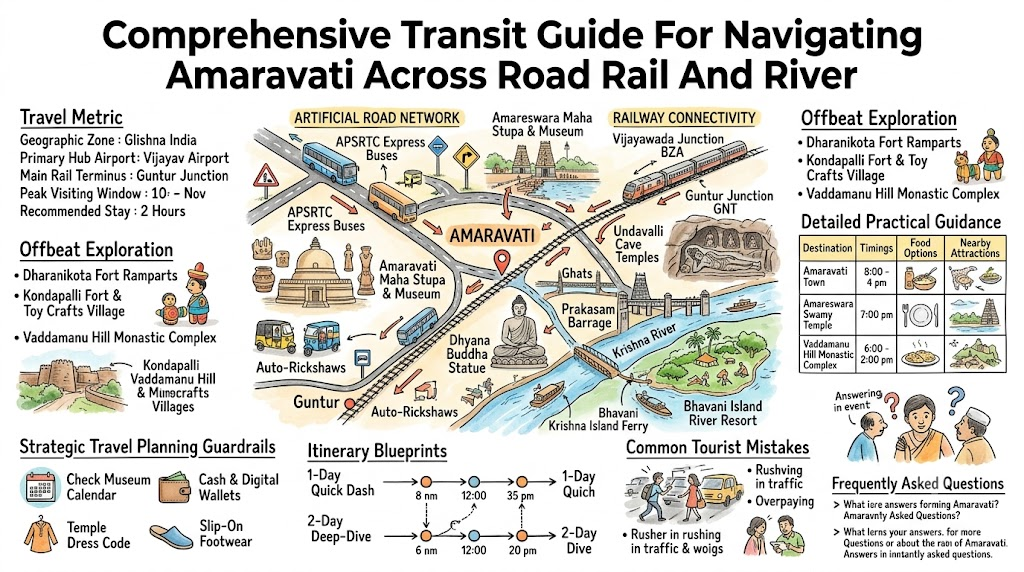
| Travel Metric | Regional Specification |
| Geographic Zone | Palnadu / NTR Border, Andhra Pradesh |
| Primary Hub Airport | Vijayawada International Airport (Gannavaram – VGA), ~45 km |
| Main Rail Terminus | Vijayawada Junction (BZA) ~32 km / Guntur Junction (GNT) ~35 km |
| Transit Backbone | APSRTC Express Buses, Riverfront Arterial Road, Auto-Rickshaws |
| Peak Visiting Window | October through March (Cool, dry winter months) |
| Recommended Stay | 2 Days / 1 Night |
Best Places or Experiences
Amaravati Maha Stupa and Archaeological Museum
The monumental Amaravati Maha Stupa, conceived in the 3rd century BCE and expanded under royal Satavahana patronage, once stood as one of the largest Buddhist reliquary domes in all of Asia. Its magnificent drum and gateways were clad in intricately carved Palnadu limestone panels illustrating profound Jataka stories and the philosophical discourses of the Buddha. Walking across the open-air brick foundations, one can observe the sheer architectural audacity of early Buddhist stonemasons who designed an enduring focal point for global pilgrimage.
Directly across the road, the Archaeological Museum preserves the delicate limestone masterpieces unearthed during centuries of careful excavation. Standing inches away from finely chiseled coping stones and ancient monastic seals provides an unmatched tactile intimacy with antique craftsmanship that rivaled the finest Hellenistic and Roman reliefs of its contemporary era.
- Location: Main Heritage Core, Amaravati Town; approximately 32 km west of Vijayawada Junction.
- Why it is worth visiting: It is the birthplace of the distinctive Amaravati School of Art, renowned worldwide for expressive, dynamic limestone carvings.
- Best things to do: Trace the ancient pradakshina path around the brick drum, study the detailed limestone relief slabs inside Gallery 1 of the museum, and photograph the morning light grazing the stupa plinth.
- Best time to visit: 8:30 AM to 11:00 AM for gentle morning sunlight and minimal pedestrian traffic.
- Ideal for whom: History buffs, archaeological scholars, architecture students, and quiet contemplation seekers.
- Travel tip: Wear slip-on footwear since the core stupa courtyard requires removing shoes, and ensure you arrive before midday as the exposed stone gets hot underfoot.
Amareswara Swamy Temple
Commanding the sacred southern bank of the Krishna River, the Amareswara Swamy Temple represents one of the celebrated Pancharama Kshetras dedicated to Lord Shiva. The inner sanctum features a towering, 15-foot-tall white marble Shiva Lingam so immense that the officiating priests must climb a raised upper wooden platform to perform the sacred abhishekam rituals. The complex exhibits majestic Dravidian gopurams, sprawling granite mandapams, and historical epigraphs tracing centuries of royal grants.
The surrounding temple streets echo with the continuous hum of Vedic recitation, ringing bronze bells, and vendors selling fresh jasmine garlands and bilva leaves. Descending the steep stone steps directly to the Krishna River ghats after morning prayers reveals panoramic views of local fishermen casting nets across mist-shrouded waters.
- Location: Riverfront Ghat Road, Amaravati Town; 1 km from the central bus stop.
- Why it is worth visiting: Houses an extraordinary two-story marble Shiva Lingam within a major historic Pancharama pilgrimage site.
- Best things to do: Witness the morning milk abhishekam from the temple gallery, walk down the sacred Krishna River steps, and examine the medieval stone inscriptions along the outer prakaram.
- Best time to visit: 6:00 AM to 8:00 AM to attend the earliest devotional pujas and witness sunrise over the river.
- Ideal for whom: Cultural travelers, spiritual pilgrims, photographers, and families.
- Travel tip: Traditional conservative attire is strictly expected (dhotis/trousers for men, sarees/salwars for women); photography inside the inner sanctum is strictly prohibited.
Dhyana Buddha Statue
Soaring 125 feet into the sky on the banks of the Krishna River, the Dhyana Buddha Statue is a contemporary monument paying homage to the ancient monastic prestige of the region. Seated in an attitude of profound meditation atop a massive sculpted lotus flower, this colossal figure commands the entire rural river basin. Beneath the towering image lies a multi-tiered circular meditation hall and museum housing intricate bas-reliefs illustrating Buddhist philosophical concepts.
The surrounding landscaped parklands provide a quiet, green sanctuary filled with flowering shrubs, shaded stone benches, and expansive walking tracks. As the late afternoon sun begins to set across the water, the pristine concrete surface catches rich amber reflections, creating an atmosphere of deep meditative stillness.
- Location: Amaravati Riverfront Park, approximately 1.8 km east of Amaravati Bus Stand.
- Why it is worth visiting: One of the tallest seated Buddha statues in India, featuring a comprehensive internal gallery dedicated to Buddhist heritage.
- Best things to do: Explore the air-conditioned spiritual art gallery inside the base, meditate on the open-air terrace beneath the lotus pedestal, and capture sunset silhouettes against the river.
- Best time to visit: 4:30 PM to 6:30 PM for cool river breezes and dramatic golden-hour lighting.
- Ideal for whom: Families, meditation practitioners, landscape photographers, and relaxed evening walkers.
- Travel tip: The park complex charges a nominal entry fee; carry cash or have a working UPI app ready at the ticket counter.
Undavalli Cave Temples
Chiseled out of a massive solid sandstone hillside during the 7th century, the multi-tiered Undavalli Cave Temples reflect the architectural transition from early Buddhist monastery shelters to classical Hindu rock-cut temples. The architectural triumph of this four-story monolithic complex is a magnificent five-meter-long sculpture of Lord Vishnu reclining on the serpent Adisesha (Anantasayana Vishnu), hewn directly out of the live rock on the top level.
Wandering through the pillared halls reveals delicate floral carvings, depictions of legendary celestial musicians, and early Telugu script inscriptions. Climbing the restored exterior stone steps to the uppermost pavilion rewards travelers with a grand view across lush plantain groves, date palms, and the flowing waters of the Krishna River.
- Location: Undavalli Village, along the Prakasam Barrage road; 22 km east of Amaravati town center.
- Why it is worth visiting: Exceptional multi-tiered rock-cut monolithic architecture showcasing a massive monolithic reclining Vishnu sculpture.
- Best things to do: Inspect the detailed canopy of the serpent Adisesha, study the rock-cut Buddhist cells on the lower terrace, and view the agricultural vistas from the fourth-story balcony.
- Best time to visit: 9:00 AM to 11:30 AM when angled morning sunlight illuminates the inner cave chambers.
- Ideal for whom: Architecture aficionados, rock-art historians, trekking enthusiasts, and adventure seekers.
- Travel tip: Wear sturdy footwear with excellent grip, as the centuries-old rock steps can be uneven and slick in humid weather.
Prakasam Barrage and Riverfront Promenades
Stretching across 1.2 kilometers of the Krishna River, the Prakasam Barrage serves as both an essential agricultural regulator and a vibrant civic gathering point linking Vijayawada with the Amaravati capital territory. The vast lake created by the barrage creates a scenic inland water basin, popular for late afternoon strolls, boat departures, and cool breezes.
As dusk falls, dynamic multi-colored LED arrays illuminate the entire structural expanse of the barrage, casting vibrant reflections across the water. The adjacent riverside promenades come alive with families, street performers, and mobile tiffin stalls frying crisp regional snacks, providing a look into everyday local culture.
- Location: River Krishna Crossing, connecting Vijayawada city with the Amaravati southern bank.
- Why it is worth visiting: An impressive 1950s engineering marvel providing panoramic water views and vibrant evening illumination.
- Best things to do: Take an evening walk across the pedestrian-safe bridge pathways, sample hot mirchi bajji from riverside vendors, and photograph the night reflections across the reservoir.
- Best time to visit: 6:00 PM to 8:30 PM when the colorful display lights illuminate the entire span.
- Ideal for whom: Couples, evening strollers, street-food lovers, and urban photographers.
- Travel tip: Avoid crossing by vehicle during peak office rush hours (8:30 AM – 10:00 AM and 5:30 PM – 7:30 PM) when regional commuter traffic causes substantial bottlenecks.
Bhavani Island River Resort
Spanning over 130 acres in the middle of the Krishna River upstream from the barrage, Bhavani Island is one of the largest river-island tourism parks in India. Reached via regular motor launches from the mainland jetties, this lush sanctuary provides a green canopy of native bamboo groves, casuarina trees, and open picnic lawns.
The island features a well-maintained network of walking trails, rope-adventure courses, kayaking bays, and waterfront dining pavilions. Escaping the mainland vehicle traffic to spend a quiet morning under the rustling bamboo makes it a refreshing midpoint on any Amaravati cultural itinerary.
- Location: River Krishna, accessible via Bhavani Ghat / Punnami Ghat jetties, Vijayawada side.
- Why it is worth visiting: A vehicle-free river island offering tranquil nature trails, adventure sports, and scenic boat transit.
- Best things to do: Rent a tandem kayak for a morning paddle on the Krishna River, stroll through the shady bamboo forests, and take the scenic ferry crossing.
- Best time to visit: 10:00 AM to 3:00 PM for water sports, followed by a late lunch on the waterfront.
- Ideal for whom: Families with young children, corporate day-trippers, adventure seekers, and nature enthusiasts.
- Travel tip: Keep your ferry ticket safe for the return journey, and plan your exit before 5:00 PM on weekends to avoid extended lines at the boat jetty.
Offbeat Exploration: Hidden Gems Tourists Miss
Dharanikota Fort Ramparts
Tucked just two kilometers west of the modern Amaravati Stupa lie the overgrown earthen ramparts of Dharanikota, the ancient royal citadel of the Satavahana rulers. Known in classical antiquity as Dhanyakataka, this circular fortification once protected royal mints, ship docks, and granaries. Walking along the high, grassy ridges reveals exposed brick foundations, ancient potsherds, and a tranquil rural panorama undisturbed by commercial tourism.
Kondapalli Fort & Toy Crafts Village
Perched on a forested sandstone ridge roughly 25 km north of the river, the 14th-century ruins of Kondapalli Fort feature stone bastions, old royal armories, and three-tiered entrance arches. At the base of the hill lies the heritage village of Kondapalli, where master woodcarvers shape soft Tella Poniki timber into world-famous Kondapalli toys, coated in vibrant natural vegetable dyes. Visiting the artisan homes allows you to watch generational artisans practice their wood-turning craft firsthand.
Vaddamanu Hill Monastic Complex
Located six kilometers inland along a quiet village road, Vaddamanu Hill hosts the remnants of an isolated Buddhist and Jain monastic settlement dating back to the post-Mauryan era. A modest 20-minute hike up stone steps through dry scrub forest leads to an open summit with excavated stupa foundations, offering sweeping 360-degree views across green paddy fields, irrigation canals, and distant granite hills.
Detailed Practical Guidance for Travelers
| Destination | Standard Entry Fee | General Timings | Best Local Food Options Nearby | Recommended Nearby Attractions |
| Amaravati Maha Stupa & Museum | ₹25 (Indian), ₹300 (Foreigner) | 9:00 AM – 5:00 PM (Museum Closed Fridays) | Traditional Andhra vegetarian thali at Hotel Amaravathi mess | Amareswara Swamy Temple (900 m) |
| Amareswara Swamy Temple | Free (Special Darshan ₹50 / ₹100) | 6:00 AM – 1:00 PM, 4:00 PM – 8:00 PM | Fresh hot Punugulu & Dibba Rotti at temple bazaar stalls | Krishna River Ghats (Adjacent) |
| Dhyana Buddha Statue | ₹20 per adult, ₹10 per child | 8:00 AM – 6:30 PM Daily | Coconut water & local spiced tea stalls at the entry gate | Dharanikota Fort Ramparts (1.8 km) |
| Undavalli Cave Temples | ₹25 (Indian), ₹300 (Foreigner) | 9:00 AM – 5:30 PM Daily | Steaming idlis and filter coffee at Undavalli village crossroads | Prakasam Barrage (3.5 km) |
| Prakasam Barrage | Free Access | Open 24 Hours (Lighting 6:30 PM – 9:30 PM) | Spicy Cut Mirchi Bajji & sweet corn carts along riverside | Bhavani Island Ferry Ghat (2 km) |
| Bhavani Island | ₹60 Round-trip Boat Ferry | 9:30 AM – 5:30 PM (Ferry operations) | Haritha Waterfront Restaurant buffet on the island | Kanaka Durga Temple (3 km from jetty) |
Logistics & On-Ground Navigation
Local Transport Options
- State Transit Express Buses (APSRTC): Frequent state-run buses run every 15 to 20 minutes from Vijayawada Pandit Nehru Bus Station (PNBS) and Guntur Bus Station directly to Amaravati Town Bus Stand. Fares are remarkably economical (under ₹45 per seat), offering an authentic, comfortable commute among friendly local passengers.
- Shared & Private Auto-Rickshaws: Auto-rickshaws are the most flexible option for moving between town landmarks like the Stupa, Amareswara Temple, and Dhyana Buddha. Shared autos charge fixed rates (₹10–₹20 per hop), while hiring an entire three-wheeler on a private hire basis runs approximately ₹150–₹250 per hour.
- Eco-Friendly E-Rickshaws: Operating mainly around the temple zone and river ghats, battery-powered e-rickshaws offer quiet, zero-emission hops across narrow town streets for nominal fares.
- Self-Drive Cars & Private Taxis: For tourists traveling with elderly family members or heavy photographic gear, hiring a chauffeured private taxi from Vijayawada for the entire day (₹2,500–₹3,200 for 8 hours/80 km) provides air-conditioned ease between distant sites like Undavalli, Kondapalli, and Amaravati town.
Budget Planning
- Backpacker / Solo Explorer Tier: ₹1,100 – ₹1,600 per day. Includes point-to-point transit via APSRTC buses and shared autos, staying in clean pilgrimage guesthouses or basic lodges in Amaravati town, dining at local tiffin messes, and standard archaeological entry tickets.
- Mid-Range / Comfort Traveler Tier: ₹3,500 – ₹5,500 per day. Encompasses private taxi rentals for seamless multi-hub sightseeing, staying at 3-star business hotels in Vijayawada or riverfront resorts, dining on authentic Andhra multi-course thalis, and paying for guided walking tours and boating tickets.
Safety and Inclusivity Tips
- Family Travelers: The archaeological gardens and Dhyana Buddha park feature smooth, paved pathways suitable for strollers and seniors, but keep a close eye on young children near open rock edges at Undavalli Caves.
- Couples & Solo Explorers: The rural towns and temple precincts are welcoming, respectful, and peaceful. It is best to schedule return transportation to your base hotel before 8:30 PM, as rural public transit slows down significantly after dark.
- General Safety Considerations: The coastal Andhra sun can be intense even in winter; stay hydrated with fresh green coconuts, apply broad-spectrum sunscreen, and wear polarized sunglasses when touring unshaded archaeological complexes.
Strategic Travel Planning Guardrails
Travel Planning Tips for Amaravati
- Check Archaeological Museum Calendar: Note that the official Archaeological Museum at the Amaravati Stupa is strictly closed every Friday; ensure your itinerary places you at this site on any other day of the week.
- Balance Cash and Digital Wallets: While UPI QR-code payments are widely accepted at ticket booths and roadside eateries, carrying ₹500–₹1,000 in physical small currency notes is wise for rural auto-rickshaws and small village vendors.
- Respect Sacred Temple Dress Codes: Both men and women should wear traditional clothing covering shoulders and knees when entering Amareswara Swamy Temple; avoid sleeveless tops, shorts, or graphic lounge wear.
- Carry Slip-On Footwear: Given that you will need to remove footwear at the Maha Stupa complex, temple precincts, and the Dhyana Buddha inner chamber, comfortable slip-on shoes or sandals save significant time.
- Hydration and Sun Defense: Pack lightweight cotton clothing, wide-brimmed hats, and an insulated reusable water bottle to comfortably manage the afternoon heat.
Common Mistakes to Avoid
- Underestimating Inter-Site Travel Times: Do not assume all Amaravati sights sit within walking distance; Undavalli Caves and Kondapalli Fort are geographically separate and require dedicated transit time.
- Skipping the Indoor Museum Galleries: Skipping the small Archaeological Museum leaves you with only half the story, as the most stunning limestone carvings and relics are preserved inside its protective halls.
- Overpaying for Unmetered Auto-Rickshaws: Never climb into a private three-wheeler without agreeing upon the total destination fare first; ask a local shopkeeper for standard prevailing rates if unsure.
- Overlooking Authentic Tiffin Centers: Choosing generic continental buffets in modern chain hotels over authentic roadside eateries robs you of tasting signature dishes like Pesarattu Upma and crispy Punugulu.
- Rushing Out Before Sunset: Leaving the riverbank at 4:00 PM means missing the most scenic time of day, when cool breezes sweep the Krishna River and the temples and monuments light up for evening Aarti.
Local Transit Secret: If traveling between Vijayawada and Amaravati, take the scenic river embankment road (Karakatta Road) by private cab or auto instead of the national highway. The route winds past emerald paddy fields, banana plantations, and quiet river hamlets, cutting transit time while offering a peaceful travel experience.
Suggested Itinerary Blueprints
1-Day Quick Dash (The Heritage Highlights Route)
A fast-paced circuit designed for day-trippers arriving from Vijayawada or Guntur looking to cover key cultural highlights efficiently.
- 08:00 AM – 10:30 AM: Depart Vijayawada via taxi or express bus to the Amaravati Maha Stupa and explore the Archaeological Museum.
- 10:45 AM – 12:15 PM: Walk across to the Amareswara Swamy Temple for morning prayers and river ghat vistas.
- 12:30 PM – 02:00 PM: Traditional Andhra vegetarian thali lunch at a local heritage town mess.
- 02:30 PM – 04:00 PM: Tour the colossal Dhyana Buddha Statue and its meditation galleries.
- 04:45 PM – 06:15 PM: Transit to Undavalli Caves on the return route to explore the rock-cut reclining Vishnu in late-afternoon light.
- 06:30 PM – 07:30 PM: Enjoy street food and sunset views along the illuminated Prakasam Barrage.
2-Day Deep-Dive (The Complete Monastic & Artisan Trail)
A well-paced exploration designed for heritage lovers, photographers, and families wanting a thorough regional dive.
- Day 1 (Spiritual & Archaeological Heritage):
- Morning: Deep exploration of the Amaravati Stupa, Archaeological Museum, and Amareswara Swamy Temple.
- Afternoon: Leisurely thali lunch followed by the Dhyana Buddha Park and the historic earthen ramparts of Dharanikota Fort.
- Evening: Peaceful sunset boat ride on the Krishna River, followed by evening Aarti along the temple ghats. Stay overnight in town or Vijayawada.
- Day 2 (Rock Architecture, Craft, and River Life):
- Morning: Early visit to Undavalli Cave Temples before midday heat sets in.
- Midday: Head north to Kondapalli Village to watch wooden toy artisans at work and explore the 14th-century hillside fort.
- Late Afternoon: Ferry ride to Bhavani Island for a walk through bamboo groves and light water sports.
- Evening: Riverfront promenade stroll across Prakasam Barrage with local snacks.
Complete Weekend Travel Plan (The Ultimate Capital Loop)
- Friday Evening: Arrive at Vijayawada Junction or Airport, check into your hotel, and enjoy dinner featuring authentic coastal Andhra cuisine like Gongura Mamsam or spicy Gutti Vankaya.
- Saturday (Core Amaravati Discovery): Dedicate the full day to Amaravati town. Cover the Stupa, Museum, Amareswara Temple, Dharanikota ramparts, and Dhyana Buddha. Return via the scenic river levee route.
- Sunday (Culture, Nature & Departure): Spend the morning touring Undavalli Caves and hiking the quiet trail to Vaddamanu Stupa. Spend the afternoon shopping for authentic Kondapalli toys and GI-tagged Mangalagiri handloom cottons before evening departure.
Common Tourist Mistakes to Avoid
- Geographic Blunders: Trying to visit Kondapalli Fort in the far north and Amaravati Stupa in the southwest on the same morning leads to rushed sightseeing and excessive time sitting in highway traffic.
- Commercial Traps: Spending afternoon hours browsing generic, air-conditioned retail malls in central Vijayawada instead of exploring the historic artisan workshops of Kondapalli or traditional handloom weaving lanes of Mangalagiri.
- Neglecting Modern/Alternative Zones: Focusing exclusively on the ancient town ruins and overlooking the newly developing Amaravati riverfront boulevards and landscaped government enclaves, which showcase modern urban architecture.
- Transport Overpayment: Accepting the first price quoted by auto-rickshaw drivers outside major railway exits without cross-checking app-based estimates or booking through pre-paid counters.
- Luxury Dining Bias: Sticking exclusively to multi-cuisine hotel buffets and missing out on authentic regional street stalls serving fresh, stone-ground peanut chutney with steaming Idli and Punugulu.
Frequently Asked Questions
1. What is the most cost-effective way to travel between Vijayawada and Amaravati?
Taking an APSRTC state express bus from Vijayawada’s Pandit Nehru Bus Station (PNBS) directly to Amaravati Town Bus Stand is the most economical choice. Buses depart every 15 to 20 minutes, cost under ₹45 per passenger, and take around 60 to 75 minutes, offering scenic views across rural farmland.
2. Are auto-rickshaws easily available for local sightseeing in Amaravati?
Yes, auto-rickshaws and battery-powered e-rickshaws are abundant throughout central Amaravati town, particularly near the bus stand, the Stupa, and the Amareswara Temple. For visiting multiple sites, it is best to negotiate an hourly rate (typically ₹150 to ₹250 per hour) directly with the driver before starting your trip.
3. Is it possible to hire self-drive or rental cars in the Amaravati region?
While self-drive rental services are limited in small rural towns, major platforms operate out of nearby Vijayawada city and its airport. The most convenient alternative is booking a chauffeured private taxi for a full day (around ₹2,500 to ₹3,200), providing flexible transit between widespread sites like Undavalli, Kondapalli, and Amaravati.
4. What are the operating days and hours for the Amaravati Archaeological Museum?
The Archaeological Museum at Amaravati is open from 9:00 AM to 5:00 PM Saturday through Thursday. It is strictly closed to the public every Friday. Plan your travel dates carefully so you do not miss seeing the priceless limestone sculptures, ancient pottery, and relic caskets preserved inside the museum.
5. How much time should I allocate to explore the Undavalli Cave Temples?
Plan for approximately 1.5 to 2 hours to comfortably tour all four levels of the Undavalli Caves. This allows ample time to climb the rock-cut stairs, examine the massive monolithic reclining Vishnu sculpture, view the intricate pillar carvings, and admire the sweeping views over the surrounding paddy fields.
6. Is there a dress code enforced at the Amareswara Swamy Temple?
Yes, the Amareswara Swamy Temple enforces traditional Hindu temple attire. Men should wear dhotis, kurtas, or full-length formal trousers, while women should wear sarees, half-sarees, or salwar kameez. Western casual wear such as shorts, mini-skirts, and sleeveless shirts are strictly prohibited inside the inner temple complex.
7. Can tourists visit Bhavani Island without staying at the island resort?
Yes, day-trippers can visit Bhavani Island without booking overnight hotel accommodations. Visitors purchase a round-trip boat ferry ticket (around ₹60 per person) from the mainland jetties at Bhavani Ghat or Punnami Ghat. The island offers walking paths, adventure activities, and casual dining pavilions from morning through late afternoon.
8. What authentic local culinary specialties should I try during my visit?
Do not leave the region without tasting authentic coastal Andhra specialties. Try Pesarattu Upma (green moong dal crepes filled with semolina upma), Dibba Rotti (a thick, crispy rice-lentil skillet cake), crispy Punugulu with spicy ginger chutney, hot Mirchi Bajji, and traditional spicy Andhra meals served on fresh banana leaves.
9. Is Amaravati safe for independent solo women travelers?
Amaravati is safe, culturally conservative, and welcoming toward independent travelers. Locals are helpful and respectful. Standard travel safety habits apply: dress modestly in line with local customs, avoid isolated rural ruins after dark, and arrange your return transport back to Vijayawada or Guntur before 8:30 PM.
10. Are the main heritage sights in Amaravati accessible for wheelchair users?
The garden grounds of the Dhyana Buddha Statue and the outer pathways of the Amaravati Stupa offer flat, paved terrain accessible to wheelchairs. However, historic rock-cut sites like the Undavalli Caves and older sections of Amareswara Temple feature steep, narrow stone staircases that are not wheelchair accessible.
11. Where is the best place to purchase authentic Kondapalli toys nearby?
The best place to buy genuine Kondapalli toys is directly from the artisan cooperative workshops in Kondapalli village, located at the base of Kondapalli Fort. Alternatively, certified government handicraft emporiums (such as Lepakshi) across Vijayawada offer authentic, GI-tagged wooden figurines, mythological sets, and decorative village scenes.
12. What is the scenic Karakatta Road route, and why is it recommended?
Karakatta Road is the flood-bank embankment road running along the south side of the Krishna River, connecting Prakasam Barrage directly to Amaravati town. This route avoids busy commercial highway bypasses, winding instead through banana plantations, betel vines, and riverside hamlets, offering scenic views and a tranquil drive.
Conclusion
Journeying through Amaravati is a grounding cultural pilgrimage through an ancient landscape of profound spiritual and architectural significance. Stepping onto the weathered brickwork of the Maha Stupa, listening to the gentle lapping of the Krishna River against the temple ghats, and climbing through the sandstone corridors of Undavalli provides an authentic encounter with southern India’s living past. By stepping away from the rushed tempo of standard tourist circuits and exploring these sacred riverbanks on local transport, you discover a deeply fulfilling travel experience where ancient monastic wisdom and vibrant Andhra traditions continue to flourish side by side.
