Introduction
Mainstream vacation spots across India often drown out the inner journey of solo travel with deafening crowds, commercial traps, and superficial sightseeing. Amaravati, by contrast, invites independent travelers into a contemplative sanctuary where centuries of spiritual devotion, classical art, and riverine tranquility converge. Nestled along the fertile, winding curves of the sacred Krishna River, this ancient seat of kings and scholars allows solo wanderers to slow down and listen.
Here, solitary exploration feels both grounded and deeply profound. You walk along pathways once tread by Mahayana Buddhist philosophers, touch stone reliefs carved more than two millennia ago, and witness the beginnings of a futuristic river capital. For the solo voyager seeking self-reflection, historical resonance, and unfiltered human connection, Amaravati is a rare sanctuary untouched by tourist commercialization.
Why Amaravati is a must-visit city
Amaravati represents one of the most intellectually and spiritually layered chapters in the heritage of the Indian subcontinent. As the illustrious imperial seat of the Satavahana dynasty and a renowned cradle of Buddhist theology, the city nurtured international trade and profound philosophical exchange across Asia. Geographically poised between the vibrant transit nodes of Vijayawada and Guntur, Amaravati pairs rural historic charm with effortless accessibility.
Modern four-lane highways, frequent bus corridors, and direct connectivity to Vijayawada Junction ensure that independent backpackers can navigate the terrain safely and affordably. Hospitality ranges from simple pilgrim guest houses to upscale business hotels just across the river.
The travel circuit seamlessly bridges ancient Buddhist monastic complexes, Dravidian temple towers, monolithic sandstone cave architecture, and expansive river vistas. Solo travelers can chart their own pace, alternating between solitary museum visits, reflective riverbank meditations, and lively street food interactions.
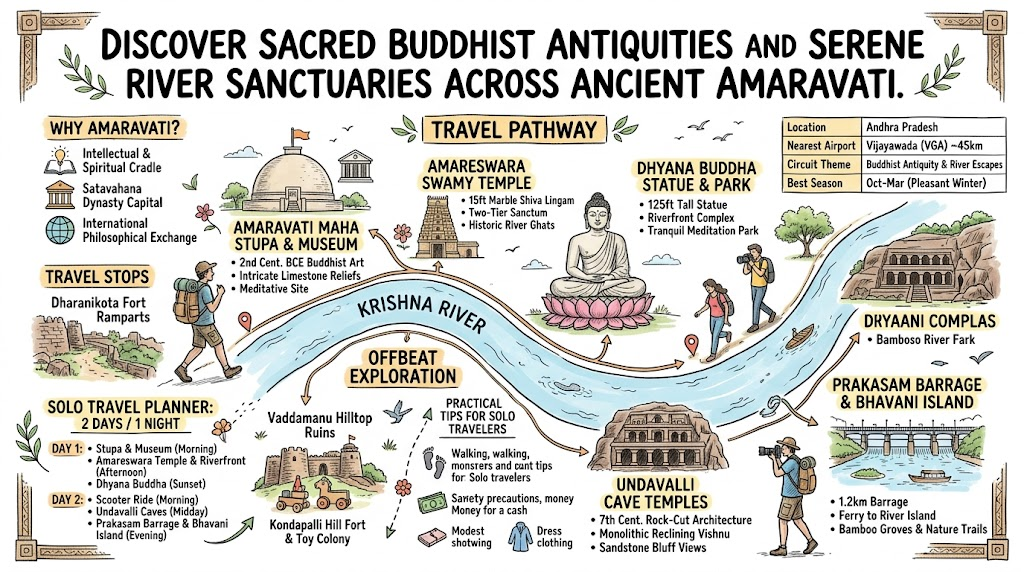
| Aspect | Details |
|---|---|
| Location | Palnadu and NTR Districts, Andhra Pradesh |
| Nearest Airport | Vijayawada International Airport (VGA) ~45 km |
| Nearest Railway Hub | Vijayawada Junction (BZA) ~32 km |
| Circuit Theme | Buddhist Antiquity, Shaivite Heritage, Rock-Cut Architecture, River Escapes |
| Best Travel Season | October to March (Pleasant, dry winter weather) |
| Recommended Solo Stay | 2 Days / 1 Night |
The serene Dhyana Buddha Statue overlooking the Krishna River.
Best Places or Experiences
Amaravati Maha Stupa & Archaeological Museum
Dating back to the 2nd century BCE, the Amaravati Maha Stupa (the Deepaladinne or Mound of Lamps) is an extraordinary monument of early Buddhist art. In antiquity, this hemispherical wonder soared over the river plains, wrapped in intricately carved limestone panels depicting the life of Gautama Buddha and Jataka fables. The adjacent Archaeological Museum preserves magnificent limestone medallions, ancient monastic seals, and inscribed railings recovered from the site.
For a solo traveler, walking around the silent brick foundations of the ancient drum offers an unmatched meditative experience. Free from tour groups, you can observe the subtle narrative artistry preserved in each surviving stone base. The morning breeze across the open lawns makes it an ideal spot for sketching, journaling, or quiet contemplation.
Exquisite limestone relief carving from the Amaravati Stupa.
- Location: Heart of Amaravati Heritage Town, 32 km west of Vijayawada city center.
- Why it is worth visiting: It is the birthplace of the distinctive Amaravati school of art, celebrated globally for its expressive sculptural style.
- Best things to do: Study the intricate limestone narrative panels in the museum, trace the circumambulatory path of the excavated stupa mound, and read the informative ASI historical markers.
- Best time to visit: 8:00 AM to 10:30 AM for gentle morning light and total silence.
- Ideal for whom: Solo backpackers, history researchers, photographers, and mindful travelers.
- Travel tip: The museum is closed on Fridays; plan your solo itinerary around this to avoid missing the best relief panels.
Amareswara Swamy Temple (Amararama)
Perched right upon the southern embankment of the Krishna River, the Amareswara Swamy Temple is one of the five revered Pancharama Kshetras dedicated to Lord Shiva. The inner sanctum houses an awe-inspiring 15-foot marble Shiva Lingam that extends across two architectural levels, requiring priests to stand on an elevated gallery to perform ritual Abhishekam. Dravidian gopurams and concentric stone courtyards envelope the complex in timeless rhythm.
Visiting alone allows you to sink into the hypnotic cadence of morning Vedic chants without external distractions. Stepping down to the ancient river ghats outside the temple walls offers a reflective view of local fishermen setting their nets at dawn.
The historic gopuram of the sacred Amareswara Swamy Temple.
- Location: Riverbank Road, Amaravati Town Center.
- Why it is worth visiting: Rare two-tier sanctum housing an exceptionally tall white-marble Lingam of deep antiquity.
- Best things to do: Observe the two-story morning milk-abhishekam ritual, sit in the quiet stone pillared halls, and stroll along the bathing ghats.
- Best time to visit: 6:00 AM to 7:30 AM during early morning rituals.
- Ideal for whom: Spiritual seekers, culture lovers, and solo travelers.
- Travel tip: Dress conservatively with legs and shoulders fully covered, and keep small change handy for temple shoe stalls.
Dhyana Buddha Statue & Meditation Park
Soaring 125 feet into the sky on an eight-petaled lotus pedestal, the colossal Dhyana Buddha Statue is a modern homage to Amaravati’s ancient spiritual status. Constructed right beside the flowing Krishna River, the mammoth hollow statue houses a three-story interpretive gallery beneath its base, adorned with carved sculptures showcasing Buddhist tenets and regional history.
The tranquil, landscaped grounds provide an open retreat for solitary walking and personal meditation. As late afternoon turns to golden hour, the vast statue casts a peaceful silhouette against the water, offering solo travelers an inspiring vantage point for reflection and panoramic photography.
- Location: Riverfront Complex, Amaravati Town, 1.5 km from the town bus depot.
- Why it is worth visiting: One of the tallest seated Buddha statues in India, featuring a meditative interior hall and lush river gardens.
- Best things to do: Meditate under the shade of riverside ficus trees, explore the subterranean museum galleries, and watch the sunset from the observation terrace.
- Best time to visit: 4:00 PM to 6:00 PM for cool river breezes and evening golden hour.
- Ideal for whom: Solo meditators, photographers, and leisure walkers.
- Travel tip: Climb to the upper terrace of the pedestal for a panoramic view of the Krishna River basin.
Undavalli Cave Temples
Carved into a massive solid sandstone bluff during the 7th century, the Undavalli Caves showcase the transitional genius of early rock-cut architecture. Rising four tiers above the ground, the cave complex features pillared monastic cells, sculpted friezes, and an enormous 5-meter-long monolith of Lord Vishnu reclining on the serpent Shesha (Anantasayana Vishnu), carved directly out of living sandstone.
The upper terrace rewards the solitary explorer with sweeping views of verdant agricultural fields, date palms, and the sparkling river in the distance. Exploring each cool, shadowed stone cell on your own feels like deciphering a private archaeological riddle.
The multi-tiered sandstone facade of Undavalli Caves.
- Location: Undavalli Village, 22 km east of Amaravati town, near Prakasam Barrage.
- Why it is worth visiting: Rare four-story rock-cut monolith with magnificent early medieval rock art and Vishnu iconography.
- Best things to do: Examine the monolithic reclining Vishnu sculpture on the third tier, find the hidden elephant and lion relief carvings along the pillars, and soak in the hilltop landscape.
- Best time to visit: 9:00 AM to 11:30 AM when direct sunlight illuminates the rock galleries.
- Ideal for whom: Solo adventurers, architecture lovers, and heritage photographers.
- Travel tip: Wear shoes with reliable grip; the centuries-old rock-cut steps are worn smooth and can be slick.
Prakasam Barrage & Bhavani Island Crossing
The historic Prakasam Barrage spans more than 1.2 kilometers across the Krishna River, creating an expansive inland freshwater reservoir. A short boat ride upstream leads to Bhavani Island, one of India’s largest riverine islands, featuring over 130 acres of bamboo groves, mangrove edges, and nature walking trails.
For solo travelers, the island is a quiet place to escape the midday heat. You can stroll through shaded canopy trails, observe native river birds, or sit quietly beside the water while sipping fresh coconut water.
- Location: Krishna River crossing, connecting Vijayawada with the Amaravati capital region.
- Why it is worth visiting: Breathtaking expansive river views paired with an accessible, green island sanctuary.
- Best things to do: Take the morning ferry ride across the reservoir, walk through bamboo groves on Bhavani Island, and photograph the barrage illuminations at dusk.
- Best time to visit: 3:30 PM to 6:30 PM for a pleasant island stroll followed by bridge lights.
- Ideal for whom: Nature lovers, solo backpackers, and casual hikers.
- Travel tip: Avoid weekend late afternoons when local family crowds can create long lines for the ferry dock.
Offbeat Exploration: Hidden Gems Tourists Miss
Dharanikota Fort Ramparts
Barely two kilometers from the Amaravati Stupa lie the unexcavated earthworks of Dharanikota, the ancient fortified capital of the Satavahanas. Wandering alone along these ancient earthen mounds reveals old brick kilns, weathered pottery shards embedded in the topsoil, and panoramic pastoral views of rural Andhra life without a single commercial vendor around.
Kondapalli Hill Fort & Toy Colony
Perched in the forested hills 25 km northwest, Kondapalli Fort features 14th-century battlements, Persian-arched durbar halls, and forgotten reservoirs. Down in the foothill village, master artisans carve colorful, lightweight wooden toys (Kondapalli Bommalu) from Tella Poniki softwood. Spending a quiet afternoon watching craftsmen paint delicate lacquer figurines offers an authentic cultural interaction.
Vaddamanu Hilltop Monastic Ruin
Located on a solitary granite outcrop southeast of Amaravati, Vaddamanu holds the ruins of an ancient Buddhist and Jaina hermitage dating back to the 3rd century BCE. The short hill climb rewards the solo trekker with total silence, rock-cut inscriptions, and an uninterrupted 360-degree panorama of emerald paddy fields stretching toward the horizon.
Detailed Practical Guidance for Travelers
| Destination | Standard Entry Fee | General Timings | Best Local Food Options Nearby | Recommended Nearby Attractions |
|---|---|---|---|---|
| Amaravati Stupa & Museum | ₹25 (Indians), ₹300 (Foreigners) | 9:00 AM – 5:00 PM (Museum closed Fridays) | Authentic Andhra vegetarian meals at local town messes | Amareswara Swamy Temple (1 km) |
| Amareswara Swamy Temple | Free (Special Darshan ₹50) | 6:00 AM – 1:00 PM, 4:00 PM – 8:00 PM | Street tiffins: Hot Dibba Rotti & spicy chutney | River Bathing Ghats (adjacent) |
| Dhyana Buddha Statue | ₹20 per person | 8:00 AM – 6:30 PM Daily | Local stalls serving tender coconut & Mirchi Bajji | Dharanikota Earthworks (2 km) |
| Undavalli Caves | ₹25 (Indians), ₹300 (Foreigners) | 9:00 AM – 5:30 PM Daily | Filter coffee & roasted maize carts at parking area | Prakasam Barrage (3 km) |
| Prakasam Barrage & Bhavani Island | ₹60 (Ferry return), Barrage free | 9:30 AM – 5:30 PM (Ferry operations) | Riverside snacks: Cut Mirchi, sweet corn, tea | Kanaka Durga Temple (2.5 km) |
Logistics & On-Ground Navigation
Local Transport Options
- Public APSRTC Buses: The most budget-friendly choice for solo travelers. Frequent non-AC and “Express” buses run from Vijayawada PNBS and Guntur to Amaravati town (Bus No. 206 series) for approximately ₹35 to ₹50 one way.
- Shared & Private Auto-Rickshaws: Excellent for short hops between the Stupa, Dhyana Buddha, and Dharanikota. Shared autos charge ₹10–₹20 per hop, while private autos cost ₹100–₹150 for point-to-point drop-offs.
- Two-Wheeler Rental: Highly recommended for solo travelers who want complete freedom. You can rent a scooter in Vijayawada for ₹400–₹600 per day to cruise along the scenic Krishna riverbank road (Karakatta Road).
- Ride-Hailing Apps (Ola/Uber): Dependable for journeys within the Vijayawada-Undavalli corridor, but often unavailable for pickups originating out of rural Amaravati town.
Budget Planning
- Backpacking / Budget Solo Tier (₹1,000 – ₹1,500 per day): Stays in comfortable pilgrim dormitories or budget lodges near the bus station (₹600–₹800), regional bus travel (₹100), hearty South Indian thali meals and street tiffins (₹300), and monument entry tickets (₹100).
- Mid-Range / Comfort Solo Tier (₹3,000 – ₹4,500 per day): Private room in a boutique riverside hotel or Vijayawada 3-star property (₹2,200–₹3,000), dedicated scooter or auto rental (₹800), sit-down dining (₹600), and guide fees (₹500).
Safety and Inclusivity Tips
- Solo Women Travelers: Amaravati is conservative, peaceful, and hospitable. Modest clothing covering shoulders and knees ensures comfortable interactions, particularly around religious shrines. Avoid walking along unlit river ghats after 8:30 PM.
- Solo Seniors & Families: While paths around the Stupa and Dhyana Buddha are flat, the Undavalli Caves require climbing stone steps without continuous handrails. Carry a lightweight trekking pole if balance is a concern.
- General Safety Precautions: The Krishna River has deceptive currents near the ghats. Never venture beyond marked steps for a swim, even if the surface appears calm.
Strategic Travel Planning Guardrails
Travel Planning Tips for Amaravati
- Carry a Compact Daypack with Water: Midday heat can be intense even in winter; keep an insulated reusable bottle with electrolyte powder.
- Cash is Essential for Rural Transit: UPI is common in shops, but rural auto-rickshaws, shoe-stand keepers, and small coconut stalls often require paper currency (keep ₹10, ₹20, and ₹50 notes).
- Align Your Schedule with Temple Darshan Hours: Most traditional temples close between 1:00 PM and 4:00 PM; use this window for museum visits or lunch breaks.
- Ride the Scenic Karakatta Embankment: When traveling from Vijayawada to Amaravati on a scooter or taxi, take the Krishna River Bund road (Karakatta) for serene river views and rural backdrops.
- Respect Photography Rules: Don’t take photos of the deity inside temple inner sanctums, and verify museum camera permissions at the ticket counter.
Common Mistakes to Avoid
- Visiting Amaravati Museum on a Friday: The Archaeological Museum is closed every Friday, which can ruin a heritage-focused solo day trip.
- Assuming Amaravati Town and Vijayawada are the Same: Amaravati is an ancient heritage village and capital region 32 km outside Vijayawada; plan transit times accordingly.
- Skipping Local Tiffin Messes: Bypassing regional breakfast joints means missing legendary culinary staples like Pesarattu Upma and crispy Punugulu.
- Attempting Midday Treks: Climbing the open rock terraces of Undavalli or Kondapalli Fort between 12:30 PM and 3:00 PM can lead to exhaustion.
- Overpacking the Itinerary: Rushing through six sites in a single day undermines the relaxed, reflective pace that makes solo travel in this region special.
Suggested Itinerary Blueprints
1. Day Quick Dash (The Express Solo Heritage Run)
Perfect for backpackers with limited time based in Vijayawada who want to experience the core highlights in a single, focused day.
- Morning (07:30 – 12:00): Board an early morning bus to Amaravati town. Explore the peaceful Amaravati Maha Stupa, browse the Archaeological Museum, and visit the nearby Amareswara Swamy Temple.
- Afternoon (12:30 – 15:30): Enjoy a traditional banana-leaf thali at a local mess. Spend an hour relaxing and meditating at the Dhyana Buddha Statue.
- Late Afternoon to Evening (16:00 – 18:30): Catch an auto back along the river corridor to Undavalli Caves to see the rock monoliths in golden hour light, wrapping up at Prakasam Barrage for sunset.
2. Day Deep-Dive (The Contemplative Soul Route)
Designed for solo travelers seeking a balanced, unhurried journey through ancient ruins, rural life, and riverfront landscapes.
- Day 1: Base yourself in Amaravati. Spend the morning exploring the Maha Stupa in depth and chatting with museum caretakers. In the afternoon, walk out to the overgrown Dharanikota Fort Ramparts. Finish with a quiet sunset meditation at Dhyana Buddha and dinner by the river.
- Day 2: Take a morning scooter ride along the Karakatta road to Undavalli Caves. Spend the midday hours exploring the four cave tiers. In the afternoon, take the boat across to Bhavani Island for a peaceful nature walk, ending the evening at the bustling Prakasam Barrage.
Complete Weekend Travel Plan (The Ultimate Heritage & Crafts Loop)
- Friday Evening: Arrive at Vijayawada Junction or airport. Check into your hotel, take an evening walk across Prakasam Barrage, and sample street snacks.
- Saturday: Take a full-day excursion to Amaravati. Visit the Maha Stupa, Museum, Amareswara Temple, and Dhyana Buddha. Spend the late afternoon hiking the quiet hill ruin of Vaddamanu before returning for dinner.
- Sunday: Visit Undavalli Caves at opening time for soft light. Head northwest to the foothills of Kondapalli Village to watch toy artisans at work, climb up to the Kondapalli Fort ramparts, and head out by late evening.
Common Tourist Mistakes to Avoid
- Geographic Blunders: Grouping Kondapalli Fort (northwest) and Amaravati Stupa (southwest) into the same morning results in hours lost in transit.
- Commercial Traps: Spending scarce travel hours in sanitized Vijayawada shopping centers instead of exploring ancient temple alleys and artisan lanes.
- Neglecting Modern Alternative Zones: Overlooking the expansive, quiet green boulevards and river parks of the emerging capital region, which highlight modern sustainable urban planning.
- Transport Overpayment: Agreeing to unmetered auto-rickshaw fares outside major stations without asking locals about the standard point-to-point rate.
- Luxury Dining Bias: Eating only at standardized chain hotels, thereby missing out on local flavors like freshly roasted Mirchi Bajji, tangy Gongura Pachadi, and rich Potharekulu sweets.
Frequently Asked Questions
1. Is Amaravati safe for a solo female traveler?
Yes, Amaravati is safe for solo female travelers due to its welcoming and respectful culture. Keep to modest attire covering shoulders and knees when visiting temples or rural villages, and avoid traveling down poorly lit riverside roads late at night.
2. What is the cheapest way to travel from Vijayawada to Amaravati?
The most economical transit is the APSRTC state bus service operating from Pandit Nehru Bus Station (PNBS) in Vijayawada directly to Amaravati bus stand. One-way tickets cost around ₹35 to ₹50, and buses depart every 20 to 30 minutes throughout the day.
3. Can I find good budget accommodation directly inside Amaravati town?
Yes, Amaravati town offers several clean pilgrim guest houses, temple choultries, and modest budget lodges priced between ₹600 and ₹1,200 per night. For modern amenities, swimming pools, and business centers, staying in Vijayawada along the MG Road corridor is preferable.
4. How many days are ideal for a solo trip to Amaravati?
A 2-day, 1-night itinerary is ideal. It allows you to explore the central Buddhist monuments and Shaivite temples at a relaxed pace on the first day, while dedicating the second day to Undavalli Caves, Bhavani Island, and rural artisan communities.
5. Are English and Hindi widely spoken across Amaravati?
Telugu is the primary local language. However, students, priests, auto drivers, and hospitality staff usually understand basic Hindi and conversational English, particularly around major archaeological landmarks and transport terminals.
6. Do I need to pre-book entrance tickets for the archaeological monuments?
While you can purchase physical tickets at on-site counters for the Archaeological Museum and Undavalli Caves, booking via the official Archaeological Survey of India (ASI) QR portal on your phone saves time and offers a small digital discount.
7. What is the best local dish a solo traveler must not miss?
Do not leave the region without trying an authentic Andhra vegetarian thali served on a banana leaf, featuring fiery Gongura chutney, warm rice, and homemade ghee. For breakfast, savor a crisp Pesarattu stuffed with savory upma.
8. Is renting a two-wheeler recommended for solo exploration?
Yes, renting a scooter in Vijayawada provides total independence. The ride along the Krishna River embankment (Karakatta) offers pleasant breezes, minimal truck traffic, and panoramic rural vistas that public buses miss.
9. Are mobile networks and internet stable throughout Amaravati?
Major telecom providers like Jio and Airtel offer reliable 4G and 5G mobile coverage across Amaravati town and the surrounding highway routes. Digital UPI payments work smoothly at most formal stores and restaurants.
10. What makes the Amaravati Stupa historically unique?
The Amaravati Maha Stupa is globally celebrated for its distinctive limestone carvings, characterized by fluid, naturalistic human forms and dynamic compositions. It played an instrumental role in shaping early Buddhist art traditions across Southeast Asia.
11. Can solo visitors meditate inside the Dhyana Buddha complex?
Yes, the landscaped lawns surrounding the 125-foot statue and the subterranean museum halls are open to peaceful, silent meditation. Visitors are requested to maintain silence and respect the serene atmosphere of the grounds.
12. What authentic regional souvenirs should I purchase?
The most authentic souvenirs are hand-carved wooden Kondapalli Bommalu (traditional lightweight toys), handloom cotton textiles from nearby Mangalagiri, and local sweet delicacies such as Pootharekulu and Bandar Laddu.
Conclusion
Solo travel to Amaravati is more than an escape from crowded tourist destinations; it is a grounding journey through centuries of artistic and spiritual expression. Standing alone amidst the weathered marble foundations of the Maha Stupa, listening to the soft rustle of river breezes, you tap into a rare sense of quiet perspective. Here, history is not preserved under velvet ropes, but lives on in active temple bells, quiet rural lanes, and timeless waters. By choosing this mindful solo path, you return with genuine stories, grounded tranquility, and an enduring connection to the cultural heart of Andhra Pradesh.
