Introduction
When the chaos of urban planning, screens, and traffic jams begins to blur your weeks, the typical modern response is to book a resort stay. But let’s be honest: overcrowding, loud poolside music, and overpriced commercial buffets rarely reset a tired mind. There is a different kind of quiet waiting for you just beyond the horizon of Andhra Pradesh’s upcoming capital.
Stepping into the sacred landscapes right outside your door offers an undeniable sense of grounded authenticity. These are not manufactured tourist traps designed for quick social media check-ins; they are living, breathing spaces of devotion where bells have echoed across rivers and hills for thousands of years. Choosing a spiritual weekend getaway lets you slow down, sync with regional rhythms, and trace footsteps that emperors and saints left behind centuries ago.
Why The Spiritual Circuits Around Amaravati Are A Must Visit
The capital region of Amaravati sits at a phenomenal geographical and historical crossroads. Flanked by the perennial Krishna River, this land has served as a sanctuary for both Vedic Hinduism and ancient Buddhism since the Satavahana dynasty. Choosing this region as your travel launchpad means you can access powerful Jyotirlingas, ancient cave temples, and hilltop shrines within a few hours of driving.
The connectivity is highly practical, featuring a network of exceptionally maintained national highways like NH16 and NH65, extensive rail links via Vijayawada Junction, and readily available local transport. Whether you are a solo backpacker looking for budget-friendly state transport buses or a family preferring a comfortable private cab ride, navigating these spiritual trails is incredibly smooth. The hospitality across these circuits ranges from humble, clean temple dharamshalas to well-appointed mid-range hotels, ensuring a seamless stay for every archetype of traveler.
| Key Travel Factor | Circuit Details & Quick Facts |
| Primary Base Hub | Amaravati / Vijayawada twin-city region |
| Major Connecting Highways | NH16 (Chennai-Kolkata corridor), NH65, and the Srisailam Ghat Road |
| Nearest Massive Railhead | Vijayawada Junction (BZA) — one of India’s busiest transit hubs |
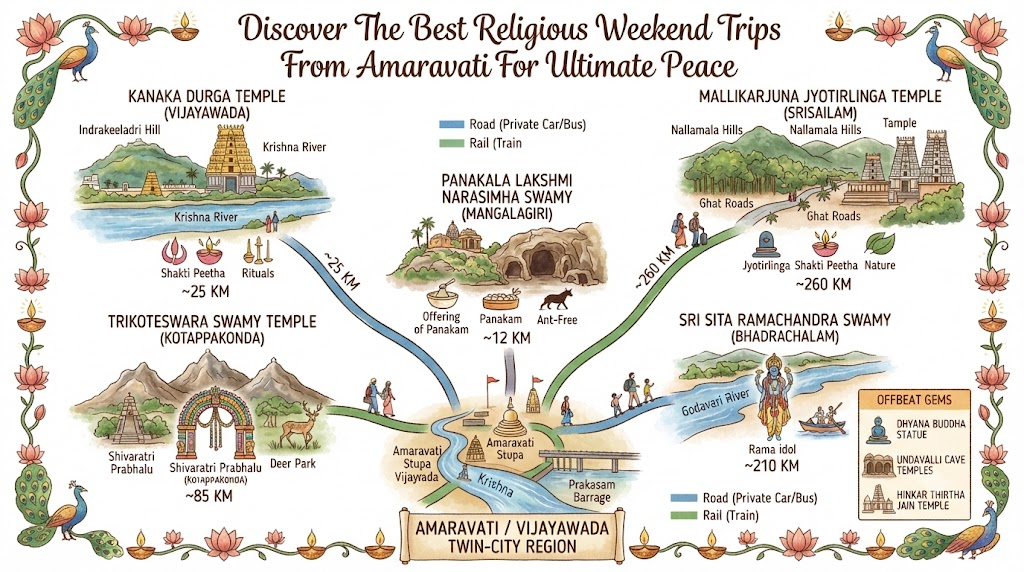
| Average Travel Radius | Ranges from 12 kilometers to 260 kilometers for weekend getaways |
| Core Spiritual Themes | Shaivism, Vaishnavism, Shaktism, and Ancient Buddhist Monasticism |
| Local Culinary Identity | Spicy Andhra meals, traditional pot-cooked sweets, and classic filter coffee |
Best Places or Experiences
Kanaka Durga Temple (Vijayawada)
Perched majestically atop the Indrakeeladri Hill, the Kanaka Durga Temple is the spiritual crown jewel of the immediate capital region. According to local scriptures, Arjuna obtained the Pasupatastra here after intense penance, and Goddess Durga self-manifested after slaying the demon Mahishasura. The shimmering golden gopuram (temple tower) overlooks the sweeping curve of the Krishna River, creating an unforgettable visual baseline for incoming pilgrims.
The architecture reflects a beautiful convergence of Dravidian styles, constantly updated through centuries of royal patronage. Walking through the stone corridors during the early hours fills your senses with the fragrance of fresh jasmine, camphor, and the rhythmic chanting of Vedic priests. It is an intensely sensory experience that immediately strips away modern mental fatigue.
- Location: NTR District, Vijayawada; approximately 25 kilometers from the core Amaravati capital site.
- Why it is worth visiting: It is one of the most powerful Shakti Peethas in India, featuring a self-manifested (Swayambhu) deity.
- Best things to do: Attend the mesmerizing Kunkuarchana ritual, witness the evening Harathi by the river banks, and admire the panoramic view of the Prakasam Barrage from the hilltop.
- Best time to visit: October to March, particularly during the vibrant Dasara festival if you want to experience incredible cultural energy.
- Ideal for whom: Multi-generational families, solo spiritual seekers, and architecture photography enthusiasts.
- Travel tip: Skip the long general queues by purchasing the Special Darshan ticket online via the official portal to save up to three hours of waiting time.
Mallikarjuna Jyotirlinga Temple (Srisailam)
Nestled deep within the dense forests of the Nallamala Hills, Srisailam is a rare spiritual sanctuary where a Jyotirlinga and a Shakti Peetha coexist on the same compound. The ancient temple complex is dedicated to Lord Mallikarjuna (Shiva) and Goddess Bhramaramba (Devi). The journey itself is an integral part of the experience, taking you through winding mountain ghat roads, misty valleys, and the protective canopy of a tiger reserve.
The temple walls are a fortress of sculpted stone, showcasing elaborate carvings of elephants, warriors, and mythological legends dating back to the Vijayanagara Empire. The air up here feels crisp, sacred, and entirely disconnected from the dusty plains below. It provides a profound sense of isolation that forces internal reflection.
- Location: Nandyal District; roughly 260 kilometers from Amaravati via a scenic 5-to-6-hour road trip.
- Why it is worth visiting: It is an incredibly holy confluence of a Jyotirlinga and an Ashta Dasa Shakti Peetha in a single location.
- Best things to do: Take a refreshing dip in the holy Patalaganga river, ride the ropeway down the cliffside, and take a peaceful boat ride to the secluded Akkamahadevi Caves.
- Best time to visit: November to February when the forest weather is cool and the ghat roads are blissfully clear of monsoon landslides.
- Ideal for whom: Adventure-loving couples, solo travelers, and dedicated history buffs.
- Travel tip: The forest check-posts close strictly from 9:00 PM to 6:00 AM, so plan your drive carefully to avoid being stranded on the highway overnight.
Panakala Lakshmi Narasimha Swamy Temple (Mangalagiri)
Mangalagiri translates directly to “The Auspicious Hill,” and this unique temple site has a history that stretches into the ancient Puranas. The temple is unique because the deity, Lord Narasimha, is housed inside a cave halfway up the hill, represented only by a wide-open mouth cast in metal. The defining ritual here involves offering jaggery water (Panakam) directly into the mouth of the deity.
Astonishingly, when the sweet water is poured, you can hear a distinct gurgling sound as if the deity is actively drinking it. Once the exact half-measure is completed, the statue naturally stops accepting more, spilling the rest back out. Despite the massive amounts of sugary water poured here daily, you will not find a single ant or fly on the temple premises.
- Location: Guntur District; a quick 12-kilometer drive from the heart of the Amaravati region.
- Why it is worth visiting: To witness the inexplicable ancient phenomenon of the panakam-drinking deity and explore a mountain steeped in Vedic history.
- Best things to do: Climb the stone steps to the hill temple to offer panakam, visit the Gandhalaya down below, and shop for authentic, GI-tagged Mangalagiri handloom sarees in the base village.
- Best time to visit: Early mornings between 7:00 AM and 10:00 AM before the afternoon sun heats the stone steps.
- Ideal for whom: Curious travelers, textile enthusiasts, and families traveling with children.
- Travel tip: Walk down to the lower temple (Diguva Alayam) to see the massive 11-story gopuram, which is one of the tallest traditional brick structures in South India.
Trikoteswara Swamy Temple (Kotappakonda)
Rising sharply above the surrounding agricultural plains of Guntur, Kotappakonda is a distinct three-peaked hill dedicated to Lord Shiva as Trikoteswara Swamy. The three hills represent the Hindu trinity of Brahma, Vishnu, and Maheswara. Climbing the hill offers spectacular views of the rural landscape, punctuated by patches of marigold fields and quiet villages.
The temple is famous for its grand celebration of Maha Shivaratri, when massive, illuminated bamboo frames called Prabhalu are carried to the hill by villages across the district. Outside of festival days, it is a beautifully serene location where wind sweeps through the open pavilions, offering a peaceful space for quiet meditation.
- Location: Palnadu District; approximately 85 kilometers southwest of Amaravati.
- Why it is worth visiting: Famous for its unique hill geometry and the incredible community-led Prabhalu festival traditions.
- Best things to do: Take the winding ghat road up the mountain, explore the hilltop deer park and medicinal gardens, and meditate in the quiet inner sanctum.
- Best time to visit: September to February, or during February/March to witness the towering Shivaratri processions.
- Ideal for whom: Nature lovers, senior citizens using the accessible road, and cultural researchers.
- Travel tip: Monkeys are highly active along the steps and terraces; keep all food items, plastic bags, and glasses securely zipped inside your backpacks.
Sri Sita Ramachandra Swamy Temple (Bhadrachalam)
Located on the banks of the sacred Godavari River, Bhadrachalam is deeply woven into the fabric of the Ramayana epic. It is said to be the spot where Rama, Sita, and Lakshmana spent their exile in the Dandakaranya forest. The main idols are highly unusual: Lord Rama is depicted in a rare four-armed posture (Chaturbhuja), holding his legendary bow along with the conch and discus of Vishnu.
The temple was beautifully constructed by Kancharla Gopanna, a local revenue official popularly known as Bhakta Ramadasu, who spent state funds to build it and was subsequently imprisoned. The entire town echoes with his soulful devotional compositions, giving the riverfront a deeply spiritual, artistic resonance.
- Location: Bhadradri Kothagudem District; roughly 210 kilometers north of Amaravati.
- Why it is worth visiting: It is considered the premier destination for Ramayana-centric devotion in Southern India, featuring unique iconographical structures.
- Best things to do: Participate in the early morning Godavari river bath, explore the historic Ramadasu Dhyana Mandiram prison cell museum, and buy sacred Gotra Gotram prasadam.
- Best time to visit: October to March, particularly during Sri Rama Navami when the celestial wedding ritual is performed.
- Ideal for whom: Classical music lovers, families, and solo spiritual travelers.
- Travel tip: Take a local motorboat ride to Parnasala, located 35 kilometers upstream, to see the exact spot where local folklore states Sita’s abduction occurred.
Offbeat Exploration: Hidden Gems Tourists Miss
The Massive Dhyana Buddha Statue (Amaravati Town)
While millions head straight to the Hindu temples, generic tourists completely miss the towering 125-foot Dhyana Buddha statue sitting on the banks of the Krishna River in ancient Amaravati town. This stunning monument sits on a massive three-tier museum structure detailed with replicas of the historic 2nd-century Amaravati Mahachaitya relief carvings. The interior of the structure contains an exceptionally quiet, air-conditioned meditation hall where you can sit in absolute silence.
Undavalli Cave Temples
Carved directly out of a solid sandstone hillside in the 4th and 5th centuries, these multi-storied rock-cut caves are a phenomenal testament to Vishnukundina architecture. The highlight is on the third floor: a colossal, monolithic stone sculpture of Lord Anantasayana Vishnu reclining on the cosmic serpent, hidden completely from the main road view. The caves look out over green rice paddies and canals, offering a peaceful, historic space that feels completely untouched by tourist crowds.
Hinkar Thirtha Jain Temple
Located on a quiet hillside near Mangalagiri, this is the largest Jain spiritual center in Andhra Pradesh. Built with pristine, intricately carved white Rajasthani marble, the structure features classic Jain temple geometry with towering columns and quiet, sunlit courtyards. It is rarely visited by mainstream weekend crowds, making it an excellent offbeat stop for travelers seeking architectural beauty and undisturbed mental clarity.
Detailed Practical Guidance for Travelers
| Destination | Standard Entry Fee | General Timings | Best Local Food Options Nearby | Recommended Nearby Attractions |
| Kanaka Durga | Free (Special Rs.100/300) | 4:00 AM – 10:00 PM | Hot Puliora, Poori, Filter Coffee | Bhavani Island, Prakasam Barrage |
| Srisailam | Free (Special Rs.200/500) | 4:30 AM – 10:00 PM | Traditional South Indian Thali | Chenchu Lakshmi Museum, Dam |
| Mangalagiri | Free | 5:00 AM – 4:00 PM | Dibba Rotti, Jaggery Panakam | Undavalli Caves, Haailand Park |
| Kotappakonda | Free (Ghat Road Fee Rs.20) | 6:00 AM – 8:00 PM | Local Village Meals, Fresh Buttermilk | Kondaveedu Fort ruins |
| Bhadrachalam | Free (Special Rs.50/100) | 4:30 AM – 9:00 PM | Idli with ginger chutney, Pot meals | Parnasala, Papikondallu Boat Tour |
Logistics & On-Ground Navigation
Local Transport Options
- State Transport (APSRTC): Highly reliable super-luxury and express buses run around the clock from Vijayawada and Guntur central stands to Srisailam, Kotappakonda, and Bhadrachalam.
- Auto-Rickshaws & E-Rickshaws: These are best used for short-distance transits within Vijayawada, Mangalagiri, and Amaravati town. Always settle on a fixed fare before stepping into the vehicle.
- Self-Driven or Private Rentals: Hiring a private cab from Vijayawada remains the most comfortable method for exploring the hills of Srisailam or handling a multi-temple circuit in a single weekend.
Budget Planning
- Backpacker / Budget Tier: Budget Rs. 1,200 to Rs. 1,800 per day. This covers state transport bus fares, basic clean accommodation at temple choultries, and eating delicious local street food or free temple annadanam lunches.
- Mid-Range / Comfort Tier: Budget Rs. 3,500 to Rs. 6,000 per day. This easily covers a private air-conditioned cab rental, comfortable 3-star hotel accommodations, special quick-access darshan tickets, and dining at clean, family-friendly restaurants.
Safety and Inclusivity Tips
- Families: Most locations have well-paved pathways, but ensure you carry essential medications and standard snacks for children, especially during the long mountain climbs to Srisailam.
- Couples: The paths around Undavalli Caves, Srisailam ropeway, and the Dhyana Buddha park are highly peaceful and safe; however, avoid exploring lonely forest paths or remote riverbanks after sunset.
- General Safety: Keep your personal items secure around monkey-populated hill temples. Always dress conservatively (men in dhotis or trousers, women in sarees or salwar suits) to respect local religious sentiments.
Strategic Travel Planning Guardrails
Travel Planning Tips for the Region
- Book your accommodation and special darshan tickets at least three weeks in advance if your trip coincides with major weekends, full moon nights, or festivals.
- Always keep a fair amount of physical cash on hand; unified payment network apps (UPI) work everywhere, but mobile network signals drop significantly in the deep Nallamala forest valleys around Srisailam.
- Wear simple, easily removable slip-on footwear or sandals since you will be taking off your shoes at every single monument and cave entry point.
- Carry a lightweight cotton scarf or umbrella to shield your skin from the intense afternoon sun on long stone temple walkways.
- Plan your meal times around the temple schedules to experience the clean, traditional free meals (Annadanam) served at most major religious centers.
Common Mistakes to Avoid
- Do not plan your drive through the Srisailam tiger reserve roads late in the afternoon, or you will hit the strict evening gate closures and face a long, uncomfortable night in your car.
- Avoid booking non-AC transport during the summer months, as temperatures across the inland plains of Palnadu and Guntur can easily breach 40 degrees Celsius.
- Do not buy religious offerings from the first vendor you see at the base of the hills; walk closer to the official temple counters to find standardized prices.
- Avoid packing a heavy, fast-paced itinerary that cames across multiple districts on a single Saturday; give yourself time to soak in the spiritual atmospheres.
- Do not stick purely to multi-cuisine hotel menus; missing out on regional delicacies like crispy Dibba Rotti or spicy Gongura Pachadi means missing the authentic culinary soul of Andhra.
Suggested Itinerary Blueprints
1. Day Quick Dash (The Capital Twin-Shrine Route)
Designed for time-pressed corporate professionals or residents needing a fast, single-day reset.
- 07:00 AM: Start from Amaravati, drive straight to the Undavalli Caves for a cool, crowd-free morning exploration.
- 09:30 AM: Head directly to Mangalagiri to watch the morning Panakam ritual and buy handlooms.
- 01:00 PM: Relish an authentic Andhra meal in downtown Vijayawada.
- 03:30 PM: Ascend Indrakeeladri Hill for an unhurried darshan at the Kanaka Durga Temple.
- 06:30 PM: Watch the sunset over the Krishna River from the Prakasam Barrage before driving home.
2. Two-Day Deep-Dive (The Palnadu & Hill Country Loop)
Perfect for families seeking a complete weekend immersion without rushed driving.
- Day 1: Leave early toward Kotappakonda Hill. Spend the morning exploring the three peaks and the hilltop deer park. After a traditional lunch, drive to the historic Kondaveedu Fort ruins to catch a magnificent sunset view over the valley. Stay overnight in Guntur.
- Day 2: Drive to ancient Amaravati town on the riverbanks. Spend the morning looking at the massive 125-foot Dhyana Buddha monument and the nearby Amareshwara Swamy temple. Enjoy an afternoon boat ride along the Krishna River before heading back.
3. Complete Weekend Travel Plan (The Nallamala Forest Sanctuary)
The definitive Friday-to-Sunday road trip escape into pristine nature and deep spirituality.
- Friday Afternoon: Leave the capital region by 2:00 PM to clear the forest check-post before sundown. Arrive in Srisailam, check into your hotel, and catch the peaceful night illuminations around the outer temple walls.
- Saturday: Attend the early morning abhishekam inside the Mallikarjuna Jyotirlinga sanctum. Take the scenic ropeway down to Patalaganga for a boat ride to Akkamahadevi Caves. Spend your evening listening to chanting at the Bhramaramba Shakti Peetha.
- Sunday Morning: Visit the Shikhareswaram viewpoint—the highest peak in the area—before starting your drive down the ghat road. Stop by the Chenchu Lakshmi Tribal Museum on your way back to Amaravati, arriving home by Sunday night.
Common Tourist Mistakes to Avoid
Geographic Blunders
A regular mistake is trying to visit Bhadrachalam and Srisailam on the exact same weekend. These destinations sit in completely opposite geographical directions from Amaravati and involve hours of driving through distinct terrain. Pick one specific river valley or mountain system per weekend to avoid spending your entire holiday looking at asphalt through a windshield.
Commercial Traps
Many travelers end up spending their precious evening hours inside the modernized shopping malls or food courts of downtown Vijayawada. While those spaces are comfortable, they strip away the unique character of your trip. Instead, spend your evenings walking through the old, atmospheric temple bazaars or sitting quietly on the steps of the river ghats.
Neglecting Modern/Alternative Zones
Do not focus your attention entirely on the main crowded altars. Take time to explore the quieter expansions, like the manicured parks surrounding the Dhyana Buddha monument or the peaceful Jain gardens at Hinkar Thirtha. These modern additions are intentionally designed with open spaces that offer a wonderful contrast to the compact, historic inner sanctums.
Transport Overpayment
Avoid hiring local auto-rickshaws directly outside the main exit gates of transit points without cross-referencing rates on ride-sharing applications first. Drivers routinely quote double the standard fare to unsuspecting weekend tourists. Walking just fifty meters away from the main gates can save you a significant amount of money.
Luxury Dining Bias
Steering clear of local, street-level eateries out of a preference for fine dining can deprive you of the regional culinary identity. The absolute best versions of local breakfast items like fluffy idlis or crispy dibba rotti are found in humble, decades-old messes and small street stalls around temple streets. Look for places with high local crowds; their high turnover guarantees completely fresh, piping hot food.
Frequently Asked Questions
1. Can we complete the Srisailam trip in a single day from Amaravati?
While it is technically possible if you drive continuously for twelve hours, it is highly discouraged. The long mountain ghat roads require full concentration, and the forest check-posts close at night. Booking a two-day trip ensures you can travel safely and attend the early morning rituals without exhaustion.
2. Is there a strict dress code enforced at the Kanaka Durga Temple?
Yes, traditional dressing is strongly expected at the hilltop shrine. Men should wear standard trousers, formal shirts, or traditional dhotis, while women should wear sarees, half-sarees, or salwar kameez with a dupatta. Western beachwear, short skirts, and distressed denim are strictly prohibited inside the main complex.
3. What is the mystery behind the Panakala Narasimha Swamy temple?
The ancient temple features a deity that accepts jaggery water offered directly into its open metal mouth. A distinct gurgling sound is heard as the fluid goes down, and the statue naturally stops accepting the drink once an exact half-measure is met. No insects or ants are found on the premises despite the sweet fluid poured daily.
4. Are online darshan tickets mandatory for these spiritual destinations?
Online tickets are not mandatory, as every site features physical ticket windows at the entrance. However, booking your special darshan tickets online via official state portals saves you hours of exhausting queue wait times, especially during weekends and public holidays.
5. Which is the best offbeat spot to include on a trip to Mangalagiri?
The Undavalli Cave Temples, located just a short drive away, are an exceptional offbeat addition. These ancient 4th-century rock-cut structures house a stunning monolithic sculpture of a reclining Lord Vishnu that generic tourists often entirely miss.
6. Are the forest roads to Srisailam safe for family cars and new drivers?
The roads are exceptionally well-tarred, but they feature numerous sharp hairpin turns and steep inclines. New drivers should exercise high caution, maintain low gears, and avoid overtaking on blind curves. Avoid driving through the forest corridors during heavy monsoon downpours.
7. What are the must-buy souvenirs from a religious weekend trip around Guntur?
You should buy authentic, GI-tagged Mangalagiri handloom sarees directly from the weavers’ cooperatives at the base of the hill. Additionally, look for traditional brass idols from local metal craft shops and regional sweets like Sunnundalu.
8. Do temple premises provide free food options for budget travelers?
Yes, almost all the major religious shrines listed in this guide run extensive daily Annadanam programs. These clean kitchens serve free, highly nutritious, and delicious traditional South Indian lunches to all visiting pilgrims in massive dining halls.
9. What is the significance of the Prabhalu festival at Kotappakonda?
The Prabhalu tradition involves nearby villages constructing towering, beautifully decorated bamboo frames wrapped in colorful cloth. These massive structures are carried on shoulders or bullock carts all the way up the hill during Maha Shivaratri as a grand community offering to Lord Shiva.
10. Is public transport readily available to reach the distant Bhadrachalam temple?
Yes, the state transport corporation operates regular deluxe, super-luxury, and night-express buses directly from the Vijayawada and Guntur central bus terminals. The road connectivity is excellent, making it highly accessible for solo budget travelers.
11. How do we access the Akkamahadevi Caves in Srisailam?
To reach the secluded caves, you need to head to the Patalaganga riverbank via the hill ropeway or steps. From there, the state tourism department runs organized motorboat tours that take you on a scenic ride across the Krishna river waters directly to the cave entrance.
12. Are there any specific seasonal closures we should know about before planning?
The temples themselves remain open throughout the year without seasonal closures. However, boat tours to the Akkamahadevi Caves or Papikondallu can be temporarily suspended by authorities during peak monsoon months due to high water levels in the rivers.
Conclusion
Choosing a spiritual weekend escape from Amaravati is far more than a simple break from your weekly routine; it is an intentional step into a deeper, quieter world. While ordinary resort vacations often leave you feeling empty after the initial distraction fades, these historic trails give something permanent back to the traveler. Standing before a golden temple tower as the sun rises over the river or sitting in absolute silence inside an ancient rock-cut cave provides a profound sense of mental clarity. You return to your modern life not just rested, but deeply grounded, carrying the ancient peace of the hills back into your everyday world.
