INTRODUCTION
The cloud-native landscape has transformed how modern organizations design, deploy, and scale software. At the center of this revolution is Kubernetes, the de facto standard for container orchestration. For engineering professionals navigating careers in DevOps, site reliability engineering, and platform engineering, practical container expertise is no longer optional. This comprehensive guide breaks down the Certified Kubernetes Application Developer (CKAD) program to help you navigate your cloud-native learning path. Whether you are building automated pipelines or managing resilient microservices, understanding how to effectively design and configure applications for Kubernetes clusters is critical for long-term career growth. By evaluating the structure, preparation strategies, and real-world applications of this credential, this guide serves as a practical roadmap for technical professionals and engineering leaders aiming to build robust containerized workflows across global enterprise environments. You can explore the official curriculum and structured training programs through the DevOpsSchool platform, or discover specialized operational frameworks tailored for autonomous, data-driven systems at aiopsschool to align your cloud infrastructure with advanced monitoring strategies.
What is the Certified Kubernetes Application Developer (CKAD)?
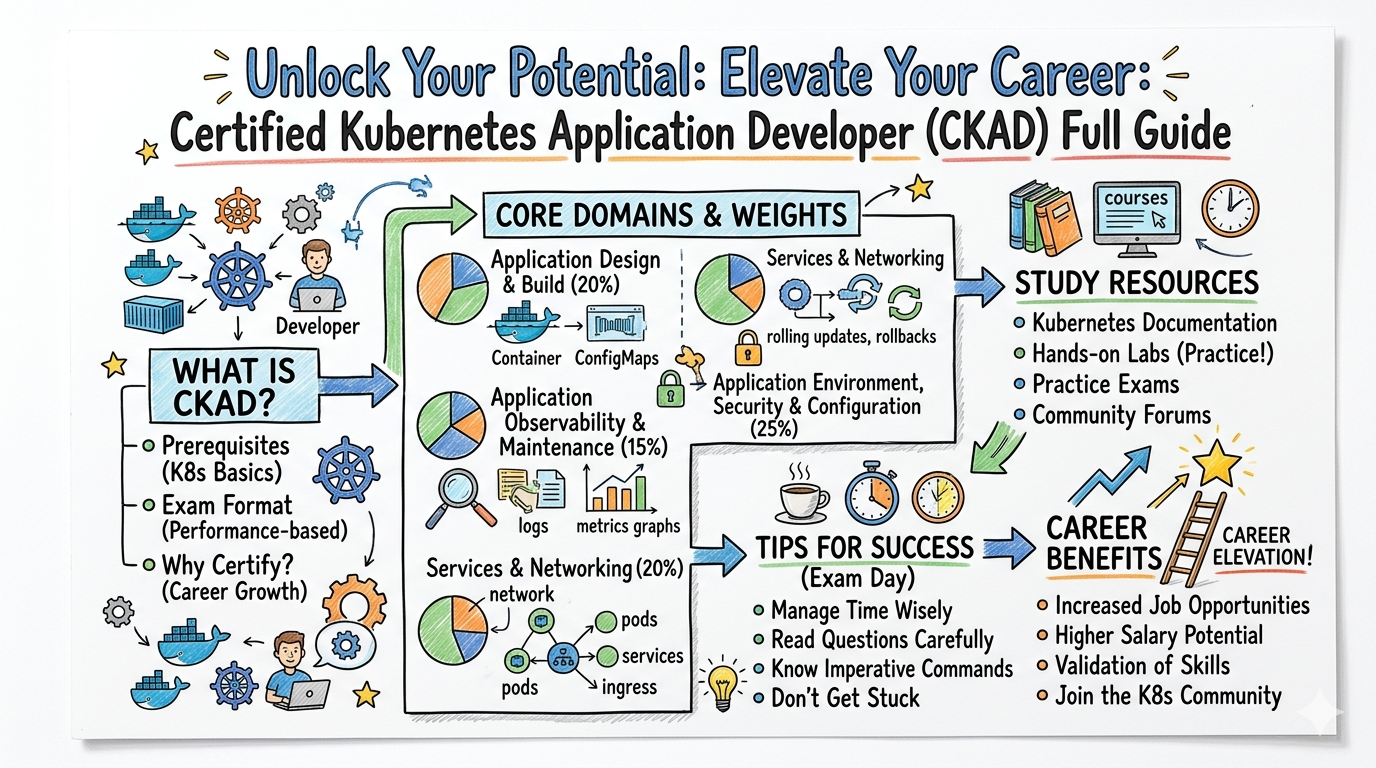
The Certified Kubernetes Application Developer (CKAD) is a performance-based certification developed by the Linux Foundation and the Cloud Native Computing Foundation. Unlike traditional multiple-choice exams that test rote memorization, this program requires candidates to solve practical, hands-on problems in a live command-line environment. It proves an engineer’s capability to design, build, configure, and expose cloud-native applications on a live Kubernetes cluster.
The certification directly addresses the industry need for engineers who understand operational realities rather than theoretical concepts. Candidates must demonstrate proficiency in managing application resources, configuring security contexts, setting up liveness and readiness probes, and troubleshooting deployment issues under tight time constraints. This rigorous assessment ensures that certified professionals possess the exact skills required to manage production-grade container environments successfully.
Who Should Pursue Certified Kubernetes Application Developer (CKAD)?
This certification is designed primarily for software engineers, application developers, and cloud professionals who write code and deploy workloads to Kubernetes environments. It is highly beneficial for DevOps engineers, platform teams, and site reliability engineers who bridge the gap between development and infrastructure management. Additionally, data engineers and cloud architects who build microservices-based architectures will find immense value in mastering these core constructs.
The program accommodates both mid-career professionals looking to formalize their container skills and senior engineers aiming to validate their cloud-native expertise. In highly competitive technology hubs across India, North America, and Europe, holding this credential provides a distinct advantage during technical interviews. It serves as tangible proof that an engineer can immediately contribute to complex, distributed software development projects without requiring baseline container training.
Why Certified Kubernetes Application Developer (CKAD)
Enterprise cloud adoption continues to accelerate, with Kubernetes serving as the operating system for modern distributed architectures. As organizations shift away from monolithic systems toward microservices, the demand for engineers who can seamlessly deploy and manage containerized code remains exceptionally high. This certification provides an enduring skill set because it focuses on core open-source Kubernetes APIs rather than vendor-specific proprietary cloud tools.
Investing time into this training yields a substantial professional return by establishing deep architectural familiarity with cloud-native design principles. As automation, artificial intelligence, and platform engineering continue to evolve, the underlying container abstraction layer remains constant. Professionals who master these deployment patterns ensure their technical relevance, remaining highly versatile assets across diverse multi-cloud and hybrid environments.
Certified Kubernetes Application Developer (CKAD) Certification Overview
The program evaluates a candidate’s hands-on proficiency through a practical online examination consisting of multiple performance-based tasks. The assessment is conducted in a secure, proctored environment where the candidate interacts directly with active Kubernetes clusters via the command-line interface. This ensures that the individual can efficiently write YAML manifests, debug failing pods, and manage container runtimes in real production scenarios.
The curriculum covers a broad range of core operational domains, including application deployment configurations, pod design strategies, networking services, and persistent storage mechanisms. Candidates are permitted to access the official online documentation during the exam, closely mimicking the real-world environment of a working engineer. This structure prioritizes problem-solving efficiency, accurate syntax configuration, and rapid troubleshooting over theoretical trivia.
Certified Kubernetes Application Developer (CKAD) Certification Tracks & Levels
The ecosystem treats this certification as a core professional benchmark focused heavily on application architecture and deployment lifecycles. It functions as an essential bridge between entry-level container familiarity and advanced cloud infrastructure management. By masterfully separating application concerns from underlying cluster administration, the track establishes a clean progression for development teams.
Engineers typically leverage this foundational competency to branch into specialized technical domains across modern infrastructure engineering. Whether progressing upward into deep cluster design or horizontally into security automation, the application development track forms the cornerstone of practical enterprise operational capability. It establishes the baseline patterns needed before scaling complex distributed systems.
Complete Certified Kubernetes Application Developer (CKAD) Certification Table
| Track | Level | Who it’s for | Prerequisites | Skills Covered | Recommended Order |
| Application Core | Professional | Software Engineers, Cloud Developers, DevOps Associates | Linux CLI basics, Container fundamentals | Pod design, Service configuration, Volume management, Observability | First |
| Multi-Container Architectures | Professional | SREs, Platform Engineers, Microservices Developers | Core Pod design, YAML syntax | Sidecar patterns, Init-containers, ConfigMaps, Secrets | Second |
| Cloud-Native Delivery | Advanced | Senior DevOps, Release Managers, GitOps Engineers | Service mesh basics, CI/CD knowledge | Ingress controllers, NetworkPolicies, Deployment strategies, Blue-Green rollouts | Third |
Detailed Guide for Each Certified Kubernetes Application Developer (CKAD) Certification
Certified Kubernetes Application Developer (CKAD) – Application Core
What it is
This certification validates an engineer’s ability to deploy, configure, and maintain functional application instances inside a Kubernetes cluster environment using the command line.
Who should take it
Software developers, cloud practitioners, and system engineers who need to deploy their applications onto managed or self-hosted Kubernetes infrastructure.
Skills you’ll gain
- Creating and managing core Pod resources using imperative commands
- Configuring persistent volumes and claims for stateful applications
- Implementing environment variables, ConfigMaps, and Secret objects safely
- Defining multi-container pods with specific sharing mechanisms
Real-world projects you should be able to do
- Migrate a legacy legacy microservice into a highly available Kubernetes Deployment
- Configure dynamic application storage backed by enterprise cloud block storage
Preparation plan
- 7–14 days: Focus entirely on mastering imperative commands using kubectl to generate manifest templates rapidly without writing manual YAML from scratch.
- 30 days: Build out sample applications locally using Minikube or Kindle, focusing heavily on configuring storage classes and debugging broken container applications.
- 60 days: Execute timed mock examinations repeatedly to build operational muscle memory, ensuring comfort with documentation searches under severe time constraints.
Common mistakes
- Spending excessive time writing complex YAML configuration files from scratch instead of leveraging built-in kubectl dry-run flags.
- Misunderstanding the distinction between absolute and relative paths when mounting volume components inside complex container paths.
Best next certification after this
- Same-track option: Multi-Container Architectures
- Cross-track option: Certified Kubernetes Administrator
- Leadership option: Certified Kubernetes Cloud Native Associate
Certified Kubernetes Application Developer (CKAD) – Multi-Container Architectures
What it is
This certification track validates advanced architectural capabilities in designing complex, co-dependent container relationships, lifecycle hooks, and system decoupling methods.
Who should take it
Mid-to-senior software engineers and site reliability specialists responsible for complex logging infrastructure, ambient monitoring, and application localization solutions.
Skills you’ll gain
- Designing and implementing efficient Init-Containers for database pre-checks
- Utilizing Sidecar patterns for decoupled application log streaming
- Setting up precise container lifecycle hooks and graceful shutdown sequences
- Managing container resource requests, limits, and quality of service classes
Real-world projects you should be able to do
- Deploy an automated log-forwarding architecture using an ambient sidecar agent configuration
- Build an enterprise web application that utilizes an initialization container to safely manage schema migrations before main launch
Preparation plan
- 7–14 days: Review official documentation examples for multi-container paradigms and understand the execution order of init-containers explicitly.
- 30 days: Configure complex multi-container pods that handle dynamic configuration reloading without disrupting active user traffic.
- 60 days: Build end-to-end multi-tier local environments, simulating container failures to observe how runtime engines handle resource over-allocation.
Common mistakes
- Failing to allocate separate resource limits for sidecar containers, leading to unpredictable primary pod eviction events.
- Forgetting that init-containers must exit successfully before standard application containers can begin initialization routines.
Best next certification after this
- Same-track option: Cloud-Native Delivery
- Cross-track option: Certified Kubernetes Security Specialist
- Leadership option: Cloud Native Sustainability Associate
Certified Kubernetes Application Developer (CKAD) – Cloud-Native Delivery
What it is
This advanced validation track targets complex cloud-native networking, ingress control systems, secure intra-cluster communications, and structured rolling update patterns.
Who should take it
Senior DevOps engineers, deployment architects, and GitOps delivery leads managing production rollouts and strict application traffic routing matrices.
Skills you’ll gain
- Implementing advanced rolling update profiles, maximum surge adjustments, and quick rollbacks
- Designing secure intra-cluster communication boundaries utilizing explicit NetworkPolicies
- Configuring complex Ingress resources for secure path-based microservice routing
- Troubleshooting DNS resolution glitches and container network interface anomalies
Real-world projects you should be able to do
- Construct a secure multi-tenant network mesh that isolates staging workloads completely from production databases
- Implement an automated zero-downtime rolling deployment pattern with specific canary routing parameters via an Ingress controller
Preparation plan
- 7–14 days: Deep dive into networking fundamentals, CIDR block allocation rules, and the mechanics of HTTP path matching algorithms.
- 30 days: Practice writing complex NetworkPolicy configurations that mix label selectors, namespace criteria, and ports accurately.
- 60 days: Simulate broken deployment scenarios, practicing rapid root-cause isolation and rollbacks using command history and active cluster event auditing.
Common mistakes
- Creating broad NetworkPolicies that accidentally isolate required cluster core DNS services, breaking all outbound application lookups.
- Applying incorrect label selectors on Ingress configurations, resulting in persistent bad gateway errors due to missing target endpoints.
Best next certification after this
- Same-track option: Advanced GitOps Automation
- Cross-track option: Promethean Certified Associate
- Leadership option: Certified Cloud Manager
Choose Your Learning Path
DevOps Path
This path focuses heavily on automation, release orchestration, and fast iteration. Engineers learn to integrate container deployment routines seamlessly into standard continuous delivery toolchains. The primary objective is minimizing time-to-production while ensuring configuration consistency across testing and staging environments. Practitioners master the use of imperative manifest generation to accelerate the deployment of reliable infrastructure components.
DevSecOps Path
Security must be injected directly into the application deployment phase rather than treated as a final afterthought. This track teaches professionals how to enforce runtime security contexts, leverage read-only root file systems, and configure secure API communication. Engineers master the deployment of secret resources and restrict container privileges to eliminate vulnerabilities within clusters. It bridges the gap between secure compliance demands and rapid software engineering workflows.
SRE Path
Reliability engineers prioritize cluster stability, effective monitoring, and structured resource management. This learning path emphasizes setting accurate CPU and memory bounds to protect node infrastructure from rogue application processes. Professionals learn to construct accurate liveness and readiness probes, ensuring self-healing clusters can automatically replace degraded containers. It centers heavily on maximizing application availability and minimizing critical incident response metrics.
AIOps Path
Modern operational workflows leverage data analytics and intelligent frameworks to predict system bottlenecks before they affect end-users. This specialization trains engineers to deploy analytical models and intelligent agents directly within container ecosystems. Professionals learn how to scale microservices based on streaming event data rather than basic memory metrics. It ensures that complex automated operations can safely run alongside standard cloud-native architectures.
MLOps Path
Deploying machine learning pipelines requires unique lifecycle orchestration, reliable data input access, and specialized processing resources. This track instructs engineers on how to deploy distributed training workloads, interface with GPU hardware layers, and manage ephemeral inference containers. Practitioners focus on stateful volume attachments and job orchestration objects. It ensures that data science architectures can scale reliably using standard container management frameworks.
DataOps Path
Data-focused pipelines require predictable storage access, highly efficient batch processing, and secure multi-tier networking infrastructure. This pathway details how to configure persistent volume abstractions, claim policies, and stateful application workloads inside clusters. Engineers learn to deploy high-throughput messaging queues and stateful databases without risking data corruption during cluster node transitions. It guarantees data integrity across highly dynamic infrastructure landscapes.
FinOps Path
Cloud cost efficiency demands absolute visibility into container resource allocations and cluster utilization patterns. This learning path teaches engineers to identify over-provisioned workloads, match actual resource usage with defined limits, and minimize waste. Professionals discover how namespace quotas and priority classifications directly impact cloud billing cycles. It empowers engineering teams to deliver high-performance applications while remaining strictly within corporate budgetary guidelines.
Role → Recommended Certified Kubernetes Application Developer (CKAD) Certifications
| Role | Recommended Certifications |
| DevOps Engineer | Application Core, Cloud-Native Delivery |
| SRE | Multi-Container Architectures, Application Core |
| Platform Engineer | Application Core, Multi-Container Architectures, Cloud-Native Delivery |
| Cloud Engineer | Application Core, Multi-Container Architectures |
| Security Engineer | DevSecOps Core Validation, Application Core |
| Data Engineer | Application Core, Stateful Resource Tracks |
| FinOps Practitioner | Application Core, Resource Optimization Tracks |
| Engineering Manager | Application Core, Cloud-Native Overview |
Next Certifications to Take After Certified Kubernetes Application Developer (CKAD)
Same Track Progression
After mastering application development patterns, engineers should move directly into deeper infrastructure administration. The logical next milestone is focusing heavily on cluster setup, control plane components, node maintenance, and underlying networking options. This expands an engineer’s capability from simply consuming cluster APIs to actively maintaining and troubleshooting the entire orchestration plane.
Cross-Track Expansion
Broadening your technical capabilities requires venturing into dedicated cloud-native security frameworks or robust observability systems. Transitioning toward specialized cloud-native security credentials helps engineers understand threat vectors, compliance controls, and cluster vulnerability scanning. Alternatively, pursuing specialized metrics tracking credentials ensures professionals can design comprehensive monitoring strategies across enterprise container distributions.
Leadership & Management Track
For senior engineers transitioning toward team leadership or architectural governance, focusing on high-level strategy is paramount. This involves pursuing broader architectural designations that focus on cloud-native sustainability, multi-cloud strategy, and financial engineering. These credentials validate an individual’s capacity to manage large engineering budgets, select appropriate technology vendor ecosystems, and guide organization-wide digital transformations.
Training & Certification Support Providers for Certified Kubernetes Application Developer (CKAD)
DevOpsSchool offers highly structured, instructor-led training programs specifically tailored for hands-on technical certifications. Their curriculum emphasizes real-world application, providing comprehensive labs that simulate live testing environments to build immediate technical competence.
Cotocus provides targeted corporate training solutions and specialized technical bootcamps designed to upskill engineering teams rapidly. Their practical approach ensures that enterprise professionals can transition smoothly from legacy deployments to modern cloud platforms.
Scmgalaxy acts as a deep technical repository and community hub for configuration management, build automation, and release engineering professionals. They provide extensive free tutorials, documentation guides, and architectural breakdowns to assist self-directed learners.
BestDevOps centers its training methodology on practical continuous delivery paradigms and advanced cloud infrastructure management practices. Their study frameworks help working engineers master complex automation workflows and advanced command-line navigation.
devsecopsschool delivers specialized curriculum focusing entirely on injecting automated security controls into every phase of the software delivery lifecycle. Their courses train professionals to build threat modeling systems directly into standard container deployments.
sreschool provides specialized operational education focused on maximizing system uptime, engineering high availability, and mastering incident response. Their programs deep dive into complex log analysis, telemetry collection, and deep infrastructure troubleshooting patterns.
aiopsschool focuses heavily on the intersection of automated cloud infrastructure and machine learning operations. Their courses prepare engineers to deploy intelligent analytical systems capable of managing complex container environments autonomously.
dataopsschool addresses the growing demand for structured data delivery pipelines, stateful application storage management, and database orchestration. Their training helps data professionals leverage container abstractions without risking data transactional safety.
finopsschool teaches engineering teams and financial professionals how to collaborate effectively on cloud cost optimization strategies. Their workshops focus on defining resource quotas, identifying infrastructure waste, and analyzing multi-tenant container bills.
Frequently Asked Questions (General)
- What makes a performance-based exam different from standard multiple-choice assessments?Performance-based exams require candidates to execute actual commands on a live server or cluster to solve practical problems. There are no theoretical questions, meaning success depends entirely on your ability to configure functional software components correctly.
- Can I use external study notes or browse arbitrary websites during the test?No, you are strictly limited to accessing the official product documentation domain during the exam session. All other external websites, search engines, personal notes, or AI assistants are blocked by the secure testing browser.
- How long does it typically take a working engineer to prepare for this type of test?An engineer with baseline container familiarity generally requires between thirty to sixty days of consistent hands-on practice. Those completely new to command-line environments may need additional foundational preparation time.
- Is it necessary to memorize every single YAML manifest syntax variation?No, memorization is not required because you can use the official documentation during the test. Instead, you should master using imperative command flags to generate clean base manifests quickly.
- What happens if my connection drops midway through the live exam session?The secure testing platform monitors active connectivity throughout the test. If a temporary network interruption occurs, your progress is typically preserved, and you can resume once stability is restored.
- Are these technical credentials recognized globally across different enterprise industries?Yes, since the curriculum is designed by major open-source steering bodies, the certification is highly respected worldwide. It serves as a standard benchmark for technical container competency across all major cloud providers.
- How long does the certification remain active before requiring renewal?The credential remains valid for a period of three years from the initial date of passing the exam. To maintain active status, professionals must pass the updated version of the exam or advance to higher tiers.
- Can I use a Windows or macOS operating system to complete the evaluation?The exam interface runs inside a standard web browser, but the target testing environment is entirely Linux-based. Candidates must be fully comfortable navigating standard Linux command shells and text editors.
- What happens if I fail the practical examination on my first attempt?Most official registration options include a free retake window within a specific timeframe. This allows candidates to review their performance feedback and attempt the practical problems a second time.
- Is an entry-level associate certification required before attempting professional tracks?No, there are no mandatory structural prerequisites required before scheduling your professional exam. Candidates can jump straight into advanced tracks if they already possess sufficient hands-on experience.
- How strictly are time management strategies enforced during the practical exam?Time management is critical, as you must resolve numerous distinct cluster challenges within a strict two-hour window. Spending too long debugging a single complex issue can prevent you from completing simpler tasks.
- Why do enterprises prefer hands-on certifications over theoretical training certificates?Hands-on credentials ensure that a candidate can perform actual deployment tasks from day one without extensive oversight. It minimizes hiring risk by confirming practical execution capability rather than passive reading habits.
FAQs on Certified Kubernetes Application Developer (CKAD)
- What specific core domains are evaluated during the practical examination process?The assessment focuses heavily on application deployment architecture, core pod configuration design, networking services, security contexts, and storage volume allocations. Candidates must also demonstrate clear proficiency in debugging broken applications and diagnosing cluster configuration mismatches under live testing conditions.
- Is deep software programming language expertise required to pass this application developer test?No, you do not need to write complex application source code in languages like Python, Java, or Go. The exam evaluates your ability to containerize, configure, deploy, and scale application binaries using Kubernetes manifests and command-line inputs.
- Which text editor options are natively available within the secure command-line testing environment?The live testing terminal includes standard Linux command-line editors such as Vi, Vim, and Nano. Candidates should become highly efficient with at least one of these text editors to modify YAML configurations rapidly during the test.
- How do I verify that my newly created resources are functioning correctly during the exam?Candidates should always use output verification commands immediately after completing a task. Checking resource statuses, reviewing container logs, and running quick curl commands against service endpoints ensures that your configurations are fully operational.
- Can I utilize standard Kubernetes aliases and autocomplete flags during the test session?Yes, candidates are highly encouraged to configure shell aliases and enable bash autocompletion at the very start of the exam session. These shortcuts save valuable minutes when typing repetitive commands across multiple clusters.
- What is the passing score threshold for this practical performance assessment?Candidates must achieve a total score of sixty-six percent or higher across all combined practical deployment challenges. Scores are calculated automatically based on the precise operational state of the cluster resources after time expires.
- How does this credential differ fundamentally from the Certified Kubernetes Administrator program?The developer track concentrates on configuring application resources, rolling updates, multi-container patterns, and network access points. The administrator track focuses on cluster installation, control plane components, node upgrades, backup strategies, and global security management.
- Are cloud-managed Kubernetes services like EKS or GKE used during the test?The exam utilizes standard, vanilla upstream Kubernetes clusters hosted on virtual Linux nodes. This ensures that your practical knowledge applies universally across all cloud providers and bare-metal environments without vendor bias.
Final Thoughts: Is Certified Kubernetes Application Developer (CKAD) Worth It?
When evaluating validation paths in modern infrastructure engineering, it is essential to separate passing marketing trends from deep architectural shifts. The container ecosystem is not a temporary phase; it has become the bedrock of modern software delivery pipelines. Pursuing a hands-on, performance-verified credential like this program is highly worthwhile for any engineer working with distributed web applications.
The true value of this learning process does not stem from the digital certificate itself, but from the rigorous preparation it demands. Forcing yourself to diagnose deployment failures, manage network security restrictions, and configure persistent volumes under pressure creates an incredibly resilient operational mindset. If you want to move past superficial tutorial knowledge and build genuine, production-grade cloud-native confidence, this structured educational path is an exceptionally strong investment for your professional career.
