Introduction
Modern family vacations have increasingly slipped into an exhausting loop of crowded amusement corridors, artificial resort complexes, and endless concrete queues. When travel feels more like an endurance test than an emotional reset, it is time to pivot toward something honest, grounded, and deeply restorative.
The rural hinterlands flanking Amaravati offer an authentic antidote to this urban fatigue. Here along the alluvial floodplains of the sacred Krishna River, family-friendly farm stays provide a rare portal into agrarian life where children wake up to dew-soaked betel vines, harvest organic vegetables with their bare hands, and watch traditional bullock carts roll across golden horizon lines.
Choosing an agrarian retreat around Amaravati is not merely about finding a place to sleep. It is an intentional immersion into age-old Andhra farming traditions, unhurried riparian rhythms, and generational culinary warmth that creates lifelong memories for both young minds and tired parents.
Why Amaravati is a must-visit city
Amaravati sits at an exceptional crossroads of antiquity and agricultural abundance. Located within the fertile river basins of Guntur and NTR districts in Andhra Pradesh, the region has nurtured civilization for over two millennia, evolving from the storied imperial capital of the Satavahana dynasty into a master-planned modern administrative capital. This unique dual identity means travelers experience world-class highway arteries alongside untouched rural hamlets, where ancient Buddhist monastic ethics of harmonious living still quietly guide daily community life.
The surrounding agricultural circuit is among the richest in Southern India, celebrated globally for GI-tagged Guntur chillies, organic turmeric terraces, dense banana groves, and sprawling mango orchards. Reaching this green belt is effortless, supported by the six-lane National Highway 16, comprehensive rail connectivity via Vijayawada Junction, and swift domestic access through Vijayawada International Airport at Gannavaram. Whether arriving with toddlers or elderly grandparents, the seamless transition from high-speed corridors to tranquil farm tracks makes this rural pocket uniquely accessible.
| Parameter | Essential Regional Fact |
| Geographic Setting | Krishna River alluvial basin, Guntur & NTR Districts |
| Nearest Airport Hub | Vijayawada International Airport (VGA), 45 to 60 km |
| Primary Rail Junction | Vijayawada Junction (BZA) & Guntur Junction (GNT) |
| Signature Agrarian Yields | Guntur Sannam chillies, Virginia tobacco, organic turmeric, mangoes |
| Top Climatic Window | October to March (crisp mornings, pleasant evenings) |
| Average Farm Stay Pace | Slow leisure, educational agro-tours, multigenerational living |
Best Places or Experiences
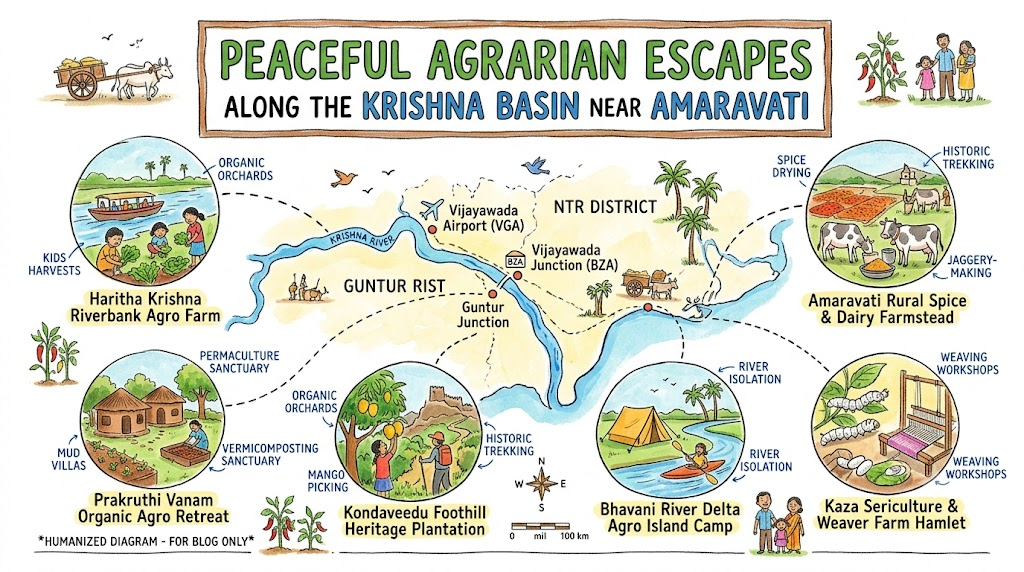
Haritha Krishna Riverbank Agro Farm
Haritha Krishna Riverbank Agro Farm sprawls across twenty-five acres of rich alluvial soil right along the gently bending waters of the Krishna River near Thullur. Designed specifically as an educational and rejuvenating sanctuary, this family retreat blends productive horticulture with comfortable eco-cottages constructed from compressed earth blocks and native thatch. The property features organized organic orchards where multi-tier farming showcases intercropped bananas, papayas, aromatic turmeric, and indigenous leafy greens.
Mornings here begin with the chorus of river terns and kingfishers nesting in the riverine bamboo clumps. Children are encouraged to participate directly in daily farm activities, from feeding native Ongole cattle at the on-site dairy shed to learning traditional drip-irrigation techniques, making it an intellectually stimulating and grounded vacation for curious young minds.
- Location: Thullur Mandal, Amaravati Capital Region, approximately 18 km west of Vijayawada.
- Why it is worth visiting: Unmatched riverfront access combined with hands-on organic farming workshops tailored for school-age children and families.
- Best things to do: Participate in morning harvest sessions for seasonal greens, take an guided sunset boat ride with local fisherfolk along the riverbank, and learn traditional seed-saving techniques.
- Best time to visit: November to February, particularly early mornings (6:30 AM to 9:30 AM) when dew coats the fields and river breezes remain cool.
- Ideal for whom: Multigenerational families, eco-conscious travelers, and parents seeking nature-immersive digital detox retreats for their children.
- Travel tip: Book riverside cottages well in advance for winter weekends, and bring slip-resistant footwear suitable for navigating muddy irrigation furrows.
Prakruthi Vanam Organic Agro Retreat
Prakruthi Vanam is an award-winning permaculture sanctuary situated in the quiet agricultural fringe of Mangalagiri. The farm champions zero-budget natural farming principles, creating a self-sustaining ecosystem populated by diverse fruit trees, medicinal plant nurseries, and flowering pollinator borders. The accommodations are designed as climate-responsive mud villas featuring wide open verandahs that naturally remain cool even under bright afternoon sunshine.
The estate offers structured experiences where visiting families can understand natural soil rejuvenation, vermicomposting, and natural pest-management methods using neem extracts. The open layout allows children to run freely across open grass pastures, interact with free-range poultry, and observe beekeeping boxes safely from guided observation decks under expert supervision.
- Location: Near Mangalagiri rural belt, roughly 22 km from the core Amaravati administrative complex.
- Why it is worth visiting: Premier living showcase of zero-chemical permaculture design with comfortable family-oriented earthen architecture.
- Best things to do: Join the resident agronomist for a soil biodiversity walk, participate in pottery-making using native clay, and hand-pick sweet guavas and pomegranates during harvest hours.
- Best time to visit: October to early March, focusing on late afternoon hours (3:30 PM to 6:00 PM) for comfortable outdoor farm walks.
- Ideal for whom: Families with young children, culinary travelers curious about chemical-free agriculture, and slow-travel enthusiasts.
- Travel tip: Request a cottage facing the inner orchards rather than the entry gates for total auditory seclusion and exceptional morning birdsong.
Kondaveedu Foothill Heritage Plantation
Nestled beneath the dramatic granite ridges of the Kondaveedu mountain range, this historic plantation estate combines agricultural stays with captivating medieval lore. The property extends across undulating terrain planted with expansive mango orchards, custard apple groves, and fragrant jasmine fields. Its stone-clad guest suites are inspired by traditional Andhra courtyard homes (Manduva Logili), offering central open-to-sky courtyards where family members can gather under starlit skies.
The geographical juxtaposition of rocky fortresses and verdant orchards gives this stay an adventurous edge. Families can spend their mornings trekking the base paths of the historic 14th-century hill fortifications, followed by relaxed afternoons under the shade of century-old mango boughs enjoying chilled buttermilk infused with fresh garden curry leaves.
- Location: Kondaveedu Valley, approximately 35 km south of the Amaravati heritage zone.
- Why it is worth visiting: Breathtaking mountain backdrop coupled with authentic regional architecture and access to historic trekking trails.
- Best things to do: Embark on an early morning nature walk along the base of Kondaveedu Fort, participate in seasonal mango picking, and enjoy evening folk storytelling sessions around courtyard braziers.
- Best time to visit: December to February for cool hiking weather, or late April to May if experiencing the vibrant mango-harvest season is your primary goal.
- Ideal for whom: Active families with teenagers, history enthusiasts, and amateur landscape photographers.
- Travel tip: Carry sturdy trail sneakers for exploring the rocky plantation perimeters, and notify the hosts in advance if you require elderly-friendly ground-floor suites.
Amaravati Rural Spice & Dairy Farmstead
Situated just past the ancient Buddhist stupa grounds, this operating dairy and spice farmstead offers families an authentic glimpse into Andhra’s world-renowned spice culture. The air here carries the warm, invigorating aroma of sundrying red chillies, coriander seeds, and boiling sugarcane syrup from adjacent artisanal jaggery units. The accommodations consist of restored brick villas overlooking grazing pastures where prized Ongole bulls and indigenous cows roam peacefully.
Children are treated to tactile rural lessons: they can watch the traditional extraction of cold-pressed sesame oil, try hand-milking gentle dairy cows under farmer guidance, and observe how natural jaggery is crystallized in massive open cast-iron pans. The farm serves unpretentious, farm-to-fork meals prepared strictly over slow wood-fired earthen hearths.
- Location: Dharanikota rural perimeter, 4 km from the ancient Amaravati Maha Stupa.
- Why it is worth visiting: Direct exposure to the cultivation of celebrated Andhra spices and humane heritage dairy preservation.
- Best things to do: Watch artisanal jaggery-making during winter harvest cycles, take an authentic wooden bullock-cart ride through village lanes, and sample freshly drawn sugarcane juice.
- Best time to visit: November through January, when open-air spice drying and jaggery processing are in peak seasonal operation.
- Ideal for whom: Food-focused families, culturally inquisitive travelers, and children raised in metropolitan environments unfamiliar with food origins.
- Travel tip: The aroma around active spice-sorting yards can be intense for young children with respiratory sensitivities; pack light cotton face scarves.
Bhavani River Delta Agro Island Camp
Resting on a secluded, silt-rich riverine silt island in the braided channels of the Krishna River, this agro camp combines farm life with tranquil water isolation. Guests arrive via a picturesque wooden motor launch, immediately leaving behind the noise of mainland highway corridors. The farm focuses on water-intensive riverine agriculture, featuring expansive sweet-corn patches, organic watermelon plots, and dense groves of swaying coconut palms.
Accommodations consist of raised safari-style canvas family tents set upon teakwood platforms, providing a thrilling glamping experience that keeps kids thoroughly excited. The island’s unique geography means the entire day is accompanied by cooling river drafts, making daytime lounging in rope hammocks an irresistible family ritual.
- Location: Mid-stream Krishna River reach near Ibrahimpatnam, accessible via private boat jetty 25 km from Amaravati.
- Why it is worth visiting: An exclusive river island farm setting offering an adventurous boat arrival, exceptional river isolation, and sustainable tented living.
- Best things to do: Harvest sweet corn ears and roast them over an evening campfire, take guided family kayak excursions through gentle river shallows, and spot migratory waterfowl from observation towers.
- Best time to visit: October to February, arriving in the afternoon around 2:30 PM to catch pleasant river crossings and evening breezes.
- Ideal for whom: Adventure-loving families, couples seeking quiet waterscapes, and birdwatching enthusiasts.
- Travel tip: Pack eco-friendly insect repellent and power banks, as power supply on isolated river island camps relies primarily on evening solar batteries.
Kaza Sericulture & Weaver Farm Hamlet
Located near the traditional textile enclaves of Guntur district, this boutique farmstead focuses on the rare intersection of sustainable mulberry agriculture, silkworm rearing, and handloom weaving. Families reside in airy, terracotta-roofed cottages bordered by lush green mulberry fields. The farm provides an educational journey through the entire lifecycle of silk production, from hand-harvesting fresh mulberry leaves to observing delicate silkworm cocoons.
Master handloom weavers maintain working wooden pit looms directly on the farm premises. Children can sit alongside local artisans, learning how natural vegetable dyes extracted from pomegranate rinds, marigold blossoms, and indigo leaves transform raw thread into vibrant heritage textiles.
- Location: Kaza rural cluster, along the old Guntur-Vijayawada highway corridor, 28 km from central Amaravati.
- Why it is worth visiting: Rare combination of organic sericulture farming and live, educational handloom weaving workshops under one roof.
- Best things to do: Participate in silkworm feeding sessions, try your hand at basic thread spinning on traditional wooden spindles, and shop for authentic handloom yardage directly from weavers.
- Best time to visit: September to February, when silkworm rearing activities are vibrant and daytime temperatures remain moderate.
- Ideal for whom: Art and craft lovers, families seeking educational craft holidays, and textile collectors.
- Travel tip: Purchase unadulterated cotton and silk fabrics directly at the farm; prices are significantly lower than urban retail showrooms and support the artisan collective directly.
Offbeat Exploration: Hidden Gems Tourists Miss
The Sunken Brick Ghats of Didugu
Tucked away along a quiet river curve upstream from Amaravati lies the forgotten village of Didugu. Here, ancient Satavahana-era brick structures and eroded mooring stones remain partially submerged in the riverbed. During low winter water levels, families can walk along these quiet sandy shoals with local guides, unearthing ancient ceramic sherds while watching river otters hunt in the shallows far away from commercial tourist eyes.
Chebrolu Terracotta & Stone Temple Enclave
While mainstream travelers rush to crowded city temples, the quiet village of Chebrolu—located a short country drive south—hides an astonishing architectural cluster. The village features an ancient temple mound surrounded by rare four-faced Brahma sculptures and intricate terracotta friezes dating from the Eastern Chalukya and Kakatiya reigns. The village roads run through betel-leaf plantations where families can witness the labor-intensive cultivation of fresh chewing leaves climbing slender timber poles.
Kondaveedu Forest Herbal Foraging Trails
Few visitors venture into the dry deciduous scrub forests flanking the rear approaches to Kondaveedu ridge. Local Yanadi tribal guides lead small, private foraging walks where families can identify native medicinal roots, wild asparagus (Shatavari), and indigenous gums used in classical Ayurvedic remedies. It offers an incredible masterclass in native ethnobotany that transforms a regular morning walk into a thrilling treasure hunt for children.
Detailed Practical Guidance for Travelers
| Destination | Standard Entry Fee | General Timings | Best Local Food Options Nearby | Recommended Nearby Attractions |
| Haritha Riverbank Farm | ₹500 (Day Visitors); Overnight packages vary | 07:00 AM – 06:30 PM Daily | Farm kitchen wood-fired Andhra lunch thali on-site | Dhyana Buddha Statue (8 km) |
| Prakruthi Vanam Retreat | ₹350 (Educational tour); Lodging extra | 08:30 AM – 05:30 PM Daily | Steamed Dibba Rotti with ginger pachadi at the farm mess | Mangalagiri Panakala Swamy Temple (6 km) |
| Kondaveedu Foothill Stay | Free access to public trails; Stays ticketed | 06:00 AM – 06:00 PM Daily | Country chicken curry and ragi sankati at foothill dhabas | Historic Kondaveedu Fort ruins (3 km) |
| Amaravati Spice Farmstead | ₹200 (Guided farm tour); Free for guests | 08:00 AM – 06:00 PM Daily | Traditional Pesarattu with fresh farm-ground podi | Amaravati Maha Stupa & Museum (4 km) |
| Bhavani Delta Agro Camp | ₹650 (Includes roundtrip river boat ferry) | 09:00 AM – 05:30 PM Daily | Fresh roasted sweet corn & island fish curry lunch | Undavalli Rock-Cut Caves (12 km) |
| Kaza Sericulture Farm | ₹150 (Weaving workshop fee); Free for guests | 09:30 AM – 05:00 PM Daily | Vegetarian Gongura rice and curd at village mess | Mangalagiri Handloom Cooperative Stores (5 km) |
Logistics & On-Ground Navigation
Local Transport Options
- Self-Drive Cars or Hired Taxis: The most flexible and convenient way to navigate dispersed rural farm stays. Roads connecting the core Amaravati capital grid to surrounding villages are broad, well-paved, and largely uncrowded.
- Pre-Booked Rural Auto-Rickshaws: Excellent for short village-to-village hops, such as moving between your farm stay and local river ghats. Always negotiate a return-trip wait fee, as hailing an empty auto in rural hamlets is difficult.
- APSRTC Rural Palle Velugu Buses: Incredibly budget-friendly state buses linking Vijayawada and Guntur central bus terminals to interior villages like Thullur, Amaravati, and Kaza. However, frequencies can be spaced 60 to 90 minutes apart.
Budget Planning
- Budget / Rural Homestay Tier: ₹1,800 to ₹2,800 per family per day. Covers straightforward village homestays or basic farm cottages, authentic public transport or shared autos, and wholesome rustic meals cooked by host families.
- Mid-Range / Comfort Agro-Resort Tier: ₹5,500 to ₹9,500 per family per day. Covers private eco-villas or safari tents with attached modern baths, full three-meal farm-to-table dining, dedicated experiential tours (pottery, tractor rides, boat trips), and a dedicated hired air-conditioned cab.
Safety and Inclusivity Tips
- For Families with Young Children: Ensure children wear closed footwear inside farms to protect against thorny acacia twigs and uneven soil furrows. Always supervise kids near open irrigation canals, farm wells, and river ghats.
- For Couples: Farm stays offer remarkable, tranquil isolation. Respect local village social sensibilities by dressing conservatively when stepping outside farm perimeters into rural communities.
- General Health & Farm Safety: Carry standard insect repellent, oral rehydration salts, and broad-spectrum sunscreens. Farm stays operate in genuine rural settings where hospitals are situated 15 to 25 kilometers away in satellite towns.
Keep in mind that farm stays are active agricultural environments, not sanitized urban resorts. Remind children to approach farm animals calmly from the front and never touch beehives or electrical irrigation panels without the farm supervisor present.
Strategic Travel Planning Guardrails
Travel Planning Tips for Amaravati Farm Stays
- Time Your Stays for Winter: The coastal Andhra plains experience intense summer heat. Schedule your family agro-vacation between late October and February for pleasant, sunny days and cool, breezy nights.
- Prioritize Advance Direct Bookings: Most authentic farm stays maintain only 4 to 8 family cottages to prevent overcrowding. Book weekend dates at least four weeks in advance.
- Carry Adequate Physical Cash: Digital UPI payments work in larger village shops, but network connectivity can occasionally drop in riverside hollows. Carry sufficient cash for farm-stand produce, artisan tips, and auto fares.
- Embrace the 6:00 AM Farm Clock: Agricultural life wakes up at dawn. Set your family alarms early to catch gentle morning light, active birds, and fresh milking demonstrations before the sun peaks.
- Pack Dedicated Farm Clothes: Pack earth-toned, washable cotton clothes and sturdy canvas sneakers that you do not mind getting stained with red soil or river clay.
Common Mistakes to Avoid
- Expecting 24/7 Room Service: Farm stays pride themselves on fixed family-style meal times using fresh ingredients; do not expect midnight room service or extensive multi-cuisine menus.
- Assuming Public Cabs Will Pick You Up: Ride-hailing aggregators will readily drop you off at rural farmsteads from Vijayawada, but they will rarely accept pick-up requests from deep rural hamlets for your return trip.
- Skipping On-Site Dining: Avoid venturing out to modern roadside restaurants; the food prepared inside farm stay kitchens using home-grown lentils, unpolished rice, and cold-pressed oils is healthier and far more delicious.
- Over-Scheduling Sightseeing: Packing five monuments into your day defeats the very purpose of an agro-stay. Limit yourself to one cultural excursion a day and spend the rest resting on the farm.
- Neglecting Sun Protection: Even in winter, the midday Andhra sun can be strong. Ensure children wear broad-brimmed hats and drink plenty of fresh coconut water throughout the afternoon.
Suggested Itinerary Blueprints
1-Day Quick Dash (The Rural Reconnect Loop)
Designed for families staying in Vijayawada or Guntur who want a rapid, meaningful daylight immersion into rural farm life without staying overnight.
- Morning (07:30 AM – 11:30 AM): Drive out to Haritha Riverbank Agro Farm near Thullur. Enjoy a traditional breakfast of steaming hot idlis and farm-fresh ginger pachadi, followed by an educational vegetable-harvesting tour.
- Afternoon (12:00 PM – 03:30 PM): Savor an authentic wood-fired Andhra thali lunch on the farm. Relax in rope hammocks under mango trees while the kids try hands-on clay pottery.
- Evening (04:00 PM – 06:30 PM): Head down to the riverbank for a private country-boat ride along the Krishna River during golden hour before driving back to the city.
2-Day Deep-Dive (The Green Earth & Heritage Trail)
The quintessential family weekend itinerary balancing active farm engagement with gentle regional heritage exploration.
- Day 1 (Agrarian Immersion): Check into Prakruthi Vanam Retreat by 10:00 AM. Spend the morning learning natural farming techniques and feeding calves. After a farm-to-table lunch, spend your late afternoon picking seasonal fruit and watching honeybee foraging. Close the day with an open-air starlit dinner in the central courtyard.
- Day 2 (History Meets Handlooms): Wake up early for an unhurried birdwatching trail along field perimeters. Check out by 10:30 AM and drive to the ancient Amaravati Maha Stupa and its air-conditioned museum. Enjoy lunch in town, then spend your afternoon at the Kaza sericulture enclave watching handloom weavers before starting your journey home.
Complete Weekend Travel Plan (The Grand Krishna Basin Farm Circuit)
- Friday Evening: Arrive at Bhavani River Delta Agro Island Camp via boat. Check into your safari tent, unwind to the sound of flowing water, and enjoy a slow campfire dinner featuring sweet-corn specialties.
- Saturday: Spend the morning kayaking along river sandbars and harvesting watermelons. After lunch, take the ferry back and drive to Kondaveedu Foothill Heritage Plantation. Check in, relax during the warm hours, and take a 4:30 PM guided walk to the base ramparts of Kondaveedu Fort. Enjoy an evening of folk stories in the courtyard.
- Sunday: Wake up to crisp mountain breezes, participate in a bullock-cart ride through surrounding orchards, and enjoy a lavish traditional breakfast. Visit the nearby Undavalli Rock-Cut Caves on your relaxed afternoon drive back to the airport or rail terminal.
Common Tourist Mistakes to Avoid
- Geographic Blunders: Grouping Kondaveedu Fort (situated south in Guntur district) and the river island camps (situated upstream on the Krishna) into the same half-day block. The rural connections take longer than highway driving; tackle one distinct geographic zone per day.
- Commercial Traps: Spending your precious weekend shopping at overpriced highway souvenir plazas. Instead, purchase authentic Kondapalli toys, Mangalagiri cottons, and stone crafts directly from artisan hamlets where money directly supports creator families.
- Neglecting Modern Alternative Expansions: Focusing solely on ancient temples while completely overlooking the stunning modern capital public plazas, green riverfront promenades, and scenic agricultural bypasses of new Amaravati.
- Transport Overpayment: Agreeing to arbitrary round-trip auto-rickshaw fares without consulting your farm stay hosts. Farm managers almost always have trusted local village drivers who charge fair, standardized daily rates.
- Luxury Dining Bias: Passing up small, pristine village messes serving piping-hot Dibba Rotti or Pesarattu Upma in favor of standardized hotel multi-cuisine dining. Local street and village gastronomy is clean, extraordinarily fresh, and full of unmatched regional character.
Frequently Asked Questions
1. Are farm stays near Amaravati safe and hygienic for toddlers and infants?
Yes, established farm stays around Amaravati maintain clean, well-screened private cottages with modern attached bathrooms. Hosts routinely prepare customized, mild baby food like boiled lentils, soft mashed rice with home-churned ghee, and fresh organic milk upon prior request.
2. What should families pack for a weekend farm stay in this region?
Pack comfortable, breathable cotton clothing, sturdy walking sneakers, sun hats, organic mosquito repellent, basic first-aid supplies, and reusable water bottles. A light shawl or jacket is helpful for crisp winter mornings and open riverboat crossings.
3. Do local farm stays accommodate strict dietary preferences like pure vegetarian or Jain food?
Virtually all authentic agro-retreats in the Amaravati belt specialize in pure vegetarian, farm-fresh traditional Andhra cuisine. Jain food without root vegetables can easily be arranged if communicated to the host at least twenty-four hours before your arrival.
4. Can children participate in animal feeding and agricultural harvesting directly?
Yes, interactive participation is the cornerstone of these farm stays. Children can safely feed indigenous cows, collect fallen fruit, plant vegetable saplings, and learn composting under the gentle supervision of resident farm staff and naturalists.
5. How far are these rural farm stays from Vijayawada Railway Station and Airport?
Most farm retreats in the Amaravati-Thullur-Mangalagiri triangle are situated between 20 to 45 kilometers from Vijayawada Railway Station (BZA) and roughly 40 to 65 kilometers from Vijayawada International Airport (VGA), requiring a 45 to 80-minute cab ride.
6. Are these rural properties equipped with dependable Wi-Fi for remote working parents?
Most farm retreats offer decent Wi-Fi in common dining areas, though speeds may not match fiber-optic city lines. Cellular 4G and 5G mobile networks from major Indian telecom providers work reliably across the open agricultural plains.
7. Are pets allowed at family farm stays around Amaravati?
Many open-air agro properties welcome family pets provided they are vaccinated and kept on leashes near farm poultry and livestock. Always check the specific property’s pet policy prior to confirming your reservation.
8. Is it possible to visit local historical sites while based at a farm stay?
Absolutely. Staying at a farm puts you within an easy 20 to 40-minute country drive of iconic landmarks like the Amaravati Buddhist Stupa, Dhyana Buddha, Undavalli Caves, and the historic hillfort of Kondaveedu.
9. What medical facilities are available in case of an emergency at the farm?
Basic primary health centers operate within five to ten kilometers across all mandal headquarters such as Thullur and Mangalagiri. Multi-specialty tertiary hospitals like AIIMS Mangalagiri are conveniently situated within a 20 to 30-minute drive.
10. What is the cancellation policy typically observed by boutique farm stays?
Because these eco-stays operate a limited number of guest rooms, they usually require a 50% advance deposit. Full refunds are generally provided for cancellations made at least seven to ten days prior to your scheduled check-in.
11. Can elderly grandparents comfortably navigate the terrain of these farm properties?
Most farmsteads feature single-story ground-floor cottages with flat, paved garden paths connecting living quarters to dining pavilions. However, unpaved farm interior trails require steady footing, so walking sticks are highly recommended for seniors.
12. Are day visits permitted without booking an overnight cottage stay?
Several agro farms welcome day-tripping families for guided morning tours, traditional lunches, and evening tractor rides. Pre-booking your day-pass at least a day in advance is mandatory to ensure fresh meal preparation.
Conclusion
Stepping away from the predictable rhythms of commercial holiday resorts to spend unhurried days on a Krishna basin farm stay is a gift that honors your family’s well-being. Watching your children plunge their fingers into clean, fragrant soil, taste vegetables plucked straight from living vines, and listen to the whisper of river reeds under star-dusted skies restores something vital that modern city life quietly erodes. In the fertile embrace of Amaravati’s agricultural heartland, you will discover that the simplest experiences—warm food, honest earth, and shared quiet hours—leave the most enduring, luminous imprint on your family’s travel memories.
