Introduction
Modern enterprise engineering environments operate at unprecedented velocity, forcing organizations to move beyond isolated automation patterns toward comprehensive cross-functional execution across distributed architectures. Distributed microservices, high-throughput streaming pipelines, autonomous artificial intelligence workloads, and dynamic multi-cloud environments demand deep operational synchronization between previously detached technical disciplines. Traditional team boundaries generate significant context switching, fractured telemetry, integration latency, and recurrent production failures, all of which erode operational stability. To solve these fragmented delivery cycles, progressive technology teams actively turn to XOps as a unified operational methodology that binds delivery, platforms, data pipelines, intelligence loops, and security automation into a resilient continuum. Platforms like XOpsSchool document this convergence, guiding teams through shared telemetry, infrastructure-as-code foundations, and cross-discipline collaboration standards to eliminate architectural silos and sustain predictable software delivery.
What Is XOps?
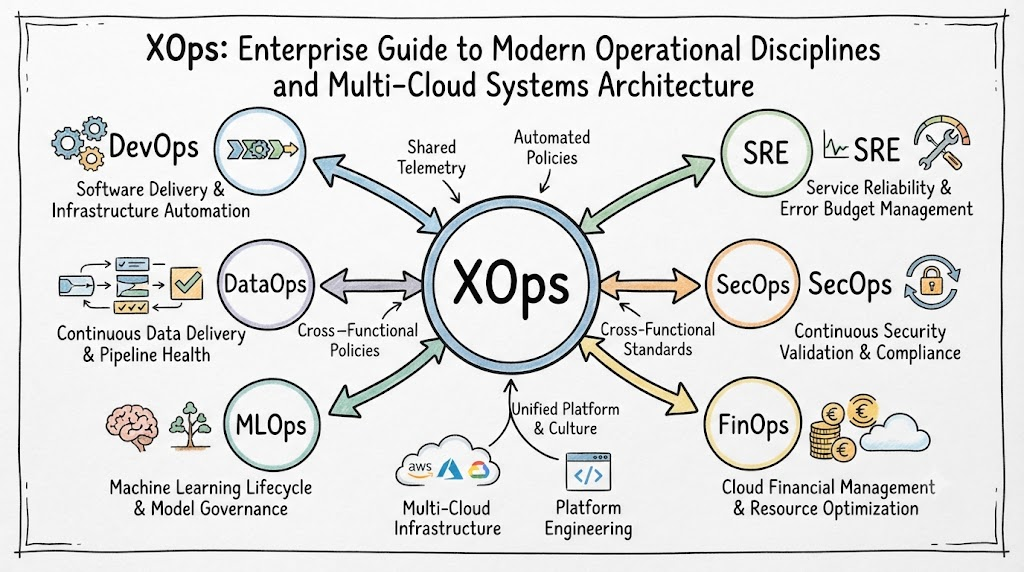
XOps represents an overarching operational framework where the variable “X” acts as a universal placeholder encompassing diverse functional operations disciplines across modern technology organizations. Rather than treating delivery, data lifecycles, platform resilience, and intelligent automation as independent operational silos, XOps establishes shared systemic governance, unified telemetry fabrics, automated testing protocols, and integrated deployment architectures across all domains. For instance, consider a modern fraud detection platform: developers deploy application microservices through standard continuous integration flows, data engineers orchestrate continuous ingest pipelines, machine learning practitioners manage model inferencing layers, and automated intelligence engines continuously evaluate operational telemetry to predict outages. Concurrently, security engineers automate identity verification and vulnerability scanning, financial managers monitor cloud infrastructure costs, and reliability engineers establish automated error budget policies. When these disciplines operate through unified XOps integration patterns, every single layer functions collaboratively, eliminating operational friction, reducing mean time to recovery, and guaranteeing resilient end-to-end service delivery across production environments.
What Does XOps Include?
The modern operational ecosystem unites distinct engineering methodologies under a shared delivery framework, establishing end-to-end visibility and continuous operational alignment across distributed architectures.
| XOps Discipline | Primary Focus | Typical Responsibilities |
| DevOps | Continuous Delivery & Infrastructure | Orchestrating CI/CD pipelines, containerizing applications, automating release cycles, and managing infrastructure as code. |
| DataOps | Pipeline Integrity & Data Flow | Automating extract-transform-load workflows, validating schema changes, monitoring data drift, and ensuring pipeline quality. |
| MLOps | Model Lifecycle & Serving | Versioning model artifacts, managing feature stores, automating model deployment, and monitoring production inferencing drift. |
| AIOps | Algorithmic Operations & Telemetry | Correlating cross-system event streams, filtering operational noise, detecting anomalies, and triggering automated remediation. |
| SecOps | Continuous Security & Compliance | Automating static and dynamic vulnerability scans, managing secrets, auditing policy compliance, and enforcing zero trust. |
| FinOps | Cloud Cost Governance | Tracking cloud resource expenditure, optimizing cloud compute commitments, right-sizing workloads, and budgeting across teams. |
| SRE | Production Reliability & Scalability | Defining service level indicators and objectives, managing system error budgets, running incident responses, and building fault-tolerant systems. |
| InfraOps | Base Systems & Hardware Layers | Provisioning core computing virtualization, maintaining physical and cloud networks, and establishing base operating system baselines. |
| Platform Engineering | Internal Developer Platforms | Building self-service deployment portals, standardizing deployment golden paths, and streamlining developer workflow tooling. |
Each specialized discipline contributes directly to operational durability: while platform engineers construct self-service golden paths and site reliability specialists define strict availability budgets, data and security practitioners continuously protect data flows and runtime integrity.
What Is XOpsSchool?
XOpsSchool functions as a dedicated technical learning and knowledge platform designed to help software professionals understand the interdependencies within modern enterprise computing ecosystems. The educational resource deconstructs complex topics—ranging from cloud-native architecture, Kubernetes management, GitOps patterns, and automated infrastructure provisioning to specialized domains including data engineering pipelines, machine learning lifecycle deployment, and algorithmic incident remediation. By grounding concepts in vendor-neutral implementation patterns and practical architectural blueprints, the platform helps engineers transition from narrow operational boundaries into cohesive cross-disciplinary thinkers capable of designing resilient, scalable production environments.
Why Is XOps Important?
The dramatic evolution of cloud-native infrastructure, coupled with decoupled microservice topologies, has radically escalated operational interdependencies across contemporary technology platforms. When teams run machine-learning inference engines feeding real-time streaming data into distributed Kubernetes clusters across hybrid clouds, isolated team practices fail to guarantee uptime. Outages frequently emerge at the boundaries between specialized teams—such as silent schema mutations breaking downstream machine learning inference or unoptimized infrastructure scaling out of financial control. Adopting cross-discipline operational practices eliminates these organizational and technological chasms by standardizing infrastructure templates, centralizing observability streams, enforcing automated governance, and establishing collective operational ownership across every digital layer.
Why Choose XOps Training?
Pursuing comprehensive cross-domain operational training provides technical professionals with the architectural insight required to navigate modern enterprise infrastructure safely. When engineers understand how container runtimes impact data pipeline latency, how security scanning affects continuous integration throughput, or how machine learning model drift triggers operational alerts, they can proactively design more reliable architectures. This balanced educational scope builds versatile technical specialists who can effectively communicate across software engineering, platform operations, data engineering, and operational management roles, thereby eliminating technical debt, streamlining operational incident responses, and building highly maintainable systems.
How Does XOps Training Work in Practice?
Effective technical education relies on structured, hands-on architectural progression that moves from fundamental systems concepts to advanced automated cross-domain engineering workflows.
- Mastering enterprise Linux internals, network socket communication, process isolation, and shell scripting basics.
- Implementing strict distributed version control workflows, automated branch testing, and continuous integration pipeline automation.
- Packaging application workloads into optimized OCI container images while enforcing minimal layer sizing and vulnerability scanning.
- Deploying, securing, and orchestrating distributed container workloads using multi-node Kubernetes clusters.
- Provisioning repeatable multi-cloud cloud infrastructure declaratively through Infrastructure as Code and GitOps patterns.
- Instrumenting microservices with continuous distributed tracing, high-cardinality metric collection, and structured log aggregation fabrics.
- Integrating dynamic vulnerability management, secret rotation, and automated policy-as-code guardrails across build pipelines.
- Configuring robust data pipelines, schema migration verifications, model serving registries, and automated telemetry correlation loops.
Prioritizing hands-on laboratory setups ensures engineers cultivate the actual troubleshooting intuition necessary to resolve complex production incidents when real-world services degrade.
XOps Certification: What Should You Look For?
When evaluating technical certification programs, practitioners must prioritize rigorous hands-on assessments over superficial, multiple-choice theoretical tests that fail to mirror production reality. A meaningful credential must thoroughly validate a candidate’s practical ability to write clean declarative infrastructure configurations, remediate broken deployments, resolve high-cardinality monitoring anomalies, and secure cross-platform network communication. While passing an industry-recognized assessment confirms that an engineer understands standard operating procedures and core platform capabilities, certifications must always serve as a complement to, rather than a replacement for, direct real-world engineering troubleshooting experience.
XOps Tools: Understanding the Technology Stack
Modern enterprise operations utilize specialized tools across diverse technical disciplines, avoiding single-vendor lock-in to establish resilient operational pipelines.
| Operational Area | Example Tools | Practical Purpose |
| Version Control & CI/CD | Git, GitHub Actions, GitLab CI, Jenkins | Managing declarative source repositories and executing automated build, test, and release validation workflows. |
| Containers & Orchestration | Docker, Podman, Kubernetes, containerd | Packaging software dependencies into immutable images and orchestrating resilient, scalable container runtimes. |
| Infrastructure as Code | Terraform, OpenTofu, Pulumi, Ansible | Automating cloud platform resource provisioning, state management, and declarative operating system configurations. |
| GitOps & Delivery | Argo CD, Flux CD, Spinnaker | Synchronizing Kubernetes cluster states automatically with declarative Git repositories through pull-based models. |
| Observability & Metrics | Prometheus, Grafana, OpenTelemetry | Capturing runtime operational metrics, tracking distributed traces, and visualizing system health indicators. |
| Log Management | Elasticsearch, Fluentd, Kibana, Splunk | Ingesting, parsing, indexing, and searching structured operational log streams across multi-cloud environments. |
| AIOps & Remediation | Dynatrace, Datadog, BigPanda, Moogsoft | Correlating disparate system events, filtering alert noise through machine learning, and accelerating root-cause analysis. |
| Secrets & Policy Control | HashiCorp Vault, Open Policy Agent, Kyverno | Managing dynamic encryption keys, rotating infrastructure credentials, and enforcing declarative runtime security policies. |
Selecting the ideal operational stack depends entirely on specific organizational requirements, compliance frameworks, performance metrics, and existing technical platform investments.
DevOps Training as the Foundation of XOps
Establishing reliable DevOps automation patterns remains the mandatory starting point for any successful journey into broader cross-functional engineering disciplines. Mastery over core concepts such as Git branching strategies, infrastructure automation frameworks, containerization best practices, zero-downtime deployment patterns, and continuous integration pipelines provides the baseline knowledge needed to manage advanced operations. Without a secure, predictable foundation of automated software delivery and immutable infrastructure practices, engineering organizations cannot hope to maintain more complex downstream systems like real-time streaming pipelines, automated model retraining frameworks, or self-healing platform topologies.
AIOps Training: Adding Intelligence to Operations
Algorithmic operations leverage advanced machine learning models, statistical pattern evaluation, and automated data processing to digest millions of real-time telemetry signals generated by distributed enterprise platforms. By continuously aggregating metrics, log entries, and distributed tracing spans, intelligent operational systems automatically isolate actionable anomalies, correlate disparate events across interdependent microservices, suppress redundant alerts, and accelerate root-cause diagnosis. However, engineers must recognize that algorithmic operations engines depend entirely on high-quality telemetry data; feeding fragmented, noisy, or unstandardized logs into automated analysis models produces unreliable predictions, false-positive alerts, and untrustworthy operational remediations.
MLOps Training: Taking Machine Learning Into Production
Machine learning operations bridges the gap between academic mathematical modeling and reliable, enterprise-grade software engineering in live production environments. While traditional software development focuses primarily on code versioning and runtime binaries, artificial intelligence deployments require the continuous orchestration of code, shifting data distributions, and evolving model parameters. Robust operational pipelines must automate feature storage, manage model artifact registries, support canary inferencing deployments, and actively monitor production predictions for real-time model accuracy degradation, allowing engineers to trigger continuous, automated retraining pipelines whenever underlying operational data profiles shift.
DataOps Training: Making Data Operations Reliable
Data operations adapts agile development methodologies, continuous integration automation, and statistical quality control to the end-to-end lifecycle of enterprise data workflows. In modern distributed architectures, a minor, unannounced schema modification executed by an upstream transactional database can silently corrupt analytics warehouses and disrupt production machine learning pipelines downstream. By embedding automated schema validation, pipeline performance tests, data lineage tracking, and continuous data observability into orchestration tools like Apache Airflow or dbt, teams ensure data processing runs as reliably, predictably, and securely as enterprise software services.
Real-Life Scenarios / Experiences
Implementing unified operational methodologies directly addresses real-world enterprise infrastructure bottlenecks, as demonstrated across everyday engineering environments.
- A high-volume financial services platform resolves intermittent transaction timeouts by establishing shared OpenTelemetry tracing pipelines between application microservices and backend database clusters, exposing query latency bottlenecks instantly.
- An enterprise e-commerce platform prevents catastrophic database lockups during flash sales by implementing automated load shedding and dynamic pod autoscaling rules triggered directly by custom ingress latency metrics.
- A healthcare analytics provider eliminates silent clinical reporting errors by enforcing automated continuous data pipeline validation checks, halting pipeline transformations instantly whenever incoming records violate expected medical data schemas.
- A machine learning recommendations engineering team prevents customer conversion drops by deploying automated model drift monitors, safely routing production inference traffic back to deterministic baseline algorithms whenever feature distributions skew abnormally.
These scenarios illustrate how breaking down traditional operational silos protects revenue, preserves user trust, and improves technical system stability under demanding enterprise conditions.
Common Mistakes to Avoid When Choosing Learning Resources
Navigating technical educational paths requires a critical eye to avoid programs that provide little real-world value to working engineers.
- Enrolling in courses that focus entirely on passive video lectures while omitting mandatory hands-on technical labs.
- Selecting curricula that rely on multiple-choice theoretical quizzes rather than production-style troubleshooting exams.
- Choosing programs that teach a single proprietary commercial vendor tool rather than open, vendor-neutral architectures.
- Focusing purely on rapid script generation while ignoring underlying Linux networking, file systems, and operating system internals.
- Practicing deployment strategies solely on local workstations while neglecting multi-node cloud environments and network security configurations.
- Ignoring distributed observability, high-cardinality metric collection, and structured log parsing in favor of simple code delivery.
- Overlooking declarative Infrastructure as Code and GitOps principles to deploy infrastructure manually through web consoles.
- Assuming that earning a theoretical course certificate automatically replaces real-world software architecture debugging and production engineering experience.
Evading these common training missteps ensures that technical professionals invest their time and resources into developing authentic, career-resilient engineering capabilities.
How XOpsSchool Can Support the Learning Journey
Engineers seeking a structured path through modern operational engineering can leverage the comprehensive learning materials available across XOpsSchool. The platform delivers systematic technical documentation, step-by-step implementation tutorials, and practical infrastructure architectures covering core Linux administration, Kubernetes cluster orchestration, Terraform automation, and GitOps workflows, alongside emerging fields like DataOps data pipeline verification and MLOps model serving. By prioritizing practical, production-ready engineering patterns over marketing abstractions, the site serves as an accessible educational reference for engineers aiming to build, stabilize, and automate complex cloud-native architectures.
How to Get the Most From an XOps Course
To extract genuine capability from any advanced engineering course, learners must adopt an active experimental framework: Learn, Implement, Break, Troubleshoot, Document, Automate, and Measure. Passive consumption of video lectures creates an illusion of competence that quickly shatters during real production outages; authentic expertise develops when an engineer intentionally misconfigures a Kubernetes networking manifest, triggers a split-brain condition in an automated data cluster, isolates the root failure using deep observability tools, writes an exhaustive post-mortem document, and writes automated infrastructure-as-code policies to prevent the failure from ever recurring.
Frequently Asked Questions
1. What does the term XOps actually mean in modern IT?
XOps serves as an umbrella methodology representing various operational disciplines—including DevOps, DataOps, MLOps, and SecOps—unified under a single technical strategy. It treats the “X” as a variable placeholder, emphasizing standardized deployment automation, shared telemetry, and cross-discipline collaboration across all operational teams.
2. How does XOps differ from traditional DevOps practices?
While DevOps centers primarily on bridging the gap between software development and platform operations for standard application delivery, XOps expands that foundational concept. It incorporates specialized data workflows, machine learning models, artificial intelligence monitoring, and cloud financial governance into one operational ecosystem.
3. Which skills should an engineer learn first before attempting XOps?
Engineers must first establish a firm technical baseline in core systems administration, starting with Linux operating system internals, shell scripting, networking topologies, and Git version control. Once these fundamentals are solid, they can confidently progress to containers, cloud orchestration, and automated pipelines.
4. Why is observability considered an essential pillar of XOps?
Observability moves beyond static metric dashboards by providing deep, contextual insight into complex, distributed microservice architectures through distributed traces, metrics, and structured logs. Without centralized observability, teams cannot reliably detect cross-discipline performance anomalies across data, applications, and cloud infrastructures.
5. What role does artificial intelligence play in modern IT operations?
Artificial intelligence automates the analysis of vast operational telemetry streams, filtering out operational alert noise, pinpointing hidden event correlations, and identifying emerging anomalies. This capability allows operations teams to diagnose underlying root causes faster and initiate automated self-healing remediations before incidents escalate.
6. Can an engineer transition from software development into an XOps role?
Yes, software developers possess valuable coding skills, architectural comprehension, and software lifecycle familiarity that translate directly into operational engineering. By expanding their expertise into infrastructure automation, container orchestration, and continuous observability frameworks, developers can successfully pivot toward modern platform and operations engineering.
7. Does earning a technical certification guarantee an operations engineering job?
A technical certification validates that an engineer understands structured system concepts and standard tool features, but it does not guarantee employment. Engineering organizations prioritize real-world problem-solving, hands-on production troubleshooting experience, and architectural competence far more than passive paper qualifications.
8. What is the difference between DataOps and MLOps?
DataOps focuses on orchestrating, transforming, validating, and monitoring the continuous delivery of high-quality data pipelines for business analytics. MLOps builds upon those reliable data streams to manage model training, versioning, deployment, and inference performance monitoring across production machine learning systems.
9. Why is Infrastructure as Code considered mandatory for modern operations?
Infrastructure as Code allows teams to define, provision, and update cloud resources using auditable, declarative configuration files instead of manual console actions. This automation eliminates human configuration errors, guarantees environmental parity between stages, and integrates infrastructure changes directly into standard Git review workflows.
10. How does GitOps relate to the broader XOps operational model?
GitOps uses Git repositories as the absolute single source of truth for declared infrastructure and application states. Automated reconciliation controllers continuously ensure that production environments match the repository configuration, accelerating deployments, simplifying rollback procedures, and enforcing strict auditable change tracking across the platform.
11. Is learning Kubernetes strictly required to practice modern operations?
While alternative orchestration platforms exist, Kubernetes has become the standard control plane across modern hybrid and multi-cloud enterprise platforms. Understanding container orchestration mechanics, pod networking, storage management, and cluster reliability remains a core competency for any engineer working across modern operational disciplines.
12. How do automated security controls fit into cross-discipline operations?
Automating security practices—often called SecOps or DevSecOps—embeds automated static code scans, container vulnerability analysis, dynamic secret rotation, and policy-as-code guardrails directly into continuous deployment pipelines. This proactive approach catches security vulnerabilities early in delivery cycles without slowing operational release velocity.
Conclusion
The ongoing evolution of distributed multi-cloud architectures, intelligent automation platforms, and data-intensive computing systems requires a fundamental shift away from traditional, siloed IT operations. By embracing XOps as an integrated technical methodology, forward-thinking organizations unify disparate engineering disciplines—from foundational infrastructure management and continuous delivery to advanced data integrity verification and predictive incident response. Developing this broad, cross-functional understanding allows software practitioners to build resilient, self-healing platforms capable of scaling reliably under demanding modern enterprise conditions. As operational complexity inevitably continues to increase, engineering teams that master holistic operational visibility, continuous delivery automation, and cross-domain systems integration will lead the future of resilient software delivery.
