Introduction
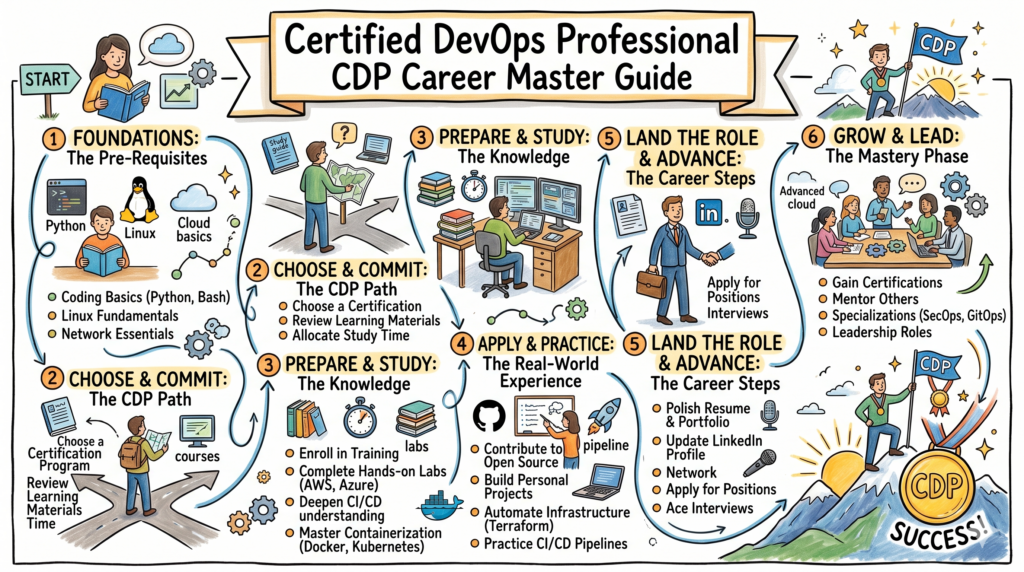
Certified DevOps Professional (CDP) is a structured certification program designed to validate real, hands-on DevOps capability across build, release, automation, observability, and reliability practices. It is ideal for working professionals who want to move beyond tool usage and demonstrate that they can run production systems responsibly. This guide is written for software engineers, DevOps and SRE professionals, cloud and platform engineers, security and data specialists, and engineering managers in India and across the globe. It will help you understand what Certified DevOps Professional (CDP) really means in practice, how it fits into modern cloud‑native and platform engineering careers, and how to use it to make smarter career decisions. By the end, you should know whether this certification is right for you, how to prepare, and what to do next in your learning path.
What is the Certified DevOps Professional (CDP)?
Certified DevOps Professional (CDP) represents a competency-based validation that you can design, implement, and operate modern DevOps practices in real-world environments. Rather than focusing only on theoretical concepts, it emphasizes pipelines, automation, observability, security, and collaboration workflows that actually run in production. The certification exists to give employers confidence that you can handle complex delivery pipelines, cloud platforms, and incident scenarios with discipline and reliability. Certified DevOps Professional (CDP) aligns closely with how modern engineering organizations work: cross-functional teams, frequent releases, heavy automation, and strong feedback loops. It bridges the gap between “I know the tools” and “I can run systems that businesses depend on every day.”
Who Should Pursue Certified DevOps Professional (CDP)?
Certified DevOps Professional (CDP) is best suited for practitioners who are already working in or moving toward DevOps, SRE, platform, or cloud roles. Software engineers who are increasingly involved in CI/CD, infrastructure as code, observability, and troubleshooting will benefit greatly from this certification. SREs, platform engineers, and cloud engineers can use it to formalize their production skills and stand out in competitive markets. Security engineers, data engineers, and analytics professionals who collaborate with DevOps and platform teams will also find value, especially when they need to understand pipelines, environments, and deployment constraints. For India-based professionals, Certified DevOps Professional (CDP) maps well to the expectations of large IT services firms, product companies, and startups, while also being fully relevant for global roles in remote or on-site positions.
Why Certified DevOps Professional (CDP)
In 2026 and beyond, most engineering organizations expect teams to ship faster without breaking stability, and DevOps skills sit at the center of that expectation. Certified DevOps Professional (CDP) helps you stay relevant even as tools change, because it focuses on principles such as automation, reliability, feedback loops, and collaborative delivery. Whether your stack is based on containers, serverless, or hybrid infrastructure, the underlying practices validated by this certification remain useful. Enterprises increasingly look for verifiable proof that a candidate can work across development, operations, and security boundaries instead of staying siloed. Investing your time in Certified DevOps Professional (CDP) gives you a strong return in terms of credibility, interview readiness, and long-term career durability across roles and industries.
Certified DevOps Professional (CDP) Certification Overview
The Certified DevOps Professional (CDP) program is delivered via the official course page at Certified DevOps Professional (CDP) and hosted on devopsschool as the primary certification provider. The structure typically includes a well-defined curriculum, hands-on labs, and scenario-based discussions aimed at real project environments. Assessments may combine practical assignments, quizzes, and project-style evaluations that test not just memory but applied judgment. The ownership and design of Certified DevOps Professional (CDP) are aligned with the realities of multi-cloud infrastructure, containerized deployments, and modern CI/CD ecosystems. You can expect the program to guide you from foundational DevOps concepts to advanced topics that are directly relevant for production teams.
Certified DevOps Professional (CDP) Certification Tracks & Levels
Certified DevOps Professional (CDP) can be visualized as a layered journey moving from fundamentals to advanced, specialized practice. A foundation level focuses on core DevOps culture, CI/CD basics, version control, and essential automation concepts. The professional level dives into real delivery pipelines, container platforms, infrastructure as code, observability, and incident handling across teams. An advanced tier can cover platform engineering, SRE practices, cost and performance optimization, and integrating security at every stage of the lifecycle. Within these levels, you can align toward specific tracks like DevOps, SRE, DevSecOps, AIOps, DataOps, or FinOps depending on your career focus. This structured view helps you pick the right starting point and then progress systematically without feeling overwhelmed.
Complete Certified DevOps Professional (CDP) Certification Table
| Track | Level | Who it’s for | Prerequisites | Skills Covered | Recommended Order |
|---|---|---|---|---|---|
| DevOps | Foundation | New DevOps engineers and software developers | Basic Linux, Git, scripting basics | DevOps principles, CI/CD basics, version control, basic automation | 1st for most practitioners |
| DevOps | Professional | Working DevOps / platform engineers | Foundation-level DevOps knowledge, project exp | CI/CD pipelines, IaC, containers, monitoring, incident response | After DevOps Foundation |
| SRE | Professional | SREs and on-call engineers | DevOps fundamentals, production exposure | SLOs, error budgets, reliability design, incident management | After DevOps Professional |
| DevSecOps | Professional | Security-focused DevOps / AppSec engineers | DevOps pipeline experience, basic security | Secure pipelines, policy as code, scanning integration, compliance | Parallel to SRE / DevOps |
| AIOps | Advanced | Senior DevOps, platform, observability engineers | Strong monitoring and automation background | Event correlation, anomaly detection, intelligent alerting, runbooks | After SRE / DevSecOps |
| MLOps | Professional | ML engineers and data scientists in production | ML basics, DevOps foundation | Model deployment, pipelines, feature stores, monitoring of models | After DevOps Foundation |
| DataOps | Professional | Data engineers and analytics platform owners | SQL, ETL basics, DevOps concepts | Data pipelines, orchestration, versioning, quality and observability | After DevOps Foundation |
| FinOps | Professional | Cloud cost owners and platform leads | Cloud fundamentals, DevOps or SRE knowledge | Cloud cost management, budgeting, showback/chargeback, optimization | After DevOps Professional |
| Leadership | Advanced | Engineering managers, architects, tech leads | Multi-year engineering leadership | DevOps strategy, org design, governance, roadmapping | After one professional cert |
| Cross-Track | Mixed Path | Senior ICs and managers shaping platforms | One or more CDP certifications | Cross-functional design across DevOps, SRE, DataOps, FinOps | Continuous progression |
Detailed Guide for Each Certified DevOps Professional (CDP) Certification
Below, “certification name” is used descriptively under the Certified DevOps Professional (CDP) umbrella so you can visualize the journey more clearly.
Certified DevOps Professional (CDP) – DevOps Foundation
What it is
DevOps Foundation under the Certified DevOps Professional (CDP) umbrella validates that you understand the core culture, principles, and basic toolchain of DevOps. It ensures you can work with Git, simple CI pipelines, and basic automation without being overwhelmed. The focus is on mindset plus essential skills rather than deep platform complexity. It is usually the first serious DevOps step for many engineers switching from pure development or operations.
Who should take it
This level is ideal for software developers, junior DevOps engineers, QA engineers, and system administrators who are starting their DevOps journey. If you are in India or globally and your role is slowly expanding into CI/CD, basic scripting, and cloud, this is a very natural first certification. It also suits students or early-career engineers who want a structured introduction with a recognizable credential. Engineering managers who supervise DevOps teams but lack hands-on exposure can also benefit for better collaboration.
Skills you’ll gain
- Understanding of DevOps culture, collaboration, and shared responsibility
- Comfort with Git, branching, and basic workflows
- Ability to design simple CI pipelines for build and test
- Familiarity with scripting and automation fundamentals
- Awareness of cloud basics, container concepts, and environments
Real-world projects you should be able to do
- Set up a basic CI pipeline for a small application with automated tests
- Automate a simple deployment to a test environment using scripts or basic tools
- Configure a shared Git repository with sensible branching and review rules
- Implement simple environment-based configuration for dev and test setups
- Contribute to documentation and runbooks for a small team project
Preparation plan
- 7–14 days: Focus on core concepts, Git workflows, CI basics, and reading about DevOps culture. Do at least one hands-on mini project and revise key terminology.
- 30 days: Work consistently on small automation tasks at work or in labs, build and refine multiple CI pipelines, and document your learning. Aim to map every concept to a real scenario you have seen.
- 60 days: Revisit weak areas, expand into basic containers and cloud usage, and practice mock assessments or labs. Consolidate learning into a mini portfolio of small but complete projects.
Common mistakes
Candidates often treat DevOps Foundation as a theory-based exam and ignore hands-on practice. Some people over-focus on tools without understanding why practices like trunk-based development or automation matter. Others underestimate Git proficiency and basic scripting, which can cause stress during labs or interviews. A few candidates cram content near the end instead of spreading practice across weeks.
Best next certification after this
For the same-track option, move to Certified DevOps Professional (CDP) – DevOps Professional to deepen your pipeline and platform skills. For a cross-track option, explore Certified DevOps Professional (CDP) – DataOps Professional if you work with data pipelines or analytics-heavy workloads. For a leadership option, you can later consider a Certified DevOps Professional (CDP) – Leadership track once you have enough experience across projects.
Certified DevOps Professional (CDP) – DevOps Professional
What it is
DevOps Professional under Certified DevOps Professional (CDP) validates your ability to build, operate, and improve production-grade CI/CD pipelines and infrastructure. It assumes that you already understand the basics and now need to show depth in automation, containers, and reliability. This level focuses strongly on end-to-end delivery flows, from code commit to production. It is designed to mirror what real platform and DevOps engineers do daily in modern organizations.
Who should take it
This certification is suited to working DevOps engineers, platform engineers, cloud engineers, and senior developers who own parts of the delivery pipeline. If you are already managing Jenkins, GitLab CI, GitHub Actions, or similar tools, this level will help formalize and extend your skills. SREs and operations engineers moving into infrastructure as code and container platforms will also benefit. It is especially helpful if you want to step up from implementing tasks to architecting and improving DevOps workflows.
Skills you’ll gain
- Designing and operating robust CI/CD pipelines with quality gates
- Implementing infrastructure as code with tools like Terraform or similar
- Managing container-based deployments, orchestration, and environments
- Setting up monitoring, logging, and alerting aligned with service health
- Handling rollbacks, canary or blue-green deployments, and release strategies
Real-world projects you should be able to do
- Design and implement an end-to-end CI/CD pipeline for microservices across environments
- Build a reproducible infrastructure stack using infrastructure as code and configuration management
- Implement container-based deployments with centralized logging and metrics
- Design release strategies that allow safe rollouts and quick rollbacks
Preparation plan
- 7–14 days: Review and solidify your current pipeline and IaC understanding, focusing on gaps. Perform targeted labs on deployment strategies and monitoring basics.
- 30 days: Build at least one complete project with CI/CD, infrastructure as code, and observability integrated. Reflect on trade-offs and write brief design notes for each decision.
- 60 days: Broaden to multiple tools and patterns, practice troubleshooting pipeline failures and deployment issues, and rehearse explaining design choices clearly. Use mock scenarios to test your thinking.
Common mistakes
Many candidates jump into advanced tooling without firm fundamentals in versioning, environments, and testing strategies. Some treat observability as an afterthought instead of a core part of the pipeline. Others focus only on “happy path” deployments and do not practice failure scenarios, rollbacks, or incident handling. Another frequent mistake is copying recipes from the internet without understanding why they work.
Best next certification after this
For the same-track option, consider Certified DevOps Professional (CDP) – Leadership to move toward architect or manager roles. For a cross-track path, SRE Professional or DevSecOps Professional are natural choices to deepen reliability or security. For a leadership option specifically, combine this certification with ongoing mentoring, design reviews, and broader organizational responsibilities.
Certified DevOps Professional (CDP) – SRE Professional
What it is
SRE Professional under Certified DevOps Professional (CDP) focuses on reliability engineering, service health, and robust operations at scale. It validates that you understand concepts such as SLOs, error budgets, incident response, and post-incident analysis. The goal is to show that you can manage production systems with discipline, not by heroics. It goes beyond pipelines to cover how services behave and are supported over time.
Who should take it
This certification is ideal for SREs, on-call engineers, production support specialists, and platform engineers responsible for uptime. DevOps engineers who increasingly own reliability metrics and incident handling will also benefit. It is particularly valuable for people working with SaaS products, fintech systems, telecom platforms, or any environment with strict SLAs. Engineering managers responsible for production health may also take it to gain credibility and deeper insight.
Skills you’ll gain
- Defining and managing SLOs and error budgets for services
- Designing monitoring, logging, and tracing across distributed systems
- Running incident response, on-call rotations, and blameless postmortems
- Applying capacity planning, scaling strategies, and resilience patterns
- Balancing release velocity with stability in partnership with product teams
Real-world projects you should be able to do
- Design and implement SLOs for critical services with meaningful user-centric metrics
- Build dashboards and alerts that indicate real issues and reduce noise
- Create and refine on-call and incident response processes for your team
- Lead post-incident reviews and implement actionable, systemic improvements
Preparation plan
- 7–14 days: Deeply review SRE fundamentals, SLOs, alerting design, and real incidents you have handled. Summarize lessons learned in your own words.
- 30 days: Implement or improve monitoring and SLOs for at least one service, and run tabletop incident simulations. Document processes and refine runbooks based on feedback.
- 60 days: Practice full incident lifecycles end-to-end, from detection to review, and evaluate capacity and resilience plans. Study multiple case studies from your company or public incidents.
Common mistakes
Candidates sometimes memorize SRE terminology without actually applying it in real or lab environments. Many over-focus on tools and graphs but ignore whether alerts are actionable and tied to user experience. Another common issue is not understanding trade-offs between reliability, cost, and delivery speed. Finally, some avoid analyzing their own incident history and therefore miss valuable context.
Best next certification after this
For the same-track option, aim for Certified DevOps Professional (CDP) – AIOps Advanced to scale reliability with intelligent automation. For a cross-track path, consider DevSecOps Professional to integrate security into your reliability mindset. For leadership, the Certified DevOps Professional (CDP) – Leadership path is natural if you are moving into SRE team lead or head of reliability roles.
Certified DevOps Professional (CDP) – DevSecOps Professional
What it is
DevSecOps Professional under Certified DevOps Professional (CDP) validates your ability to embed security into every stage of the delivery pipeline. It shifts security from a late gatekeeping activity to a continuous, automated practice. The certification focuses on secure coding practices, scanning, policy as code, and compliance integration. It aims to prepare you to collaborate effectively with both security and engineering teams.
Who should take it
Security engineers, AppSec specialists, and DevOps or SRE professionals with strong security exposure should consider this certification. It is also valuable for developers working in regulated industries like banking, healthcare, government, and telecom. Platform and cloud engineers who design shared pipelines across teams can use DevSecOps skills to make security frictionless. This path suits both India and global professionals dealing with compliance requirements and high-risk systems.
Skills you’ll gain
- Integrating static and dynamic security testing into CI/CD pipelines
- Implementing dependency scanning and container image security controls
- Defining and applying security policies as code across environments
- Collaborating with security teams to address vulnerabilities and risks
- Balancing developer productivity with necessary security controls
Real-world projects you should be able to do
- Set up end-to-end security scanning for source code and dependencies in CI
- Implement container image scanning and basic runtime protections
- Define and enforce security policies for infrastructure as code repositories
- Build a simple, developer-friendly workflow for vulnerability triage and fixes
Preparation plan
- 7–14 days: Focus on DevSecOps principles, common vulnerabilities, and how scanning tools integrate into pipelines. Practice with at least one open-source project.
- 30 days: Implement complete security pipelines for one or two services, including policy as code where possible. Work closely with security guidelines and document your setup.
- 60 days: Extend coverage to multiple services and refine developer experience, focusing on noise reduction and actionable findings. Review case studies of security incidents and prevention methods.
Common mistakes
Some candidates rely solely on tools and assume scanning equals security, without understanding how to interpret or prioritize findings. Others try to over-tighten controls and end up blocking delivery, which creates friction and workarounds. A frequent issue is ignoring infrastructure security while focusing only on application code. Finally, some people fail to coordinate with security teams and miss alignment on standards.
Best next certification after this
For the same-track option, you can grow into more advanced DevSecOps or security architecture learning under the Certified DevOps Professional (CDP) ecosystem. For cross-track growth, SRE Professional or DataOps Professional are useful to broaden your operational and data-related perspective. For leadership, combining this certification with the Certified DevOps Professional (CDP) – Leadership track helps you shape secure engineering culture at scale.
Certified DevOps Professional (CDP) – AIOps Advanced
What it is
AIOps Advanced under Certified DevOps Professional (CDP) concentrates on using automation, intelligence, and data-driven techniques to operate complex systems. It validates skills in correlating events, reducing alert noise, and automating responses based on patterns. The goal is to make large-scale operations more efficient, predictable, and proactive. It is a natural extension for teams that already have strong observability in place.
Who should take it
Senior DevOps engineers, SREs, observability specialists, and platform engineers in large or fast-growing environments are prime candidates. If you are drowning in alerts, incidents, and dashboards, this path can help bring structure and automation. It suits engineers in telecom, fintech, e-commerce, SaaS, and enterprise IT with complex infrastructures. Engineering managers responsible for operations strategy will also gain insight into where AIOps fits realistically.
Skills you’ll gain
- Designing event correlation and noise reduction workflows
- Applying anomaly detection to metrics and logs
- Building runbooks and automated remediation steps
- Integrating AIOps platforms with existing monitoring and ITSM tools
- Evaluating effectiveness and adjusting automation strategies over time
Real-world projects you should be able to do
- Implement correlation rules that cluster related alerts into meaningful incidents
- Deploy an anomaly detection mechanism for key business or system metrics
- Build automated remediation for frequent, low-risk operational issues
- Design dashboards and workflows that give a clear operational picture to teams
Preparation plan
- 7–14 days: Review core observability patterns and AIOps concepts, and analyze your current alert fatigue points. Experiment with basic correlation or anomaly detection features.
- 30 days: Implement a pilot AIOps project on a small set of services, focusing on measurable improvements in noise reduction or response time. Gather feedback from on-call engineers.
- 60 days: Expand the scope, refine rules, and introduce automation carefully while monitoring risk. Document governance, rollback strategies, and continuous improvement loops.
Common mistakes
Many people treat AIOps as a magic solution and ignore the need for clean data and good observability foundations. Over-automation without proper safeguards can create cascading failures or hidden problems. Another common issue is not involving on-call engineers in the design of rules and automations. Some teams also neglect to measure before and after impacts, so they cannot prove value.
Best next certification after this
For the same-track option, deepen your leadership path under Certified DevOps Professional (CDP) – Leadership, focusing on large-scale platform strategy. For cross-track growth, DataOps Professional or FinOps Professional can help you connect operational excellence with data and cost. For leadership, use this certification to step into roles shaping observability and operations strategy across multiple teams.
You can imagine similar detailed sub-guides for DataOps Professional, FinOps Professional, and Leadership tracks within the Certified DevOps Professional (CDP) family, following the same pattern of “what it is, who should take it, skills, projects, preparation, mistakes, and next steps.”
Choose Your Learning Path
DevOps Path
The DevOps path within Certified DevOps Professional (CDP) is ideal if your primary responsibility is enabling fast, reliable delivery for applications and services. You start with DevOps Foundation to anchor your understanding of culture, workflows, and basic automation. From there, DevOps Professional helps you build and operate end-to-end pipelines, infrastructure as code, and environment strategies. As you gain experience, leadership-level learning helps you influence organization-wide DevOps adoption. This path is great if you enjoy building systems that help many teams ship better software.
DevSecOps Path
The DevSecOps path is for professionals who want security to be a natural part of the delivery process rather than a blocker. After gaining core DevOps skills, you progress into DevSecOps Professional to learn how to embed scanning, policies, and compliance into pipelines. You will focus on making security visible, automated, and developer-friendly. Over time, you can grow into security architecture or platform security leadership roles. This path is ideal if you care deeply about both speed and safety.
SRE Path
The SRE path is centered around reliability, performance, and operational excellence for critical systems. You usually begin with general DevOps capabilities and then move into SRE Professional under Certified DevOps Professional (CDP). There, you master SLOs, incident response, and designing robust production systems. Later, AIOps-focused learning can help you scale reliability with intelligent automation. This path fits you if you enjoy solving tough production problems and keeping services healthy.
AIOps / MLOps Path
The AIOps / MLOps path suits engineers who operate at the intersection of systems, data, and intelligence. After DevOps fundamentals, you can pursue AIOps Advanced to handle large-scale operations using smart automation and data-driven decisions. In parallel or later, MLOps-focused learning helps you build and maintain production ML pipelines, monitoring models and features. This path is powerful in organizations where data and AI are central to the product. It is especially attractive if you like combining DevOps, data engineering, and applied machine learning practices.
DataOps Path
The DataOps path within Certified DevOps Professional (CDP) is designed for data engineers, analytics platform owners, and BI teams. You use DevOps principles to make data pipelines more reliable, observable, and repeatable. As you progress, you learn to manage complex ETL workflows, orchestration tools, data quality checks, and lineage tracking. This path helps organizations move from brittle, ad-hoc data flows to disciplined, production-grade data platforms. It is a strong choice if you work with large datasets and care about trust in data.
FinOps Path
The FinOps path focuses on cloud cost, value, and accountability across engineering and finance teams. After core DevOps learning, FinOps Professional under Certified DevOps Professional (CDP) helps you align cloud usage with business goals. You learn to analyze costs, optimize spend, and build showback or chargeback models that encourage responsible consumption. Over time, you can influence both technical and budgeting decisions across teams. This path fits professionals who enjoy combining technical insight with financial impact.
Role → Recommended Certified DevOps Professional (CDP) Certifications
| Role | Recommended Certifications |
|---|---|
| DevOps Engineer | DevOps Foundation, DevOps Professional, DevSecOps Professional |
| SRE | DevOps Foundation, DevOps Professional, SRE Professional, AIOps Advanced |
| Platform Engineer | DevOps Professional, SRE Professional, DevSecOps Professional |
| Cloud Engineer | DevOps Foundation, DevOps Professional, FinOps Professional |
| Security Engineer | DevOps Foundation, DevSecOps Professional, SRE Professional |
| Data Engineer | DevOps Foundation, DataOps Professional, AIOps or MLOps-oriented learning |
| FinOps Practitioner | DevOps Foundation, FinOps Professional, DevOps Professional |
| Engineering Manager | DevOps Foundation, DevOps Professional, Leadership-focused Certified DevOps Professional (CDP) |
Next Certifications to Take After Certified DevOps Professional (CDP)
Same Track Progression
After earning one or more Certified DevOps Professional (CDP) credentials in your primary track, it makes sense to deepen within that track before jumping elsewhere. For example, a DevOps engineer may move from foundation to professional and then into leadership-oriented learning focused on platform design and governance. Staying on the same track for some time allows you to build true depth and become a go-to expert in that area. This depth pays off in complex projects, promotions, and specialized roles.
Cross-Track Expansion
Once you are comfortable in your main Certified DevOps Professional (CDP) track, you can expand sideways into related areas. A DevOps engineer might pick up SRE Professional to strengthen reliability, or DevSecOps Professional to bring security into their pipelines. A data engineer might choose DataOps Professional and then explore AIOps-oriented skills. Cross-track expansion makes you more adaptable and opens opportunities in multi-disciplinary teams.
Leadership & Management Track
For professionals moving into lead, architect, or manager roles, leadership-oriented learning within Certified DevOps Professional (CDP) becomes crucial. The focus shifts from “Can I do this myself?” to “Can I design systems, processes, and teams that can do this reliably?” You will think more about org design, metrics that matter, governance, and long-term roadmaps. Combining strong hands-on credentials with leadership growth is often what unlocks director or head-of-engineering paths.
Training & Certification Support Providers for Certified DevOps Professional (CDP)
DevOpsSchool
DevOpsSchool is a focused training and certification provider that specializes in DevOps, SRE, cloud, and related disciplines, including the Certified DevOps Professional (CDP) program. It offers structured courses, hands-on labs, and real project scenarios designed to mirror industry environments. Learners can expect practical guidance on pipelines, infrastructure as code, observability, and reliability instead of pure theory. The trainers bring real-world experience, which helps bridge the gap between learning and day-to-day work. DevOpsSchool is particularly useful for working professionals who want a guided path, mentorship, and support in translating course content into career growth.
Cotocus
Cotocus operates as a technology and consulting organization that also supports specialized training across DevOps, cloud-native, and platform engineering topics. It often works closely with enterprises looking to uplift entire teams rather than just individuals. For someone pursuing Certified DevOps Professional (CDP), Cotocus can contribute by aligning training with organizational goals and transformation initiatives. Their programs tend to emphasize real-world architecture patterns, migration strategies, and operating models. This makes Cotocus a strong option when your learning is tied to larger digital transformation efforts.
Scmgalaxy
Scmgalaxy has a long-standing focus on SCM, build, and release automation training, which naturally evolved into comprehensive DevOps offerings. It supports learners at different stages, from source control fundamentals to advanced CI/CD and environment management. For Certified DevOps Professional (CDP) aspirants, Scmgalaxy can provide a strong foundation in version control and build engineering practices. Their workshops frequently include hands-on labs and case studies drawn from real projects. This makes it easier to connect theoretical concepts with actual production workflows.
BestDevOps
BestDevOps is positioned as a knowledge and community hub for DevOps practitioners, aggregating training, insights, and resources. It can be a helpful ecosystem for professionals who want to stay updated on tools, practices, and career opportunities around DevOps and SRE. In the context of Certified DevOps Professional (CDP), BestDevOps helps you understand where the certification fits in the broader market and skill landscape. Its content and community-driven approach can reinforce your learning with discussions, examples, and shared experiences. This supporting environment is particularly valuable when you are planning long-term DevOps career growth.
devsecopsschool
devsecopsschool focuses on embedding security within DevOps practices, making it an ideal companion for those interested in DevSecOps and secure delivery pipelines. It offers training, workshops, and labs centered on security scanning, policy as code, and compliance automation. For Certified DevOps Professional (CDP) learners, devsecopsschool can provide depth in the DevSecOps track, ensuring security is treated as a first-class citizen. Its curriculum usually blends application security, infrastructure security, and governance patterns. This combination helps you shift from reactive patching to proactive, integrated security.
sreschool
sreschool is dedicated to Site Reliability Engineering and production excellence, making it highly relevant to SRE-focused Certified DevOps Professional (CDP) paths. It trains engineers in SLOs, incident response, error budgets, and reliability design. The teaching style often emphasizes real incidents, playbooks, and operational runbooks taken from challenging production environments. For SRE aspirants and existing on-call engineers, sreschool provides structured guidance to move from ad-hoc firefighting to disciplined reliability engineering. This naturally strengthens your position when pursuing SRE-related roles and certifications.
aiopsschool
aiopsschool targets the intersection of operations, automation, and intelligent systems through AIOps-focused education. It covers topics such as event correlation, anomaly detection, and automated remediation using modern tools and platforms. For Certified DevOps Professional (CDP) candidates following the AIOps path, aiopsschool offers a way to move beyond dashboards into more proactive operations. Its training usually stresses real-world integration of AIOps with existing monitoring and ITSM workflows. This helps ensure that your automation strategies are both powerful and safe for production.
dataopsschool
dataopsschool specializes in DataOps, bringing DevOps-style discipline to data engineering and analytics workflows. It trains professionals in building reliable data pipelines, orchestration, quality checks, and observability around data flows. For Certified DevOps Professional (CDP) learners on the DataOps path, dataopsschool provides structure around versioning, testing, and deploying data-related changes. Its programs often use examples from BI, analytics, and machine learning environments where data trust is critical. This training can significantly raise your value as a data engineer or analytics platform owner.
finopsschool
finopsschool focuses on cloud financial management, helping professionals link technical decisions to cost and business outcomes. It covers budgeting, showback and chargeback models, cost optimization strategies, and stakeholder communication. For Certified DevOps Professional (CDP) candidates interested in FinOps, finopsschool provides a solid foundation to manage and optimize cloud spend. The programs are typically practical, with dashboards, reports, and examples from real cloud environments. This knowledge positions you as someone who not only builds systems but also understands their financial impact.
Frequently Asked Questions (General – 12 questions)
Is Certified DevOps Professional (CDP) only for DevOps engineers?
No, Certified DevOps Professional (CDP) is suitable for developers, SREs, platform engineers, cloud engineers, security specialists, and data engineers. Anyone involved in building, deploying, or operating software can benefit. The key requirement is an interest in automation, collaboration, and improving delivery workflows.
How difficult is Certified DevOps Professional (CDP) for beginners?
For beginners with some basic scripting or Linux knowledge, the foundation level is very achievable with focused preparation. The professional and advanced levels require real hands-on experience and consistent practice. Difficulty mostly depends on how much you apply concepts in real or lab projects, not just reading theory. Starting early with small, practical exercises makes the journey manageable.
How long does it usually take to prepare for Certified DevOps Professional (CDP)?
Preparation time varies with your background and target level, but many working professionals need one to three months per major milestone. Shorter, intensive windows of 7–14 days are useful for revision, while 30–60 days are ideal for deep skill-building. If you are already using some DevOps tools at work, you can progress faster. The key is steady, hands-on practice instead of last-minute cramming.
Do I need strong coding skills for Certified DevOps Professional (CDP)?
You do not need to be a full-time application developer, but you should be comfortable with scripting and reading code. Shell, Python, or similar languages are usually enough for automation, pipelines, and tooling integration. As you move into advanced levels, more coding exposure definitely helps with customization and troubleshooting. Treat coding as a practical tool rather than a theoretical subject.
Will Certified DevOps Professional (CDP) guarantee me a job?
No certification can guarantee a job, but Certified DevOps Professional (CDP) can significantly strengthen your profile. It shows employers that you take structured learning seriously and have validated your skills. Combined with real project experience and a good portfolio, it can improve interview conversion rates. Think of it as a strong signal, not a replacement for hands-on work.
Is Certified DevOps Professional (CDP) useful outside India?
Yes, the skills covered by Certified DevOps Professional (CDP)—pipelines, automation, reliability, security, observability—are globally relevant. Whether you work in India or elsewhere, modern engineering teams expect these capabilities. The terminology and concepts align with international DevOps and SRE practices. This makes the certification a useful asset for remote, on-site, or hybrid roles worldwide.
Can managers and non-hands-on leaders benefit from Certified DevOps Professional (CDP)?
Yes, managers, architects, and tech leads can benefit by understanding the practical realities their teams face. Even if they do not build pipelines daily, knowing how they work helps in planning, estimation, and governance. Leadership-oriented tracks within the Certified DevOps Professional (CDP) family help managers design better processes and organizations. This combination improves decision-making and team trust.
How does Certified DevOps Professional (CDP) compare to vendor-specific cloud certifications?
Vendor cloud certifications often focus on a specific platform’s services and patterns. Certified DevOps Professional (CDP) is more vendor-neutral and emphasizes practices such as CI/CD, IaC, and SRE that apply across clouds. Ideally, you combine CDP with one or more cloud provider certifications. This gives you both strong practices and detailed platform knowledge.
What kind of projects should I build while preparing for Certified DevOps Professional (CDP)?
You should aim for end-to-end projects that cover source control, CI/CD, infrastructure as code, and observability. For example, deploy a small microservice or web app across dev, test, and production-like environments. Add monitoring, alerts, and basic security checks to practice real scenarios. These projects will sharpen your skills and also serve as portfolio pieces.
Can I prepare for Certified DevOps Professional (CDP) while working full-time?
Yes, most learners prepare while in full-time roles by integrating learning into their daily work. You can start by improving existing pipelines, scripts, and monitoring at your job. Then, schedule consistent blocks of study and lab time in evenings or weekends. Over a few months, this steady approach is more effective than irregular bursts.
Is prior Linux or networking knowledge mandatory for Certified DevOps Professional (CDP)?
Basic Linux and networking knowledge is highly recommended because DevOps work often touches servers, containers, and connectivity. You do not need advanced expertise, but familiarity with commands, processes, and basic troubleshooting helps a lot. For networking, understanding ports, DNS, and simple routing is usually enough at the start. You can deepen both as you move to higher certification levels.
How does Certified DevOps Professional (CDP) impact salary and promotions?
While salary outcomes vary by company and region, Certified DevOps Professional (CDP) often supports stronger appraisal discussions and role transitions. It signals that you have both the mindset and capabilities that modern engineering leaders value. Combined with solid performance and visible impact on reliability or delivery speed, it can justify higher responsibility and compensation. Over the long term, structured upskilling like CDP tends to compound career growth.
FAQs on Certified DevOps Professional (CDP)
What makes Certified DevOps Professional (CDP) different from basic DevOps courses?
Certified DevOps Professional (CDP) is designed to validate real-world, production-focused capability rather than just classroom understanding. Instead of stopping at tool introductions, it pushes you to build pipelines, infrastructure as code, and observability that resemble real environments. The structure and progression across tracks support long-term career planning, not just a single workshop. This makes it more aligned with how modern teams actually operate day to day.
Can I take Certified DevOps Professional (CDP) if I am only doing development work today?
Yes, many successful DevOps professionals started as application developers and moved gradually into automation and operations. If you already use Git and CI for your code, Certified DevOps Professional (CDP) helps you expand into deployment, environments, and reliability. You can begin at the foundation level and use your projects as a lab. Over time, you can position yourself for DevOps, SRE, or platform roles.
Is Certified DevOps Professional (CDP) suitable for freshers or students?
Freshers and students can pursue Certified DevOps Professional (CDP), especially at foundational levels, but they should be realistic about experience requirements. The certification becomes much more powerful when combined with internships, projects, or open-source contributions. For students, it is smart to build small DevOps-style labs and document them alongside the certification. This combination can strongly differentiate you in entry-level hiring.
How should I balance theory and hands-on work while preparing for Certified DevOps Professional (CDP)?
A good rule is to spend at least half of your preparation time doing hands-on work. For every concept you read—such as branching strategies or monitoring—you should implement a small exercise. Use labs, side projects, or improvements to your team’s existing workflows as practice grounds. This balance ensures that you can handle practical questions and tasks confidently.
Do I need to master every DevOps tool before attempting Certified DevOps Professional (CDP)?
No, you do not need to master every tool in the ecosystem, which would be impossible. Instead, focus on understanding core categories like version control, CI, IaC, containers, and observability, and get solid with at least one tool in each. Certified DevOps Professional (CDP) is more about transferable practices than brand-specific knowledge. Once you know the patterns, switching tools becomes much easier.
Can Certified DevOps Professional (CDP) help me move into remote or international roles?
Yes, because the skills it validates—automation, pipeline design, reliability, security—are central to distributed and global teams. When you combine Certified DevOps Professional (CDP) with good communication skills and some cloud provider knowledge, you become an attractive candidate for remote work. Employers often look for evidence that you can independently manage modern tooling and practices. CDP provides a clear, structured signal in that direction.
What should my learning roadmap look like after completing my first Certified DevOps Professional (CDP) level?
After your first level, review which parts of the curriculum felt most natural and most challenging. Use that insight to choose either a deeper level in the same track or a complementary track like SRE, DevSecOps, or DataOps. Keep working on real projects while adding new topics gradually. This continuous improvement approach will keep your skills relevant and your confidence high.
How do I know if Certified DevOps Professional (CDP) is the right certification for my specific career goals?
Start by mapping your current role and desired role against the tracks and levels described in this guide. If your future involves building, operating, or securing software systems in any capacity, Certified DevOps Professional (CDP) is likely to be a strong fit. Consider whether you want to specialize in reliability, security, data, or cost, and choose your track accordingly. Reflect on whether the practical, production-focused nature of the program aligns with how you like to work.
Final Thoughts: Is Certified DevOps Professional (CDP) Worth It?
From a mentor’s perspective, Certified DevOps Professional (CDP) is worth pursuing if you treat it as a catalyst for real skill growth, not just a badge. It encourages you to build the kind of hands-on, production-focused confidence that modern engineering roles demand. If you are willing to invest time in labs, projects, and reflection, this certification can anchor your DevOps, SRE, or platform career for years to come. On the other hand, if you only want a quick credential without practice, you will get limited value. Used well, Certified DevOps Professional (CDP) becomes a practical roadmap that guides your learning, opens opportunities, and supports long-term career resilience.
