Introduction
The Certified DevOps Manager (CDM) is a specialized credential designed for those who have moved beyond individual contribution and are now responsible for the strategic direction of engineering teams. This guide is written for mid-to-senior professionals who need to bridge the gap between technical execution and business value. In the current landscape of cloud-native environments and platform engineering, the role of a manager has shifted from simple oversight to active architectural and cultural leadership.
Whether you are navigating the complexities of a global enterprise or scaling a startup, understanding the management layer of DevOps is critical. This guide provides an unbiased look at the certification, helping you evaluate its ROI and technical depth. By the end of this article, you will have a clear roadmap to transition from a Senior Engineer or Team Lead into a high-impact leadership role within the DevOps ecosystem.
What is the Certified DevOps Manager (CDM)?
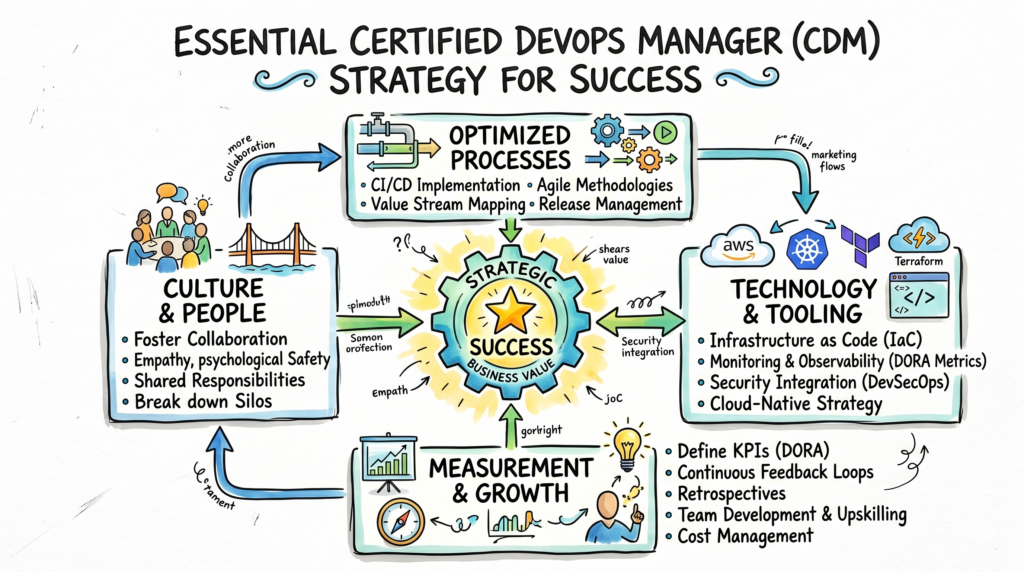
The Certified DevOps Manager (CDM) represents a shift from “how to build” to “how to scale and govern.” While most certifications focus on the syntax of tools like Kubernetes or Terraform, the CDM exists to validate a professional’s ability to design sustainable workflows and lead technical transformations. It focuses on the intersection of people, process, and technology, ensuring that delivery pipelines are not just fast, but also secure, cost-effective, and aligned with business goals.
In modern enterprise practices, a manager must understand production-focused metrics like DORA (DevOps Research and Assessment) and how to implement them. The CDM curriculum aligns with these real-world requirements, moving past theoretical concepts into the mechanics of site reliability, financial operations (FinOps), and security integration. It provides a framework for leaders to manage technical debt while maintaining a high velocity of feature delivery across diverse cloud environments.
Who Should Pursue Certified DevOps Manager (CDM)?
This certification is primarily built for software engineers, SREs, and cloud professionals who are stepping into leadership roles. If you are currently a Team Lead, a Principal Engineer, or a Project Manager overseeing technical teams, the Certified DevOps Manager (CDM) provides the necessary technical governance skills. It is also highly relevant for existing Engineering Managers who want to modernize their understanding of automated infrastructure and CI/CD maturity models.
From a global perspective, the demand for competent technical managers is surging in both India and international markets. As organizations move away from traditional silos, they need leaders who understand the nuances of DevSecOps and Platform Engineering. Whether you are managing a small remote team or a massive offshore development center, the CDM validates your ability to speak the language of both the boardroom and the server room, making it a versatile asset for any career stage.
Why Certified DevOps Manager (CDM)
As we move further into 2026, the complexity of distributed systems continues to grow, making the Certified DevOps Manager (CDM) more relevant than ever. Enterprises are no longer just looking for people who can write scripts; they need leaders who can manage the “sprawl” of cloud resources and ensure compliance across multiple jurisdictions. The CDM provides the longevity needed in a career by focusing on foundational management principles that remain constant even as specific tools evolve.
The return on time and career investment for the CDM is significant because it prepares you for high-level roles like Director of Platform Engineering or Head of DevOps. By mastering the ability to measure and improve engineering productivity, you become an indispensable part of the organization’s growth strategy. In an era where AI-driven operations (AIOps) are becoming standard, having a certification that emphasizes human leadership and strategic oversight ensures you stay ahead of the automation curve.
Certified DevOps Manager (CDM) Certification Overview
The Certified DevOps Manager (CDM) program is a comprehensive educational track delivered via and hosted on devopsschool. The program uses a structured, assessment-based approach to validate both technical knowledge and leadership aptitude. Unlike basic multiple-choice exams, this certification focuses on the practical application of management frameworks within a technical context.
The structure is designed to be accessible yet rigorous, covering various ownership models and organizational structures. Candidates are evaluated on their ability to design roadmaps, manage stakeholder expectations, and implement robust governance across the software development life cycle (SDLC). By hosting the program on devopsschool, learners gain access to a platform that is deeply rooted in the DevOps community, ensuring the content is always reflective of current industry shifts and best practices.
Certified DevOps Manager (CDM) Certification Tracks & Levels
The Certified DevOps Manager (CDM) is organized into logical levels to accommodate different career stages. The Foundation level introduces the core concepts of DevOps leadership and culture, perfect for those new to management. The Professional level dives deeper into metrics, budgeting, and toolchain orchestration, while the Advanced/Expert level focuses on organizational transformation, large-scale SRE implementations, and executive-level reporting.
Specialization tracks within the CDM allow managers to lean into specific domains such as FinOps for cost management or DevSecOps for security leadership. This modular approach ensures that your certification aligns perfectly with your current job requirements and future career goals. As you progress through these levels, you transition from managing small pods to leading entire engineering departments, with each tier of the certification providing the specific skills needed for that leap.
Complete Certified DevOps Manager (CDM) Certification Table
| Track | Level | Who it’s for | Prerequisites | Skills Covered | Recommended Order |
| Management | Foundation | Aspiring Leads | Basic DevOps knowledge | Culture, CI/CD Basics | 1st |
| Management | Professional | Current Managers | 3+ years experience | Metrics, Governance | 2nd |
| Governance | Advanced | Directors / VPs | 7+ years experience | Strategy, FinOps | 3rd |
| Security | Specialist | Security Leads | CDM Professional | DevSecOps, Compliance | Optional |
| Operations | Specialist | SRE Managers | CDM Professional | SLOs, Error Budgets | Optional |
Detailed Guide for Each Certified DevOps Manager (CDM) Certification
Certified DevOps Manager (CDM) – Foundation
What it is
This entry-level certification validates a fundamental understanding of DevOps management principles. It covers the cultural shifts required to break down silos and the basic technical components of a modern delivery pipeline.
Who should take it
It is ideal for Senior Software Engineers, QA Leads, or Systems Administrators who are transitioning into their first management role. It is also suitable for Project Managers who work closely with technical DevOps teams.
Skills you’ll gain
- Understanding the DevOps CAMS model (Culture, Automation, Measurement, Sharing).
- Basic knowledge of CI/CD pipeline architecture and orchestration.
- Conflict resolution and team collaboration techniques within engineering.
- How to identify and eliminate bottlenecks in the value stream.
Real-world projects you should be able to do
- Conduct a Value Stream Mapping (VSM) exercise for a small team.
- Design a basic automated deployment workflow for a microservices application.
- Establish team communication protocols using Slack, Jira, and Confluence.
Preparation plan
- 7–14 days: Focus on core DevOps terminology and the history of Agile/Lean methodologies.
- 30 days: Review case studies of successful DevOps transformations in small to medium enterprises.
- 60 days: Engage in hands-on labs involving basic toolchain setup to understand the developer’s perspective.
Common mistakes
- Focusing too much on specific tool syntax rather than the underlying process.
- Underestimating the cultural challenges of moving away from Waterfall or traditional Ops.
Best next certification after this
- Same-track option: Certified DevOps Manager (CDM) – Professional
- Cross-track option: Certified Kubernetes Administrator (CKA)
- Leadership option: Agile Certified Practitioner (PMI-ACP)
Certified DevOps Manager (CDM) – Professional
What it is
The Professional level focuses on the operational and tactical aspects of managing a DevOps department. It emphasizes data-driven decision-making and the implementation of enterprise-grade automation.
Who should take it
This is designed for active Engineering Managers, DevOps Leads, and SRE Managers who are responsible for the performance and reliability of production environments.
Skills you’ll gain
- Implementation of DORA metrics (Change Failure Rate, Lead Time, etc.).
- Advanced cloud governance and resource optimization strategies.
- Orchestrating complex toolchains involving security and compliance gates.
- Managing technical debt and balancing feature work with stability.
Real-world projects you should be able to do
- Implement a central dashboard for monitoring pipeline health across multiple teams.
- Develop a disaster recovery and business continuity plan for cloud infrastructure.
- Create a FinOps reporting structure to reduce cloud waste by at least 15%.
Preparation plan
- 7–14 days: Deep dive into the “State of DevOps” reports and modern metric frameworks.
- 30 days: Study advanced CI/CD patterns like Canary deployments and Blue/Green strategies.
- 60 days: Perform a mock audit of a production environment to identify security and cost leaks.
Common mistakes
- Ignoring the “People” aspect of DevOps in favor of purely technical solutions.
- Failing to align DevOps metrics with actual business outcomes (KPIs).
Best next certification after this
- Same-track option: Certified DevOps Manager (CDM) – Advanced
- Cross-track option: Certified DevSecOps Professional
- Leadership option: MBA or Executive Leadership Program
Choose Your Learning Path
DevOps Path
The core DevOps path focuses on the end-to-end automation of the software delivery lifecycle. As a manager, your goal here is to ensure that code moves from a developer’s laptop to production as seamlessly and safely as possible. You will focus on building “internal developer platforms” that allow teams to self-serve their infrastructure needs. This path is perfect for those who want to lead generalist DevOps teams in high-growth tech companies.
DevSecOps Path
In this path, security is no longer an afterthought but a core component of the management strategy. You will learn how to integrate automated security scanning (SAST/DAST) into the pipeline without slowing down the development team. This is a critical path for managers working in highly regulated industries like finance or healthcare. Your role will involve managing the relationship between the security team and the engineering pods.
SRE Path
The Site Reliability Engineering (SRE) path is for managers who prioritize system uptime and scalability above all else. You will focus on defining Service Level Objectives (SLOs) and managing “Error Budgets” to balance innovation with stability. This path teaches you how to lead teams that treat operations as a software engineering problem. It is the ideal route for those managing large-scale distributed systems or “always-on” global services.
AIOps / MLOps Path
As AI becomes central to enterprise software, managing the lifecycle of machine learning models is a specialized skill. This path covers the management of data pipelines, model training environments, and the deployment of AI at scale. You will learn how to bridge the gap between Data Scientists and DevOps Engineers. This is a forward-looking path for managers in organizations that are heavily investing in predictive analytics and automation.
DataOps Path
DataOps is about applying DevOps principles to data management and analytics. In this path, you will learn how to manage teams that build and maintain data lakes, warehouses, and real-time processing engines. The focus is on data quality, lineage, and the speed of data delivery to business stakeholders. This is an essential track for managers overseeing large data engineering or business intelligence departments.
FinOps Path
The FinOps path is dedicated to the financial management of the cloud. As a manager, you will learn how to bring accountability to cloud spending and ensure that every dollar spent on AWS, Azure, or GCP provides maximum value. You will work on “unit economics” and foster a culture where engineers take ownership of their cloud costs. This is an increasingly popular path as companies look to optimize their infrastructure margins.
Role → Recommended Certified DevOps Manager (CDM) Certifications
| Role | Recommended Certifications |
| DevOps Engineer | CDM Foundation + Professional |
| SRE | CDM Professional + SRE Specialist |
| Platform Engineer | CDM Professional + Advanced |
| Cloud Engineer | CDM Foundation + FinOps Specialist |
| Security Engineer | CDM Professional + DevSecOps Specialist |
| Data Engineer | CDM Foundation + DataOps Specialist |
| FinOps Practitioner | CDM Professional + FinOps Specialist |
| Engineering Manager | CDM Professional + Advanced + Leadership Track |
Next Certifications to Take After Certified DevOps Manager (CDM)
Same Track Progression
Once you have completed the core Certified DevOps Manager (CDM) levels, the natural next step is to seek deep specialization. This involves going into the Expert levels or focusing on niche management areas like Multi-Cloud Governance. Staying on this track ensures you remain the go-to authority for technical management within your organization.
Cross-Track Expansion
To become a truly “T-shaped” leader, consider expanding into technical tracks. For a manager, having a Certified Kubernetes Administrator (CKA) or a Professional Cloud Architect certification can be incredibly valuable. It ensures you have enough “under-the-hood” knowledge to effectively lead and challenge your highly technical individual contributors.
Leadership & Management Track
For those looking to move into the C-suite or VP-level roles, shifting toward organizational leadership is key. Certifications in Project Management (PMP), ITIL 4 for service management, or even executive education in business strategy can complement your CDM. This combination allows you to translate technical DevOps success into broad business impact.
Training & Certification Support Providers for Certified DevOps Manager (CDM)
DevOpsSchool
As the primary host for the CDM program, DevOpsSchool offers a robust ecosystem for learners. They provide a blend of instructor-led sessions and self-paced modules designed to cater to working professionals. Their curriculum is updated frequently to reflect the latest in 2026 industry standards, ensuring that you are learning relevant skills. The community aspect is a major draw, allowing students to network with other aspiring and current managers globally.
Cotocus
Cotocus is well-regarded for its corporate training and consulting-heavy approach. They specialize in helping existing teams transition to DevOps, making their CDM preparation very practical and scenario-based. If you are looking for training that feels like real-world consulting, their trainers bring deep industry experience to the table. They focus heavily on the “how-to” of management, providing templates and frameworks that can be used immediately in the workplace.
Scmgalaxy
Scmgalaxy acts as a massive knowledge repository for the DevOps community. For CDM candidates, it serves as an excellent resource for supplemental reading, community forums, and technical articles. They have a long history of supporting SCM and DevOps professionals, and their community-driven approach means you can find answers to very specific, niche management challenges that aren’t always covered in standard textbooks.
BestDevOps
BestDevOps focuses on high-quality, curated content specifically for the elite DevOps professional. Their training programs are often more intensive and aimed at those who want to master the craft of DevOps leadership. They emphasize quality over quantity, providing deep dives into complex topics like AIOps and advanced governance, making them a great choice for the Professional and Advanced levels of the CDM.
devsecopsschool
As the name suggests, devsecopsschool is the authority on integrating security into the DevOps lifecycle. For a CDM candidate, this provider is essential for the DevSecOps specialization track. They offer hands-on labs that simulate real-world security breaches and teach managers how to lead teams through incident response and proactive security hardening within a CI/CD context.
sreschool
sreschool is the go-to provider for anything related to reliability and operations management. Their support for the CDM program focuses on the SRE specialization, teaching the math and methodology behind SLOs and error budgets. For managers who want to lead teams at the scale of Google or Netflix, the specialized training here is invaluable for understanding the nuances of system stability.
aiopsschool
aiopsschool addresses the emerging need for AI and Machine Learning in operations. Their contribution to the CDM ecosystem involves training managers on how to oversee AI-driven toolsets and ML model lifecycles. As we look at the landscape of 2026, the training provided here ensures that DevOps managers are ready to lead the next wave of intelligent automation and predictive maintenance.
dataopsschool
dataopsschool provides the specialized management training needed for data-centric organizations. They focus on the CDM DataOps track, ensuring that managers know how to apply lean and agile principles to data engineering. Their training covers the governance of data pipelines and the coordination between data scientists and infrastructure teams, which is a critical skill for modern technical leaders.
finopsschool
finopsschool is dedicated to the “Cloud Financial Management” aspect of the CDM certification. They provide the tools and knowledge needed for managers to take control of their organization’s cloud billing. Their training is highly practical, focusing on tagging strategies, reserved instance planning, and fostering a culture of cost-awareness across engineering teams, which is vital for any manager’s success.
Frequently Asked Questions (General)
1. Is the Certified DevOps Manager (CDM) difficult to pass?
The difficulty is moderate to high, as it requires both technical understanding and management logic. It is not just about memorization; it is about applying frameworks to solve real-world engineering management problems.
2. How long does it take to prepare for the CDM?
For the Foundation level, 30 days is usually sufficient. For the Professional and Advanced levels, most candidates spend 60 to 90 days to fully grasp the technical governance and financial aspects.
3. Are there any strict prerequisites for the CDM?
While anyone can take the Foundation level, the Professional level strongly recommends at least 3 years of experience in a technical lead or management role to get the full value from the curriculum.
4. What is the ROI of getting a CDM certification?
The ROI is high, often resulting in a 20-30% salary increase when transitioning into management roles. More importantly, it provides the “mental models” needed to succeed in high-pressure leadership positions.
5. Does the certification expire?
Most certifications in this track are valid for two to three years, after which you can renew by taking an updated assessment or earning continuing education credits within the community.
6. Is this certification recognized in India?
Yes, it is highly recognized by major Indian IT firms and global captives (GCCs) that are scaling their DevOps and Platform Engineering teams in regions like Bangalore, Hyderabad, and Pune.
7. Can I skip the Foundation level?
It is not recommended. The Foundation level sets the cultural and terminology groundwork that is essential for the advanced strategic concepts discussed in the Professional tier.
8. Is the exam online or offline?
The exam is typically delivered online via a proctored platform, making it accessible to professionals globally regardless of their physical location.
9. Does CDM cover specific tools like Jenkins or AWS?
While it mentions these tools, the CDM is “tool-agnostic.” It focuses on the management of these tools rather than the specific command-line syntax of any single provider.
10. How does CDM differ from a standard PMP?
A PMP is general project management. The CDM is specialized for the high-velocity, automated, and often chaotic world of modern software delivery and cloud infrastructure.
11. Are there group discounts for corporate teams?
Yes, providers like devopsschool often offer corporate packages for engineering departments looking to standardize their management layer across multiple teams.
12. Will this help me move from a Windows/VMware admin role?
Absolutely. It provides the roadmap to transition from traditional “siloed” administration into the integrated, automated world of modern DevOps leadership.
FAQs on Certified DevOps Manager (CDM)
1. Does the CDM cover FinOps and cloud cost management?
Yes, cost optimization is a core pillar of the Professional and Advanced CDM tracks, focusing on bringing financial accountability to the engineering team’s cloud usage.
2. Is there a focus on “Soft Skills” in this certification?
Yes, a significant portion of the Foundation and Professional levels covers leadership, conflict resolution, and the cultural transformation required for successful DevOps adoption.
3. How does the CDM handle DevSecOps?
It treats security as a management responsibility, teaching you how to build “security-first” cultures and integrate automated compliance gates into your team’s workflow without sacrificing speed.
4. What kind of metrics are taught in the CDM?
The CDM focuses on DORA metrics (Deployment Frequency, Lead Time for Changes, etc.) and reliability metrics like MTTR (Mean Time To Recovery) and SLO attainment.
5. Is the CDM updated for AI and AIOps?
As of 2026, the CDM curriculum includes modules on managing AI-driven operations and the unique challenges of supervising automated, self-healing infrastructure.
6. Can I take the CDM if I am currently a Project Manager?
Yes, it is an excellent bridge for Project Managers who want to gain technical credibility and a deeper understanding of how modern engineering teams actually operate.
7. Does the CDM provide real-world templates?
Many of the training providers associated with CDM offer templates for Value Stream Mapping, Incident Reports, and Governance Roadmaps that you can use in your daily work.
8. What is the global standing of the CDM?
The CDM is recognized internationally, aligning with the standards set by global DevOps bodies, making it a valuable credential for those looking to work in Europe, the US, or APAC.
Final Thoughts: Is Certified DevOps Manager (CDM) Worth It?
If you are looking for a certification that will just teach you how to write a YAML file, this is not it. The Certified DevOps Manager (CDM) is for the professional who wants to be in the room where decisions are made. It is for the person who cares about how an entire organization delivers value, not just how one server is configured.
In my years observing the industry, the biggest bottleneck isn’t usually the technology—it’s the management of that technology. By earning your CDM, you are positioning yourself as a solution to that bottleneck. It is a challenging but rewarding path that shifts your career from being a “worker” to being an “architect of work.” If you are ready to lead, this is your next step.
