Introduction
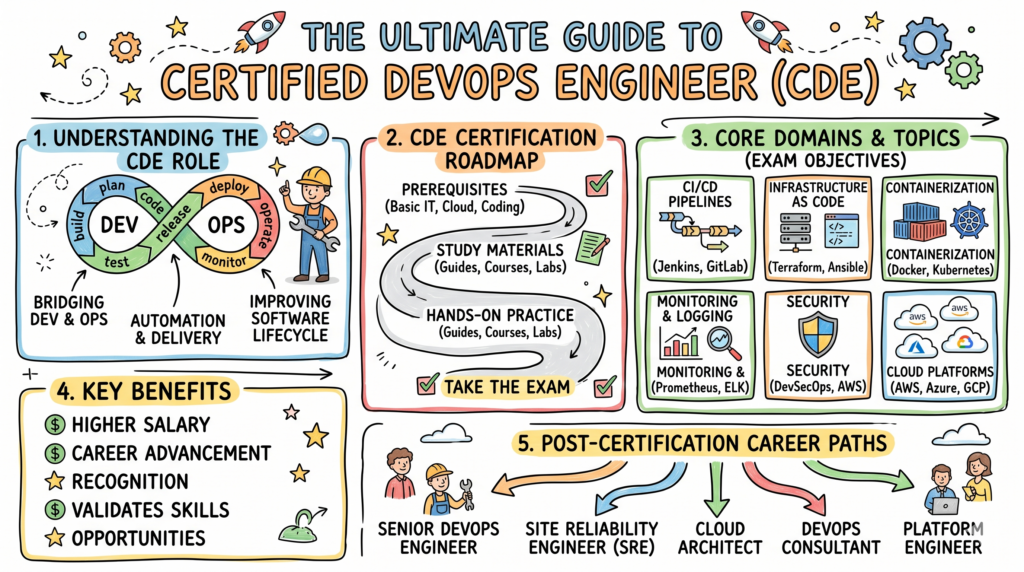
The Certified DevOps Engineer (CDE) program is a specialized curriculum designed to bridge the gap between traditional operations and modern, automated engineering. This guide is written for software engineers, systems administrators, and technical leads who want to move beyond basic automation into high-scale platform engineering. In today’s market, simply knowing a few tools isn’t enough; you need to understand the lifecycle of a product from code to production. This guide will help you evaluate the CDE path, understand its real-world impact, and determine how it fits into your specific career trajectory.
What is the Certified DevOps Engineer (CDE)?
The Certified DevOps Engineer (CDE) is a competency-based program that focuses on the practical application of DevOps principles within a production environment. Unlike theoretical courses, it emphasizes the “Engineer” aspect, requiring a deep understanding of CI/CD pipelines, Infrastructure as Code, and cloud-native architecture. It exists to provide a standardized benchmark for enterprise-grade engineering skills that align with current industry demands. By focusing on production-grade workflows, it ensures that professionals can handle the complexities of modern distributed systems and high-velocity deployment cycles.
Who Should Pursue Certified DevOps Engineer (CDE)?
This program is built for a wide range of technical professionals, ranging from backend developers wanting to manage their own infrastructure to SREs looking to formalize their automation skills. It is highly relevant for cloud engineers and security professionals in India and across the global market who are tasked with scaling applications. Even engineering managers find value here, as it provides the technical vocabulary needed to lead high-performing teams. Whether you are a beginner looking for a structured entry point or a veteran seeking to validate years of experience, the CDE offers a clear roadmap.
Why Certified DevOps Engineer (CDE) is Valuable in 2026 and Beyond
As we move through 2026, the demand for engineers who can navigate complex, multi-cloud environments continues to soar. The CDE remains valuable because it focuses on core engineering logic rather than just fleeting tool syntax, ensuring longevity in your career. Enterprise adoption of DevOps is no longer an “option” but a requirement for survival, making CDE-certified professionals essential for organizational stability. Investing time in this certification provides a high return on effort by opening doors to senior-level roles and specialized consulting opportunities.
Certified DevOps Engineer (CDE) Certification Overview
The program is delivered via the official Certified DevOps Engineer (CDE) platform and is hosted on devopsschool. It uses a tiered assessment approach that moves from foundational concepts to advanced architectural design. The structure is designed to be practical, ensuring that ownership of the certification translates directly to the ability to manage live systems. It is recognized as a comprehensive benchmark for those seeking to master the entire DevOps ecosystem under a single, cohesive framework.
Certified DevOps Engineer (CDE) Certification Tracks & Levels
The CDE is divided into Foundation, Professional, and Advanced levels to cater to different stages of a professional’s career. The Foundation level focuses on the mindset and basic toolchain, while the Professional level dives deep into orchestration and automation. Advanced levels are tailored for those moving into SRE or Architecutral roles, focusing on observability and system resilience. These tracks allow you to specialize in areas like FinOps or DevSecOps while maintaining a strong core in DevOps engineering.
Complete Certified DevOps Engineer (CDE) Certification Table
| Track | Level | Who it’s for | Prerequisites | Skills Covered | Recommended Order |
| Core DevOps | Foundation | Beginners/Associates | Basic Linux/Git | CI/CD, Culture, Scripting | 1st |
| Engineering | Professional | Experienced Admins | Foundation Level | IaC, Docker, Kubernetes | 2nd |
| Architecture | Advanced | Senior Engineers | Professional Level | Scalability, Security, SRE | 3rd |
| Security | Specialist | Security Analysts | Core DevOps | Vault, Scanning, Compliance | Optional |
Detailed Guide for Each Certified DevOps Engineer (CDE) Certification
Certified DevOps Engineer (CDE) – Foundation
What it is
This certification validates a professional’s understanding of the DevOps culture and the basic lifecycle of software delivery. It ensures you speak the language of automation and understand how different roles collaborate.
Who should take it
It is ideal for fresh graduates, manual QA testers, or traditional system administrators who are new to the world of automated deployments.
Skills you’ll gain
- Mastery of Git-based version control workflows.
- Understanding of Continuous Integration (CI) basics.
- Ability to write basic automation scripts in Bash or Python.
- Knowledge of DevOps culture and collaborative tools.
Real-world projects you should be able to do
- Setting up a basic automated build for a web application.
- Automating simple server maintenance tasks using scripts.
- Managing code repositories with proper branching strategies.
Preparation plan
- 7–14 days: Focus on understanding the DevOps Manifesto and basic Git commands.
- 30 days: Start building small pipelines using local tools and simple scripting.
- 60 days: Complete mock exams and focus on the integration points between development and operations.
Common mistakes
- Focusing too much on tools and ignoring the cultural/process shift.
- Skipping the basics of Linux command-line operations.
Best next certification after this
- Same-track option: CDE Professional
- Cross-track option: DevSecOps Foundation
- Leadership option: DevOps Leader (DOL)
Certified DevOps Engineer (CDE) – Professional
What it is
This level validates your ability to manage containerized workloads and infrastructure through code. It is a deep dive into the technical stack used by modern tech companies.
Who should take it
Suitable for engineers with at least a year of experience who are responsible for maintaining production environments and scaling applications.
Skills you’ll gain
- Advanced Containerization with Docker and Podman.
- Infrastructure as Code (IaC) using tools like Terraform or Ansible.
- Complex CI/CD pipeline design and optimization.
- Monitoring and basic log management.
Real-world projects you should be able to do
- Provisioning a multi-tier cloud environment using IaC.
- Migrating a monolithic application into a containerized microservice.
- Building an end-to-end pipeline that includes automated testing and staging.
Preparation plan
- 7–14 days: Review networking concepts and advanced Linux administration.
- 30 days: Hands-on practice with Terraform and Kubernetes deployments.
- 60 days: Focus on high-availability setups and disaster recovery scenarios.
Common mistakes
- Over-complicating pipelines without considering security.
- Not practicing troubleshooting in a live terminal environment.
Best next certification after this
- Same-track option: CDE Advanced / SRE
- Cross-track option: Certified FinOps Professional
- Leadership option: Technical Program Manager
Choose Your Learning Path
DevOps Path
This path is the backbone of the program, focusing on the seamless integration of development and operations teams. You will spend your time mastering the toolchain that allows for rapid, reliable software releases. It is the most common starting point for engineers who want to become generalists in the cloud-native ecosystem.
DevSecOps Path
Security is no longer an afterthought, and this path focuses on “shifting left” by integrating security checks directly into the code. You will learn how to automate vulnerability scanning and compliance as part of the standard deployment process. This path is critical for engineers working in regulated industries like finance or healthcare.
SRE Path
Site Reliability Engineering focuses on using software engineering practices to solve infrastructure and operations problems. This path emphasizes availability, latency, performance, and capacity management through error budgets and service level objectives. It is ideal for those who enjoy high-stakes troubleshooting and system design.
AIOps / MLOps Path
This path merges the worlds of data science and operations, focusing on the deployment and monitoring of machine learning models. You will learn how to manage data pipelines and ensure that AI models perform consistently in a production environment. It is one of the fastest-growing niches in the engineering world today.
DataOps Path
DataOps is about improving the quality and reducing the cycle time of data analytics. This path focuses on automating the data delivery process, ensuring that data engineers and analysts have reliable, high-quality data at their fingertips. It is essential for organizations that rely heavily on big data and real-time analytics.
FinOps Path
FinOps brings financial accountability to the variable spend model of the cloud. This path teaches you how to optimize cloud costs without sacrificing performance or speed. You will learn how to align engineering teams with business goals to ensure maximum ROI on cloud investments.
Role → Recommended Certified DevOps Engineer (CDE) Certifications
| Role | Recommended Certifications |
| DevOps Engineer | CDE Foundation + Professional |
| SRE | CDE Professional + SRE Advanced |
| Platform Engineer | CDE Professional + Kubernetes Specialist |
| Cloud Engineer | CDE Professional + Cloud Specialist |
| Security Engineer | CDE Foundation + DevSecOps Specialist |
| Data Engineer | CDE Foundation + DataOps Practitioner |
| FinOps Practitioner | CDE Foundation + FinOps Specialist |
| Engineering Manager | CDE Foundation + DevOps Leader |
Next Certifications to Take After Certified DevOps Engineer (CDE)
Same Track Progression
Once you have cleared the professional level, the logical step is to move into architectural or specialized engineering roles. Deep specialization allows you to become a Subject Matter Expert (SME) in areas like high-scale Kubernetes orchestration or advanced serverless architectures. This ensures you remain the go-to person for the most complex technical challenges.
Cross-Track Expansion
In a modern tech landscape, being a “T-shaped” professional is highly beneficial. Expanding into DevSecOps or FinOps after your core CDE certification makes you more versatile and valuable to your organization. It allows you to understand the broader business impact of your technical decisions and lead cross-functional initiatives.
Leadership & Management Track
For those looking to move away from the keyboard and into people management, the transition to leadership requires a different mindset. Combining your technical CDE background with leadership certifications helps you manage high-performing engineering teams effectively. You will be better equipped to bridge the gap between technical reality and executive expectations.
Training & Certification Support Providers for Certified DevOps Engineer (CDE)
DevOpsSchool is a primary provider for CDE training, offering extensive hands-on labs and expert-led sessions. They focus on real-world scenarios that prepare engineers for the actual challenges of a production environment, rather than just passing an exam. Their curriculum is updated frequently to reflect the latest changes in the DevOps landscape.
Cotocus provides specialized consulting and training services that help teams adopt DevOps practices. Their approach is very much focused on corporate training and helping large organizations transition to cloud-native workflows. They are known for their practical, result-oriented workshops.
Scmgalaxy is a long-standing community and training hub that offers a wealth of resources for SCM and DevOps professionals. They provide a deep library of tutorials and guides that complement the CDE curriculum. It is a great place for self-paced learners to find additional technical context.
BestDevOps offers focused certification paths and bootcamps for those looking to fast-track their DevOps career. Their training modules are designed to be concise and high-impact, making them ideal for busy professionals. They emphasize the most in-demand tools used by top tech companies.
DevSecOpsSchool focuses exclusively on the security aspect of the DevOps lifecycle. Their training is essential for CDE candidates who want to specialize in automated security and compliance. They provide deep insights into integrating security tools without slowing down the development process.
Sreschool provides specialized training for the Site Reliability Engineering track. They focus on high availability, incident management, and the mathematical side of system reliability. This is the go-to provider for those looking to master the SRE discipline after completing their CDE.
Aiopsschool bridges the gap between AI and IT operations. They offer cutting-edge training on using machine learning to automate operations and improve system monitoring. Their courses are essential for engineers looking to stay ahead of the curve in the AI-driven future.
Dataopsschool focuses on the intersection of data engineering and DevOps. They provide the frameworks and tools necessary to manage data pipelines with the same agility as software code. Their training is vital for anyone working in a data-heavy organization.
Finopsschool addresses the growing need for cloud financial management. They provide the training needed to understand cloud billing, optimization, and cost-allocation strategies. This provider helps engineers become more business-aware by mastering the economics of the cloud.
Frequently Asked Questions (General)
- Is the CDE certification recognized globally? Yes, the CDE is a widely recognized benchmark used by organizations globally to validate the engineering skills of their DevOps teams.
- How long does it take to prepare for the CDE exam? Depending on your experience, it typically takes 30 to 60 days of consistent study and hands-on practice.
- Are there any prerequisites for the Foundation level? There are no formal prerequisites, but a basic understanding of Linux and at least one programming language is highly recommended.
- What is the passing score for the CDE certification? The passing score varies by level but generally requires a 70% or higher to demonstrate technical competency.
- Do I need to renew my certification? Yes, most technical certifications recommend a renewal every two to three years to stay current with evolving technology.
- Is hands-on experience required? While not strictly required for the exam, it is nearly impossible to pass the higher levels without practical, hands-on experience.
- Can I take the exam online? Yes, the certification provider offers online proctored exams for the convenience of global candidates.
- What is the ROI of getting CDE certified? Certified professionals often see a significant increase in salary and are eligible for more senior engineering roles.
- Which track should I choose first? Most people start with the Core DevOps track before branching out into specialties like Security or SRE.
- How much does the certification cost? Pricing varies by region and level; it is best to check the official Website URL for the most current rates.
- Are there mock exams available? Yes, the hosting platforms provide practice sets to help you get used to the question format and technical depth.
- What tools are covered in the CDE? The program covers a wide range of industry-standard tools including Git, Jenkins, Docker, Kubernetes, Terraform, and Ansible.
FAQs on Certified DevOps Engineer (CDE)
What distinguishes CDE from other DevOps certifications? The CDE focuses heavily on the “Engineer” role, prioritizing hands-on terminal proficiency and production architecture over general theory. Is the CDE suitable for someone coming from a Windows background? Absolutely, modern DevOps is platform-agnostic, and the CDE provides the Linux and automation skills necessary for Windows admins to transition. How does CDE help with career growth in India? India has a massive demand for skilled DevOps engineers; this certification provides the standardized proof of skill required by top MNCs and startups. Can I skip the Foundation level? If you have significant industry experience, you can jump to Professional, but Foundation is recommended for a complete knowledge base.
Final Thoughts: Is Certified DevOps Engineer (CDE) Worth It?
In my experience mentoring engineers, the value of a certification isn’t in the digital badge—it’s in the discipline it forces upon you during the learning process. The Certified DevOps Engineer (CDE) program provides a structured, high-quality path through the often-confusing world of cloud-native tools. If you are looking for a way to prove that you can handle production-grade systems and want to stand out in a competitive market, this path is a solid investment. It’s not about “collecting” another certificate; it’s about becoming the engineer that organizations can trust with their most critical infrastructure.
