Introduction
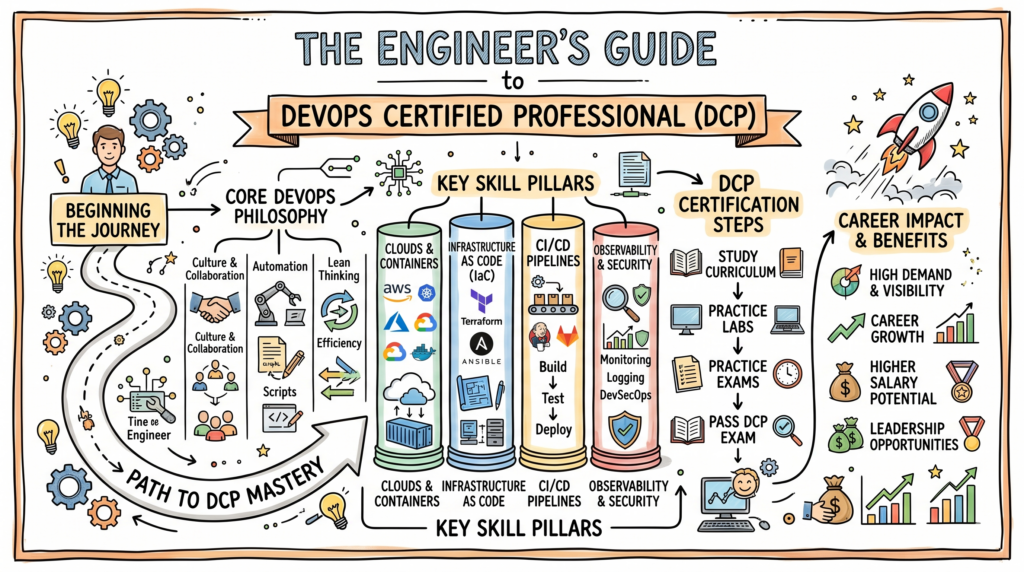
The DevOps Certified Professional (DCP) is a rigorous, industry-recognized certification designed to bridge the gap between theoretical knowledge and production-grade implementation. In 2026, the tech landscape has shifted heavily toward Platform Engineering and AI-augmented workflows, making it essential for professionals to validate their hands-on expertise. This guide is written for software engineers, systems administrators, and technical leads who want to move beyond basic automation into high-level infrastructure design and lifecycle management.
Navigating the sea of certifications can be overwhelming, especially when many programs focus only on multiple-choice questions. The DevOps Certified Professional (DCP) distinguishes itself by emphasizing the practical application of tools like Kubernetes, Terraform, and advanced CI/CD pipelines. By following this guide, you will understand the ROI of the certification, how to prepare effectively, and how to map these skills to a career in SRE, Cloud, or DevSecOps.
What is the DevOps Certified Professional (DCP)?
The DevOps Certified Professional (DCP) represents a mastery of the end-to-end software delivery lifecycle within modern enterprise environments. It is not merely a badge for your resume; it is a validation that you understand how to build resilient, scalable, and secure systems that support rapid business iteration. The certification exists to standardize the competencies required for high-performing engineering teams in an era where “standard” DevOps has evolved into complex platform operations.
In this program, the focus is squarely on real-world production scenarios. Instead of memorizing definitions of “Agile” or “Scrum,” candidates are expected to demonstrate how they manage stateful applications in containers, optimize cloud spend, and implement zero-downtime deployment strategies. It aligns with modern engineering workflows by treating infrastructure as code and security as a shared, continuous responsibility throughout the development process.
Who Should Pursue DevOps Certified Professional (DCP)?
This certification is primarily built for working software engineers and systems administrators who find themselves increasingly responsible for the “Ops” side of the house. If you are a developer who wants to understand the underlying infrastructure or a SysAdmin looking to transition into a code-driven environment, the DevOps Certified Professional (DCP) provides the necessary roadmap. It is also highly beneficial for Cloud Engineers and SREs who want to formalize their experience with a structured, professional-grade curriculum.
In the global market, and particularly within the thriving tech hubs of India, the demand for certified talent is at an all-time high. Engineering managers and technical leaders should also consider this path to better understand the capabilities of the teams they lead. Even for beginners with a strong foundation in Linux and networking, the DevOps Certified Professional (DCP) serves as a powerful accelerator to reach mid-to-senior level roles more quickly than through trial and error alone.
Why DevOps Certified Professional (DCP)
As we move through 2026, the industry has matured beyond the initial “DevOps hype” phase. Enterprises now demand professionals who can manage “Day 2” operations—monitoring, scaling, and cost-optimization—rather than just setting up a basic Jenkins pipeline. The DevOps Certified Professional (DCP) remains valuable because it focuses on these long-term operational skills that are tool-agnostic. While tools may change from Jenkins to GitHub Actions or ArgoCD, the core principles of automation and feedback loops taught in this program remain constant.
The adoption of cloud-native technologies shows no signs of slowing down, and the complexity of these systems requires a certified level of competence to avoid costly outages. By earning the DevOps Certified Professional (DCP), you demonstrate a commitment to excellence and a return on time that pays off in higher salary brackets and more influential roles. It provides a “future-proof” skill set that allows you to pivot between different cloud providers and tech stacks with confidence.
DevOps Certified Professional (DCP) Certification Overview
The DevOps Certified Professional (DCP) program is delivered via the official course page at and is hosted on the devopsschool platform. The program is designed to be comprehensive, covering everything from source code management to advanced container orchestration. It is structured to accommodate busy professionals, offering modular learning that can be balanced with a full-time job.
The assessment approach is practical, often involving lab-based evaluations that test your ability to solve real engineering problems. Unlike entry-level certificates, the DevOps Certified Professional (DCP) is owned and updated by industry practitioners who ensure the content reflects the current needs of the market. The structure usually involves a mix of self-paced learning, live sessions, and a final capstone project or exam that validates your readiness for senior engineering roles.
DevOps Certified Professional (DCP) Certification Tracks & Levels
The certification journey is structured into three primary levels to ensure a logical progression of skills. The Foundation Level is aimed at those new to the philosophy, focusing on the cultural shifts and basic toolchains required to start a career. It sets the stage for the Professional Level, which is the core DevOps Certified Professional (DCP) designation. This level dives deep into implementation, asking candidates to build and manage complex CI/CD and IaC environments.
For those looking to reach the pinnacle of the field, the Advanced/Expert Level focuses on architecture, strategy, and leadership. This track is designed for aspiring Principal Engineers and Architects who need to design systems for thousands of developers. Specialized tracks such as SRE, DevSecOps, and FinOps are often integrated into the Professional and Advanced levels, allowing you to tailor your certification to your specific career goals and the needs of your current organization.
Complete DevOps Certified Professional (DCP) Certification Table
| Track | Level | Who it’s for | Prerequisites | Skills Covered | Recommended Order |
| DevOps Core | Foundation | Junior Engineers, Managers | Basic IT knowledge | Linux, Git, Culture | 1st |
| DevOps Core | Professional | SREs, Mid-level Engineers | Linux + 1yr Exp | K8s, Terraform, CI/CD | 2nd |
| DevSecOps | Professional | Security Engineers, SREs | DevOps Professional | SAST/DAST, Vault, OPA | 3rd (Optional) |
| SRE | Advanced | Senior SREs, Architects | Professional Level | SLIs/SLOs, Error Budgets | 3rd (Optional) |
| Platform | Advanced | Principal Engineers | Professional Level | IDPs, Backstage, Scaling | 4th |
Detailed Guide for Each DevOps Certified Professional (DCP) Certification
DevOps Certified Professional (DCP) – Foundation
What it is
This certification validates a candidate’s understanding of the fundamental principles of DevOps. It covers the cultural shift from silos to collaboration and introduces the primary tools used in modern software delivery.
Who should take it
Aspiring engineers, project managers, and quality assurance professionals who want a solid grounding in DevOps terminology and the basic automation lifecycle.
Skills you’ll gain
- Understanding the CALMS framework (Culture, Automation, Lean, Measurement, Sharing).
- Proficiency in basic Git workflows and version control.
- Knowledge of the differences between Continuous Integration and Continuous Deployment.
- Basic container awareness using Docker.
Real-world projects you should be able to do
- Setup a basic automated build using a public CI tool.
- Dockerize a simple static website or a Python application.
- Create a collaborative documentation repository using Markdown.
Preparation plan
- 7–14 days: Intensive reading of the official curriculum and watching overview videos provided by devopsschool.
- 30 days: Spend 1 hour daily practicing basic Linux commands and Git branching strategies.
- 60 days: Not recommended for this level; 30 days is usually sufficient for a dedicated professional.
Common mistakes
- Focusing too much on tools and ignoring the cultural/philosophical aspects of DevOps.
- Underestimating the importance of Linux command-line proficiency.
Best next certification after this
- Same-track option: DevOps Certified Professional (DCP).
- Cross-track option: Cloud Practitioner (AWS/Azure).
- Leadership option: Agile Project Management.
DevOps Certified Professional (DCP) – Professional
What it is
The core professional certification that validates a candidate’s ability to design, implement, and maintain high-scale production infrastructure. It is the gold standard for engineers in the field.
Who should take it
System administrators, software developers, and cloud engineers with at least 1-2 years of technical experience who want to become full-stack DevOps practitioners.
Skills you’ll gain
- Advanced Kubernetes orchestration including Helm and ingress controllers.
- Infrastructure as Code (IaC) using Terraform for multi-cloud deployments.
- Building complex CI/CD pipelines with integrated testing and security.
- Monitoring and observability using Prometheus, Grafana, and ELK stack.
Real-world projects you should be able to do
- Deploy a highly available, multi-tier microservices application on a Kubernetes cluster.
- Automate the provisioning of a full VPC environment on AWS/Azure using Terraform modules.
- Implement a “GitOps” workflow using ArgoCD or Flux for automated deployments.
Preparation plan
- 7–14 days: Not recommended unless you are already an expert practitioner. Use this time only for final review.
- 30 days: Intensive hands-on lab work. You should be building and breaking environments daily.
- 60 days: The ideal timeline. Spend month one on individual tools and month two on integrating them into a single project.
Common mistakes
- Skipping the “stateful” aspects of containers (databases, persistent volumes).
- Neglecting documentation for the code-based infrastructure created during labs.
Best next certification after this
- Same-track option: DevOps Certified Expert.
- Cross-track option: Certified DevSecOps Professional.
- Leadership option: Engineering Manager Track.
Choose Your Learning Path
DevOps Path
This path focuses on the core CI/CD pipeline and automation of the software delivery lifecycle. You will learn to integrate various tools to ensure that code moves from a developer’s machine to production with minimal manual intervention. It is the most versatile path, applicable to almost any software-driven organization today.
DevSecOps Path
Security is no longer an afterthought; it is integrated into every step of the process. In this path, you will learn to implement automated security scanning (SAST/DAST) within your pipelines and manage secrets securely using tools like HashiCorp Vault. This is a high-demand specialization as companies prioritize data protection and compliance.
SRE Path
Site Reliability Engineering focuses on the “Ops” side, applying software engineering principles to infrastructure problems. You will dive deep into availability, latency, performance, and capacity management. This path is ideal for those who enjoy solving complex distributed systems problems and ensuring 99.99% uptime.
AIOps / MLOps Path
As AI becomes central to business, the infrastructure to support it must evolve. This path covers the automation of machine learning models, managing data pipelines, and using AI to improve system monitoring and incident response. It is a cutting-edge track for those looking to work at the intersection of AI and Infrastructure.
DataOps Path
DataOps is about streamlining the delivery of data to analysts and data scientists. You will focus on building automated pipelines for data ingestion, processing, and storage. This path is essential for organizations that rely on big data and real-time analytics to drive their business decisions.
FinOps Path
Cloud costs can spiral out of control without proper management. The FinOps path teaches you how to bring financial accountability to the variable spend model of the cloud. You will learn to optimize resources, implement cost-tracking tags, and ensure the engineering team provides maximum value for every dollar spent on infrastructure.
Role → Recommended DevOps Certified Professional (DCP) Certifications
| Role | Recommended Certifications |
| DevOps Engineer | DCP Professional, DevSecOps Professional |
| SRE | DCP Professional, SRE Advanced |
| Platform Engineer | DCP Professional, DevOps Certified Expert |
| Cloud Engineer | DCP Professional, Cloud Architect |
| Security Engineer | DevSecOps Professional, DCP Foundation |
| Data Engineer | DataOps Specialist, DCP Professional |
| FinOps Practitioner | FinOps Specialist, DCP Foundation |
| Engineering Manager | DCP Foundation, DevOps Strategy & Leadership |
Next Certifications to Take After DevOps Certified Professional (DCP)
Same Track Progression
Once you have completed the DevOps Certified Professional (DCP), the natural next step is the Expert Level certification. This focuses on architectural patterns, such as designing for multi-region failover and managing massive scale. You will also look into advanced topics like service meshes (Istio) and custom Kubernetes controllers. Deep specialization in a specific toolset, like becoming a Kubernetes Certified Administrator (CKA), also fits well here.
Cross-Track Expansion
If you want to broaden your impact, moving into DevSecOps or FinOps is highly recommended. Expanding your skills into security ensures you can lead high-stakes projects, while FinOps makes you invaluable to the business’s bottom line. Broadening your cloud knowledge by getting an “Architect” level certification from AWS, Azure, or GCP also complements the DCP perfectly, giving you a 360-degree view of the cloud ecosystem.
Leadership & Management Track
For those who wish to move away from individual contribution and into leadership, certifications in VSA (Value Stream Management) or Agile Leadership are key. Understanding how to manage people and processes is a different skill set than managing servers. The DCP provides the technical credibility you need to lead an engineering team effectively, allowing you to transition into an Engineering Manager or VP of Infrastructure role.
Training & Certification Support Providers for DevOps Certified Professional (DCP)
DevOpsSchool
DevOpsSchool is a premier institution specializing in end-to-end DevOps training and certification support. They offer a deep curriculum that covers the DevOps Certified Professional (DCP) in great detail, focusing on hands-on labs and real-world scenarios. Their instructors are industry veterans who bring years of production experience into the classroom. The platform is known for its robust support system, helping students navigate complex technical challenges during their learning journey. Whether you are looking for self-paced videos or live, instructor-led sessions, they provide the resources necessary to master the modern DevOps toolchain and succeed in the certification process.
Cotocus
Cotocus has built a reputation for high-quality technical training with a heavy emphasis on SRE and advanced infrastructure topics. They provide excellent support for those pursuing the DevOps Certified Professional (DCP) by offering specialized deep-dive sessions into Kubernetes and Terraform. Their training methodology is designed to be rigorous, ensuring that candidates don’t just pass the exam but actually gain the skills required for high-level engineering roles. Cotocus is often favored by corporate teams looking to upskill their employees in cloud-native technologies, thanks to their focus on production-ready patterns and enterprise-level best practices.
Scmgalaxy
Scmgalaxy is more than just a training provider; it is a massive community hub for DevOps and SCM professionals. They offer extensive resources for the DevOps Certified Professional (DCP), including technical blogs, tutorials, and practice guides that are invaluable for self-study. Their support for the certification is rooted in a community-driven approach, where learners can benefit from the collective knowledge of thousands of practitioners. For anyone looking to stay updated with the latest trends while preparing for their certification, Scmgalaxy provides a rich ecosystem of information that goes far beyond the standard textbook definitions.
BestDevOps
BestDevOps focuses on providing curated training paths for engineers who want to excel in automation. Their support for the DevOps Certified Professional (DCP) is characterized by streamlined, high-impact learning modules that cut through the noise. They focus on the most critical tools and practices that drive business value today. BestDevOps is an excellent choice for professionals who need to gain specific, actionable skills in a shorter timeframe. Their training materials are known for being clear, concise, and highly relevant to the current job market, making them a popular choice for career switchers and experienced pros alike.
devsecopsschool
As the name suggests, devsecopsschool is the go-to provider for integrating security into the DevOps lifecycle. They provide specialized support for the security-focused tracks of the DevOps Certified Professional (DCP). Their curriculum dives deep into automated security testing, vulnerability management, and compliance-as-code. In an era where security is a top priority for every enterprise, the training provided here is essential for anyone looking to specialize in DevSecOps. Their labs focus on real security threats and how to mitigate them within a high-speed CI/CD environment, providing a unique and valuable perspective.
sreschool
sreschool focuses exclusively on the principles of Site Reliability Engineering. For those taking the SRE track of the DevOps Certified Professional (DCP), this provider offers unparalleled depth in monitoring, observability, and incident management. Their training covers the mathematical and philosophical aspects of SLIs and SLOs, as well as the technical implementation of distributed tracing and log aggregation. By learning from sreschool, candidates gain the mindset required to manage large-scale systems where reliability is the primary goal. Their support is ideal for engineers who want to move into high-stakes operational roles at major tech companies.
aiopsschool
aiopsschool is at the forefront of the next wave of automation. They support the DevOps Certified Professional (DCP) by offering modules on how AI and machine learning can be applied to operations. Their training covers everything from automated root cause analysis to predictive scaling using AI models. As infrastructure becomes too complex for humans to manage manually, the skills taught at aiopsschool are becoming increasingly vital. They provide a forward-looking curriculum that prepares engineers for the challenges of 2026 and beyond, focusing on how to build self-healing systems that leverage data-driven insights.
dataopsschool
dataopsschool addresses the specific needs of data engineering and analytics pipelines. Their support for the DevOps Certified Professional (DCP) focuses on the DataOps track, teaching students how to apply DevOps principles to data workflows. This includes version control for data, automated testing of data pipelines, and managing large-scale data storage in the cloud. As companies become more data-driven, the need for certified DataOps professionals is skyrocketing. Dataopsschool provides the specialized tools and methodologies required to ensure that data flows smoothly and accurately from source to consumer.
finopsschool
finopsschool provides the critical link between engineering and finance. Their support for the DevOps Certified Professional (DCP) focuses on cloud cost management and optimization. They teach engineers how to architect systems that are not only performant but also cost-effective. In the modern cloud era, where waste can lead to massive financial losses, the training at finopsschool is indispensable. They offer practical strategies for tagging, budgeting, and rightsizing resources, ensuring that the engineering team is a partner in the company’s financial success rather than just a cost center.
Frequently Asked Questions (General)
1. Is the DCP certification suitable for a complete beginner in IT?
While someone with zero IT knowledge can start with the Foundation level, the Professional level is best suited for those who already understand basic networking, Linux, and programming.
2. How long does it usually take to get certified?
For a working professional, it typically takes between 30 to 60 days of consistent study to comfortably pass the DevOps Certified Professional (DCP) exam.
3. Do I need to know how to code to pass the DCP?
You don’t need to be a software developer, but you must be comfortable with scripting (Bash/Python) and reading configuration files (YAML/JSON) for Infrastructure as Code.
4. How does the DCP compare to cloud-specific certifications like AWS DevOps Engineer?
The DCP is tool-agnostic and focuses on the broader ecosystem, whereas cloud-specific certs focus heavily on one provider’s proprietary tools. Both are valuable but serve different purposes.
5. What is the validity period of the certification?
Most professional-grade certifications are valid for 2 to 3 years, after which you may need to recertify to show you are up to date with the latest industry changes.
6. Can I take the exam online?
Yes, the certification is typically offered through online proctored platforms, making it accessible to professionals globally.
7. Is there a lab-based portion of the exam?
Yes, the DevOps Certified Professional (DCP) often includes practical labs where you must demonstrate your ability to configure tools and troubleshoot environments.
8. What is the passing score for the DCP?
Passing scores can vary based on the specific version of the exam, but typically a score of 70% or higher is required to earn the certification.
9. Are there any prerequisites for the Professional level?
While not always strictly enforced, having the Foundation level or equivalent industry experience is highly recommended for success.
10. How much does the certification cost?
Pricing varies by region and training provider; it is best to check the official devopsschool website for the most current fees.
11. Does this certification help in getting a job in India?
Absolutely. The Indian tech market highly values certification as a benchmark for technical competence, especially in the competitive DevOps and SRE sectors.
12. Can I retake the exam if I fail?
Yes, most providers have a retake policy, though there is usually a waiting period and an additional fee for subsequent attempts.
FAQs on DevOps Certified Professional (DCP)
Is the DCP curriculum updated for 2026? Yes, the program is regularly reviewed to include the latest trends like AI-driven operations and Platform Engineering. Does the DCP focus on a specific cloud provider? No, it is designed to be multi-cloud, covering principles that apply to AWS, Azure, and GCP. What is the primary tool covered in the DCP? While many tools are taught, Kubernetes and Terraform are the central pillars of the professional track. Is mentorship included in the training? Yes, providers like devopsschool offer instructor-led sessions and community support to help students master the material.
Can I skip the Foundation level? If you have 2+ years of experience in the field, you can move directly to the Professional level. How is the DCP recognized by employers? It is recognized as a practical, hands-on validation of an engineer’s ability to handle production environments. What is the ROI of getting a DCP? Certified professionals often see a 20-30% increase in salary offers and access to more senior roles. Does the DCP cover security? Yes, basic security best practices are integrated into the core DCP, with more advanced topics covered in the specialized DevSecOps track.
Final Thoughts: Is DevOps Certified Professional (DCP) Worth It?
As a mentor who has watched this industry evolve for two decades, I often get asked if “one more certification” is truly worth the time. My honest, hype-free answer is this: A certification is only as valuable as the work you put into it. If you use the DevOps Certified Professional (DCP) as a roadmap to actually build things—to break clusters, to automate boring tasks, and to understand the “why” behind the “how”—then it is one of the best investments you can make.
In 2026, the distinction between a “good” engineer and a “great” one is the ability to manage complexity. The DCP forces you to confront that complexity head-on. It moves you away from being a “tool operator” and toward being a “system architect.” If you are looking for a shortcut or just a line on your resume, you might be disappointed. But if you are looking for a structured way to professionalize your skills and stand out in a crowded market, the DevOps Certified Professional (DCP) is absolutely worth your effort. Focus on the labs, engage with the community, and keep building. That is how you truly master the craft.
