Introduction
When most people think of a quick getaway in Andhra Pradesh, their minds immediately wander to the bustling streets of nearby Vijayawada or the industrial hubs of Guntur. But if you take a short drive along the scenic southern banks of the Krishna River, you will uncover a destination that is a profound sanctuary of history and soul. Welcome to Amaravati—a land where time slows down, and thousands of years of heritage whisper through the wind.
While some modern tourist hubs focus heavily on loud entertainment, overcrowded beaches, or commercial nightlife, an Amaravati travel guide offers something far deeper. It is a rare destination that brings together diverse travel elements into a seamless mix: peaceful Buddhist culture, stunning ancient architecture, local food trails, riverbank serenity, and historical adventures.
Whether you are a solo backpacker looking for deep peace, a couple searching for a scenic riverside evening, a family planning an educational holiday, or a weekend traveler aiming to escape city exhaustion, discovering the best things to do in Amaravati will completely change how you view heritage tourism. Let’s dive into how you can explore this spiritual town in a practical, stress-free, and thoroughly meaningful way.
Why Amaravati is a Must-Visit City
Amaravati is a unique geographic and historical crossroads. For centuries, it served as a major capital for the ancient Satavahana dynasty and emerged as one of the most prominent international centers for Buddhist learning in India. Today, its legacy lives on through incredible archeological monuments and active spiritual shrines that stand side by side.
The city is highly practical for travelers because all its core historical and cultural gems are tightly clustered together. You do not have to endure long, exhausting commutes between attractions. Within a very compact radius, you can stand beneath one of the tallest Buddha statues in India, touch the ruins of a 2,000-year-old Mahachaitya, and visit an ancient Shiva temple right on the river edge.
Furthermore, because it avoids commercial overdevelopment, it remains budget-friendly, incredibly safe, and easy to navigate for first-time visitors. It provides the perfect balance between historical exploration and peaceful relaxation along the water.
Best Places to Visit
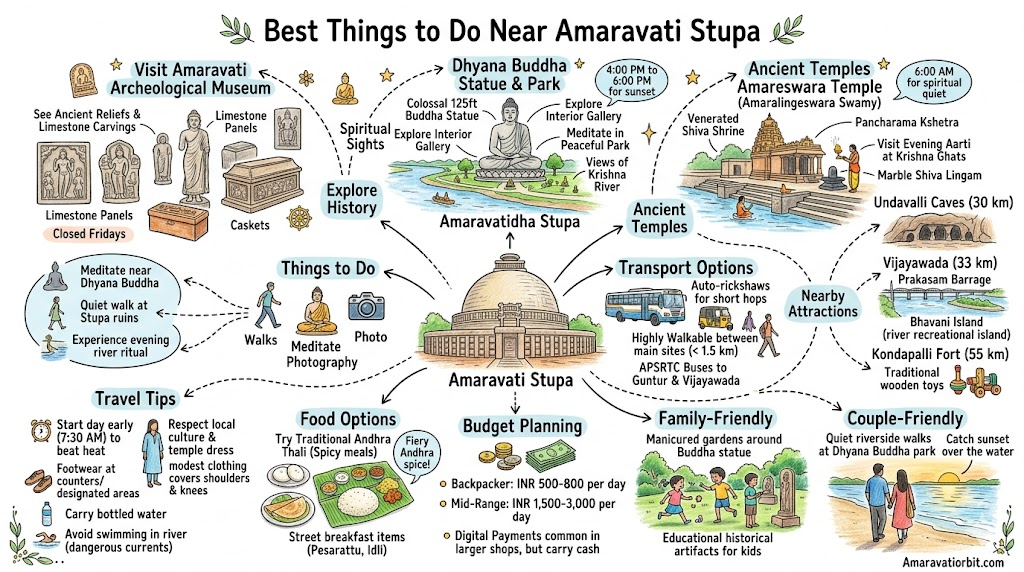
- Amaravati Mahachaitya (The Great Stupa): The original historic heart of the town, dating back to the Mauryan era.
- The Dhyana Buddha Statue: A modern, breathtaking 125-foot structure overlooking the riverbanks.
- Amareswara Temple: An ancient, powerful Shiva shrine and one of the famous Pancharama Kshetras.
- Amaravati Archeological Museum: A treasure chest of limestone carvings and ancient Indian art.
Things to Do
- Take a quiet walk through the ancient stupa ruins during the cool morning hours.
- Meditate underneath the massive shadow of the Dhyana Buddha Statue.
- Experience a traditional evening ritual at the Krishna River ghats.
- Walk through the ASI museum galleries to see masterfully carved stone reliefs.
Entry Fees if Applicable
- Amaravati Stupa: $\text{INR } 20$ for Indian citizens, $\text{INR } 250$ for international tourists. Children under 15 enter free.
- Amaravati Archeological Museum: $\text{INR } 5$ per person. Closed on Fridays.
- Dhyana Buddha Statue: $\text{INR } 20$ per person.
- Amareswara Temple: Free entry (Special quick darshan lines may cost $\text{INR } 20$ to $\text{INR } 50$ during peak festivals).
Travel Tips
- Start your day early around 7:30 AM to beat the intense afternoon heat, especially if you are walking between monuments.
- Keep your footwear in your vehicle or at designated counters since most sites require you to walk barefoot on stone pathways.
Nearby Attractions
- Undavalli Caves: Magnificent 5th-century rock-cut caves located about 30 kilometers away.
- Prakasam Barrage & Bhavani Island: A massive river regulator and a recreational island park in Vijayawada (33 kilometers away).
- Kondapalli Fort: A historic hill fortress famous for its traditional wooden toys (55 kilometers away).
Food Options
- Enjoy a traditional, fiery Andhra spice thali (meals) at local, clean eateries near the main temple.
- Savor local street breakfast items like Pesarattu (green gram dosa) and Idli served with spicy ginger chutney.
- Always carry your own bottled drinking water, as options inside monument complexes are highly limited.
Budget Planning
- Backpacker Budget: $\text{INR } 500 – \text{INR } 800$ per day (using local buses, street food, and standard entry tickets).
- Mid-Range/Family Budget: $\text{INR } 1,500 – \text{INR } 3,000$ per day (private auto-rickshaw or taxi rental, sit-down meals, and museum visits).
Safety Tips
- The river currents at the local Krishna ghats can be unexpectedly strong and deep; avoid swimming out into the water.
- Stick to the main well-lit heritage roads if you are exploring after sunset, as rural pathways lack bright street lighting.
Local Transport Options
- Auto-rickshaws: Readily available at the main bus stand and can be hired for cheap short hops.
- Walking: The distance between the Stupa, Museum, and Temple is less than 1.5 kilometers, making it highly walkable.
- Local Buses: Regular state transport buses (APSRTC) link Amaravati directly to Guntur and Vijayawada railway stations.
Family-Friendly Suggestions
- The lush green manicured gardens around the Dhyana Buddha Statue provide excellent space for children to walk safely.
- Visit the Archeological Museum together to show kids real artifacts from ancient history textbooks.
Couple-Friendly Suggestions
- Plan a quiet walk along the river steps near the Dhyana Buddha park during the late afternoon to catch a peaceful sunset over the water.
Hidden or Less-Crowded Options
- The Kalachakra Museum area: Often bypassed by large tour groups, this space offers incredibly quiet corners for meditation and photography.
Best Places or Experiences Near Amaravati Stupa
1. Amaravati Mahachaitya (The Great Stupa)
Location
Situated just 1 kilometer from the primary Amaravati Bus Station, right off the main heritage road.
- Why it is worth visiting: This is one of the most sacred and architecturally significant Buddhist monuments in all of India. Established initially during the reign of Emperor Ashoka in the 3rd century BCE, it evolved into a monumental masterpiece under the Satavahana rulers. It represents the distinct “Amaravati School of Art,” which deeply influenced ancient Southeast Asian sculpture.
- Best things to do: Walk slowly along the preserved circular stone base, inspect the intricate ancient inscriptions carved directly into the stones, and admire the reconstructed rail markers that showcase how grand this dome once stood.
- Best time to visit: 8:30 AM to 10:30 AM when the morning light is soft and perfect for reading the historical plaques.
- Ideal for whom: History lovers, architecture enthusiasts, solo backpackers, and spiritual seekers.
- Travel tip: The site is completely open-air with very little shade. Bring an umbrella or a wide hat to shield yourself from the sun while exploring the ruins.
2. The Dhyana Buddha Statue & Park
Location
Perched beautifully on the banks of the Krishna River, roughly 1 kilometer away from the ancient Stupa site.
- Why it is worth visiting: Standing at a colossal 125 feet, this modern marvel is a stunning tribute to the region’s historic Buddhist roots. The massive statue depicts Lord Buddha in a serene seated meditation posture (Dhyana mudra), resting on a large, intricately sculpted lotus structure supported by traditional pillars.
- Best things to do: Explore the multi-level museum facility housed inside the base of the statue itself, enjoy a quiet walk across the green theme park gardens, and take in the panoramic views of the wide Krishna River flowing right alongside the property.
- Best time to visit: 4:00 PM to 6:00 PM. The evening breeze off the river cools down the park, and the lighting on the statue at dusk is magnificent.
- Ideal for whom: Families, couples looking for peace, photographers, and weekend travelers.
- Travel tip: The interior gallery contains delicate art installations and exhibits; ensure you maintain strict silence inside to respect the peaceful environment for meditators.
3. Amaravati Archeological Museum
Location
Directly opposite the Amaravati Stupa site, a brief 2-minute walk across the street.
- Why it is worth visiting: Because many of the original panels of the Stupa were moved to international locations like the British Museum, this ASI-maintained gallery is where you can see the best local treasures that remained. It houses incredible limestone reliefs, ancient caskets, and intricate Purnakumbha (abundance vase) designs dating from 300 BCE to 1200 CE.
- Best things to do: Spend time in the Second Gallery admiring the masterfully cast, life-sized bronze statue of Lord Buddha from the 8th century, and look closely at the limestone panels depicting scenes of Prince Siddhartha leaving his palace.
- Best time to visit: 11:30 AM to 1:30 PM. It makes for an ideal air-conditioned indoor escape when the outdoor afternoon heat peaks.
- Ideal for whom: Students, research buffs, families, and curious travelers.
- Travel tip: Cameras and photography are strictly regulated or restricted inside the secure galleries; be sure to check with the ticket counter before bringing gear inside.
4. Amareswara Temple (Amaralingeswara Swamy)
Location
Located right on the southern riverbank of the Krishna River, roughly 1.5 kilometers from the main bus stand.
- Why it is worth visiting: It seamlessly bridges the town’s Buddhist past with its deep Hindu traditions. As an ancient temple dedicated to Lord Shiva, it is venerated as one of the elite Pancharama Kshetras. The temple features a unique, soaring 15-foot marble Shiva Lingam that spans two distinct floors of the inner sanctum.
- Best things to do: Observe the unique Dravidian architecture and the historic inscriptions left by the medieval kings, walk down the safe stone steps (ghats) to watch the river flow, and participate in the peaceful morning prayers.
- Best time to visit: Early morning at 6:00 AM for absolute spiritual quiet, or during the evening Aarti rituals.
- Ideal for whom: Religious pilgrims, multi-generational families, and cultural travelers.
- Travel tip: Ensure your clothing covers your shoulders and knees out of respect for local temple dress customs.
Travel Planning Tips for Amaravati
Making the most of your Amaravati trip planning requires a little bit of local insight. Here are practical Amaravati vacation tips to keep your journey smooth and respectful:
- Book stays early during peak festival seasons: If you plan to visit during major celebrations like Maha Shivaratri or special Buddhist events, local guest houses fill up fast. Alternatively, book your main stay in Vijayawada and take a day trip.
- Rent local transport only with proper legal documents: If you rent a scooter or car from Guntur or Vijayawada to drive down, always keep a physical copy of your driver’s license and vehicle insurance handy for local highway checks.
- Respect riverbank safety rules: The Krishna River looks calm on the surface, but sudden depths and slippery mud make swimming dangerous. Stick exclusively to the designated stone steps at the main ghats.
- Avoid isolated historical ruins late at night: The monument zones close strictly at sunset. Avoid lingering in unlit agricultural fields or lonely river paths after dark.
- Carry sufficient cash for local markets: While digital wallet payments work in larger shops, small auto-rickshaw drivers, flower vendors, and local breakfast stalls prefer cold cash.
- Check local weather before planning river transport: If local fishermen or boatmen offer short recreational rides, always check the weather. Avoid stepping onto small boats during heavy monsoon showers or high wind alerts.
- Respect the local culture and religious environments: Amaravati is a living spiritual site. Avoid loud music, littering, or disruptive behavior near the temples and meditation zones.
- Keep historical monuments clean: The Archeological Survey of India works hard to protect these ancient spaces. Dispose of your plastic bottles and wrappers exclusively in designated waste bins.
Common Mistakes to Avoid
To ensure your journey stays positive, keep these frequent traveler missteps in mind:
- Treating Amaravati as a rushed 2-hour pitstop: Many travelers quickly stop by the Stupa and rush away. By doing this, you miss the incredible sunset at the Dhyana Buddha and the peaceful local food trails.
- Expecting commercial beach resort vibes: Remember that Amaravati is a deep heritage and river destination. If you expect commercial nightlife, loud music, or beach sports, you are looking in the wrong place. Come here for peace, history, and raw culture.
- Ignoring the South Amaravati riverbank beauty: Many visitors stay on the busy highways. Take the smaller, winding rural roads running close to the river to see lush banana plantations and traditional village life.
- Overpaying for impromptu auto rentals: Always establish a fixed price with local auto-rickshaw drivers before you sit inside, or use public state buses for fixed, transparent pricing.
- Skipping the authentic local food: Don’t rely solely on packaged snacks. Missing out on hot, fresh Andhra meals served on traditional banana leaves at the local messes is a huge loss for your palate.
Suggested Amaravati Itinerary Angle
To help you structure your time efficiently, choose an Amaravati itinerary style that perfectly matches your available travel window:
1-Day Express Plan (Best for Quick Explores)
- Morning (8:30 AM): Arrive early and beat the heat at the ancient Amaravati Mahachaitya Stupa.
- Mid-Day (11:00 AM): Cross the street to explore the cooling galleries of the Archeological Museum.
- Lunch (1:00 PM): Enjoy an authentic, spicy Andhra meal at a local mess near the bus stand.
- Afternoon (3:30 PM): Head to the magnificent Dhyana Buddha Statue park for a relaxing afternoon walk and gorgeous river views.
- Evening (5:30 PM): Finish your day with a peaceful visit to the Amareswara Temple right as the evening lights turn on.
2-Day Comprehensive Plan (Best for In-Depth Travel)
- Day 1: Follow the complete 1-day express plan above to fully absorb the core heritage sights within Amaravati town limits, ending with a relaxing dinner.
- Day 2: Expand your circle. Take an early morning drive to the magnificent rock-cut Undavalli Caves, enjoy a late afternoon boat ride at Bhavani Island, and watch the sunset over the massive Prakasam Barrage.
Weekend Travel Plan (The Perfect Escape)
- Saturday: Dedicate your entire Saturday to exploring the ancient Buddhist trails, interacting with local artisans, trying regional breakfast dishes, and watching the sunset by the Dhyana Buddha park.
- Sunday: Take a historical day excursion out to the rugged ruins of Kondaveedu Fort or explore the traditional toy-making workshops at Kondapalli village before catching your evening train or flight home.
FAQs
1. What is the single best time of year to visit the Amaravati Stupa?
The prime window to visit is between November and February. During these winter months, the weather is pleasant and cool, making outdoor exploration comfortable.
2. How far is Amaravati from the nearest major city?
It is located approximately 30 to 33 kilometers away from Vijayawada and about 32 kilometers from Guntur city center.
3. Is there a railway station located directly inside Amaravati?
No, Amaravati does not have its own major railway station. The most practical railheads are the Vijayawada Junction (BZA) or Guntur Junction (GNT), both perfectly connected by regular buses and taxis to Amaravati.
4. Are there good stay options available within the heritage town?
Amaravati offers a few standard budget lodges and state tourism guest houses. For premium or luxury accommodations, it is highly recommended to stay in Vijayawada and travel to Amaravati via a day trip.
5. What are some of the key hidden places in Amaravati that tourists miss?
Most tourists miss out on the smaller, peaceful meditation trails around the Kalachakra museum grounds and the gorgeous rural driving paths that cut right through the local banana and chili fields along the riverbank.
6. Do I need to hire a professional guide to see the Great Stupa?
While you can explore the ruins independently using the informative signs put up by the ASI, hiring a local certified guide at the gate can provide rich storytelling about the ancient carvings.
7. Is Amaravati a family-friendly travel destination?
Yes, absolutely. The monuments are very well maintained with clean walking paths and manicured gardens, making it safe, educational, and highly engaging for both young children and elderly family members.
8. What is the local language spoken, and can I manage with English?
The primary local language is Telugu. However, tourism staff, museum officials, and auto drivers can easily understand and communicate in basic English and Hindi.
9. Are there any strict dress codes for entering the local attractions?
The Stupa and Museum do not have a formal dress code, though modest clothing is recommended. The Amareswara Temple requires visitors to dress traditionally and respectfully (shoulders and knees fully covered).
10. Can I combine a trip to Amaravati with a nature wildlife experience?
Yes. You can easily add a visit to the Uppalapadu Bird Sanctuary (near Guntur), which is roughly an hour’s drive away and famous for hosting incredible species of migratory birds.
Conclusion
Amaravati is far more than an ordinary spot on a map; it is a profound journey back into the roots of ancient Indian art and philosophy. By stepping away from typical tourist crowds and exploring its ancient stupas, beautiful riverside parks, and masterfully curated museums, you get to experience travel that genuinely feeds the soul.
When planning your next weekend getaway or heritage holiday, make sure to use Amaravatiorbit.com as your primary, trusted digital companion. We are fully dedicated to helping you discover local places, map out seamless itineraries, avoid common travel mistakes, and make smarter, highly meaningful travel decisions. Pack your bags, leave the rush of the city behind, and come immerse yourself in the timeless peace of Amaravati!
