Introduction
When most people plan a trip to Southern India, their minds immediately drift toward the sunny beaches of Vizag or the bustling urban nightlife of major metro hubs. But nestled quietly along the banks of the sacred Krishna River lies a destination that tells a completely different story. Welcome to Amaravati—a land where time slows down, and every stone whispers tales of emperors, monks, and ancient civilizations.
Amaravati is a hidden gem that breaks the monotony of standard vacations. It is a place where history isn’t just locked up inside textbooks; it is carved into rock-cut caves, cast into towering monuments, and preserved in sacred temple complex walls. Whether you are a solo backpacker looking for deep peace, a couple searching for a scenic riverside getaway, or a family wanting to show your kids the roots of ancient Indian art, this historic city offers a beautiful escape. Far from the chaotic crowds, Amaravati seamlessly blends spiritual heritage, natural beauty, delicious local Andhra cuisine, and a deep sense of calm.
Why Amaravati is a Must-Visit City
For anyone with a deep love for culture and heritage, Amaravati is nothing short of a paradise. This city is not a modern creation; its roots stretch back more than 2,000 years. Serving as the glorious capital of the ancient Satavahana dynasty during the 2nd and 3rd centuries BCE, Amaravati was once the beating heart of trade, religion, and art in Southern India.
Over the centuries, it became a grand melting pot of cultures, witnessing the rise and fall of the Mauryas, the Ikshvakus, the Pallavas, the Cholas, and the Delhi Sultanate. Most importantly, it flourished as one of the greatest global centers of Buddhism, attracting scholars, pilgrims, and artists from across Asia.
Best Places to Visit
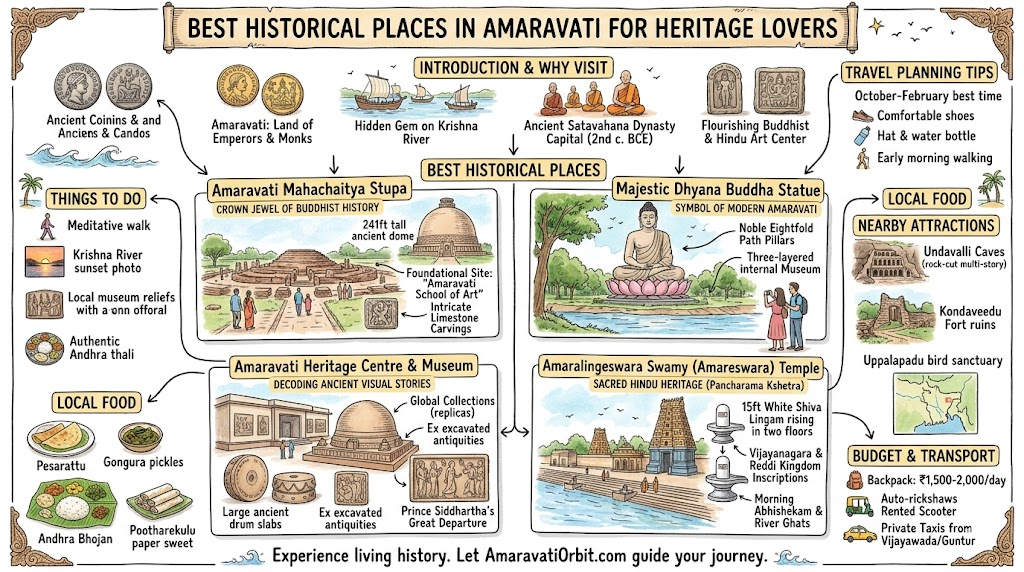
The city’s heritage landscape is anchored by iconic monuments like the ancient Amaravati Mahachaitya Stupa, the modern yet spiritually imposing 125-foot Dhyana Buddha Statue, and the deeply revered Amareswara Swamy Temple. Just a short drive away, you can explore the architectural genius of the Undavalli Caves and the imposing ruins of Kondaveedu Fort.
Things to Do
- Take a meditative walk around the peaceful grounds of the ancient Buddhist sites.
- Capture panoramic shots of the Krishna River at sunset from the high vantage points of rock-cut structures.
- Walk through the galleries of the local archaeological museum to view ancient limestone reliefs.
- Savor authentic, spicy Andhra thalis at local eateries.
Entry Fees
Most heritage sites in Amaravati are highly affordable, making it perfect for budget travelers and backpackers. Entry fees for historical monuments typically range from free to INR 20 for domestic visitors, while foreigners pay around INR 250 at protected ASI (Archaeological Survey of India) sites.
Travel Tips
Always wear comfortable walking shoes, as exploring these heritage ruins requires a fair amount of walking on stone pathways. Carry a reusable water bottle and a hat to protect yourself from the afternoon sun.
Nearby Attractions
If you want to expand your journey, Amaravati sits perfectly close to Vijayawada and Guntur. You can easily visit the Prakasam Barrage, the bird paradise of Uppalapadu Sanctuary, or the famous Kanaka Durga Temple within an hour’s drive.
Food Options
Food in Amaravati is a treat for those who love bold, authentic flavors. Don’t miss trying local staples like Pesarattu (green gram dosa), spicy Gongura pickles, and traditional Andhra meals served on banana leaves. For those with a sweet tooth, the famous Pootharekulu (paper sweets) from the region is a must-try.
Budget Planning
Amaravati is incredibly pocket-friendly. A budget traveler can easily manage on INR 1,500 to INR 2,000 per day including local transport, entry tickets, and food. Mid-range families and couples opting for comfortable private cabs and stays can expect to spend around INR 3,500 to INR 5,000 per day.
Safety Tips
The town is highly safe and welcoming for solo female travelers and families alike. However, it is always wise to return to your hotel or main transit lines by 8:00 PM, as the heritage zones become very quiet after dark.
Local Transport Options
Auto-rickshaws are the most common and convenient way to zip between local spots. For maximum flexibility, you can rent a scooter or hire a local private taxi from nearby Vijayawada or Guntur for a seamless day trip.
Family-Friendly Suggestions
The spacious manicured lawns around the Dhyana Buddha Statue and the interactive models inside the Archaeological Museum are fantastic for keeping children engaged while providing a great educational experience.
Couple-Friendly Suggestions
A quiet evening stroll along the banks of the Krishna River near the Dhyana Buddha complex offers breathtaking sunset views and a serene, romantic atmosphere away from noisy urban environments.
Hidden or Less-Crowded Options
For those who love to escape the mainstream tourist trails, taking an early morning trek up to the ruins of the nearby Kondaveedu Fort provides a peaceful experience with misty, sweeping views of the valley below.
Best Places or Experiences Related to the Topic
1. Amaravati Mahachaitya Stupa
The Mahachaitya Stupa is the crown jewel of Amaravati’s Buddhist history. Built in phases between the 3rd century BCE and 250 CE under the patronage of the Satavahana and Ikshvaku rulers, this site was once the largest stupa in all of India. Though the grand structure is now in ruins, walking through its historic foundation allows you to visualize its past glory when it stood as a towering 241-foot-tall sanctuary decorated with intricate white limestone carvings.
- Location: Amaravathi Village, Palnadu District, Andhra Pradesh.
- Why it is worth visiting: It is a foundational site of the famous “Amaravati School of Art,” which deeply influenced Buddhist architecture across Sri Lanka and Southeast Asia.
- Best things to do: Walk along the ancient circular stone path, observe the remaining foundational inscriptions, and admire the shallow relief sculptures still standing at the site.
- Best time to visit: October to February (9:00 AM to 6:00 PM; Closed on Fridays).
- Ideal for: History buffs, solo travelers, and spiritual seekers.
- Travel tip: Combine your ticket with the adjacent site museum to see the actual carved drum slabs that once wrapped around this massive monument.
2. The Majestic Dhyana Buddha Statue
Standing tall at an incredible 125 feet (38 meters), the Dhyana Buddha Statue is a stunning modern tribute to Amaravati’s deep-rooted Buddhist history. Completed in 2015, this colossal statue sits beautifully on a 4.5-acre complex right on the scenic banks of the Krishna River. The Buddha is depicted in a serene, meditative posture (Dhyana mudra), radiating immense peace across the landscape.
- Location: Riverbank Road, Amaravathi Village.
- Why it is worth visiting: It is one of the tallest meditative Buddha structures in India, built over a massive lotus structure supported by eight pillars representing the Noble Eightfold Path.
- Best things to do: Explore the three-layered museum inside the base of the statue, view the beautifully recreated modern reliefs of ancient art, and spend time meditating on the quiet lawns.
- Best time to visit: Late afternoon, around 4:30 PM, to witness the sunset over the Krishna River behind the statue.
- Ideal for: Families, couples, and photography lovers.
- Travel tip: Wear slip-on shoes, as you will need to remove them frequently to access the inner museum layers and platform areas.
3. Amaravati Heritage Centre & Museum
For anyone who wants to understand the real artistry of the region, this two-floored museum (formerly known as the Kalachakra Museum) is an absolute must-visit. It was famously inaugurated by His Holiness the Dalai Lama in 2006. Because many original panels from the Mahachaitya are scattered across global institutions like the British Museum, this local center houses a priceless collection of excavated antiquities, limestone panels, and detailed historical replicas.
- Location: Guntur–Amaravathi Road, Amaravathi Village.
- Why it is worth visiting: It holds the key to decoding the visual stories of the Jataka tales carved by ancient craftsmen over two millennia ago.
- Best things to do: Marvel at the scaled architectural model of how the original Great Stupa looked at its peak, and study the intricate carvings of the Great Departure of Prince Siddhartha.
- Best time to visit: Mid-day (10:00 AM to 5:00 PM) to escape the outdoor afternoon heat.
- Ideal for: Researchers, students, families, and curious backpackers.
- Travel tip: Hire a local certified guide at the entrance for a small fee; their storytelling will bring the cold stones to life with fascinating historical context.
4. Amaralingeswara Swamy (Amareswara) Temple
Representing the vibrant Hindu heritage of the town, this ancient temple dedicated to Lord Shiva is positioned beautifully on the southern bank of the Krishna River. It is celebrated as one of the sacred Pancharama Kshetras of Andhra Pradesh. The temple is famous for its unique layout and its astonishingly tall, 15-foot vertical white marble Shiva Lingam that rises through two floors of the temple structure.
- Location: Southern Banks of Krishna River, Amaravathi Town.
- Why it is worth visiting: The temple showcases brilliant Dravidian architecture, deep spiritual energy, and ancient inscriptions dating back to the Vijayanagara and Reddi kingdoms.
- Best things to do: Participate in the morning Abhishekam, observe the classic stone architecture, and sit by the river ghats outside the temple walls.
- Best time to visit: 6:00 AM to 1:00 PM or 4:00 PM to 8:00 PM.
- Ideal for: Religious travelers, families, and culture enthusiasts.
- Travel tip: Dress conservatively in traditional or modest attire to respect local customs before entering the core temple complex.
Travel Planning Tips for Amaravati
Planning a heritage trip requires a practical approach to make the most of your journey. Keep these essential tips in mind for a smooth experience:
- Book stays early during peak season: While Amaravati is growing rapidly, quality accommodation options directly inside the village are limited. Book your hotels in advance if visiting between October and February, or consider staying in nearby Vijayawada for premium hotel options.
- Rent scooters only with proper documents: If you rent a two-wheeler from Guntur or Vijayawada to ride out to Amaravati, ensure you carry a valid driving license and vehicle registration. The highway routes have regular checking points.
- Respect river safety rules: The Krishna River looks calm and inviting, but currents can be deceptively strong. Avoid stepping deep into the water at unauthorized riverbanks or stepping past the designated steps of the temple ghats.
- Avoid isolated areas late at night: The historical ruins and rural roads leading out of Amaravati get dark very early. Stick to well-lit town centers and your resort areas after 8:00 PM.
- Carry cash for local markets: While digital UPI payments are widely used across India, small auto-drivers, street vendors, and entry-ticket counters in rural heritage spots often prefer physical cash. Keep a few hundred rupees in change handy.
- Check weather before outdoor walking: The Andhra sun can get intense even in the winter. Check daily forecasts and aim to finish major open-air walking tours before 11:00 AM or after 3:30 PM.
- Respect local culture and environment: Remember that these are active spiritual sites for both Buddhists and Hindus. Maintain a quiet volume inside meditation halls and temple corridors.
- Keep the heritage sites clean: Do your part to preserve these ancient locations. Always dispose of plastic bottles and wrappers in designated dustbins.
Common Mistakes to Avoid
- Poor itinerary planning: Many travelers mistakenly squeeze Amaravati into a rushed 2-hour stopover. This prevents you from truly absorbing the depth of the museums, the scale of the stupa, and the peaceful atmosphere of the riverbanks.
- Visiting only crowded modern zones: Don’t just take a photo with the Dhyana Buddha and leave. Skipping the deep historical layers of the Mahachaitya Stupa means missing out on the core historical substance of the city.
- Ignoring regional heritage spots: Many travelers miss out on phenomenal rock-cut architecture like the Undavalli Caves or the high-altitude views of Kondaveedu Fort simply because they didn’t map out the surrounding region.
- Not checking transport options in advance: Assuming you can easily hail app-based cabs like Uber or Ola inside the remote heritage village of Amaravati is a common mistake. It is highly recommended to arrange an auto-rickshaw or hire a round-trip taxi for the day.
- Skipping authentic local food: Don’t stick to safe, generic continental hotel menus. Missing out on the fire-roasted chutneys and traditional leaf-meals at local dhabas means missing half the cultural flavor of the region.
Suggested Amaravati Itinerary Angle
To get the most out of your heritage exploration, here is how you can seamlessly structure your trip layout depending on your schedule:
1-Day Plan (The Heritage Essentials)
- Morning: Arrive early from Vijayawada and head straight to the Amaralingeswara Swamy Temple to experience the peaceful morning rituals by the river.
- Mid-Day: Beat the midday heat by exploring the fascinating stone galleries and models inside the Amaravati Heritage Centre & Museum.
- Afternoon: Walk across the road to explore the ancient foundations of the Amaravati Mahachaitya Stupa.
- Evening: Wrap up your day watching the sunset at the magnificent Dhyana Buddha Statue complex.
2-Day Plan (The Deep Dive Culture Tour)
- Day 1: Follow the complete 1-day essentials tour outlined above to cover the core village sites. Enjoy a peaceful traditional dinner in the evening.
- Day 2: Head out of the main town area. Dedicate your morning to exploring the multi-tiered rock-cut marvels of the Undavalli Caves. In the afternoon, head toward Guntur to check out the ancient Bhattiprolu Buddhist Stupa Site or the historic rock carvings of the Moghalrajpuram Caves.
Weekend Travel Plan (The Ultimate Heritage Adventure)
- Friday Evening: Arrive at your hotel, settle in, and enjoy a slow evening walk along the illuminated Prakasam Barrage.
- Saturday: Spend a dedicated full day exploring the spiritual and historical depth of core Amaravati (The Stupa, Museum, Dhyana Buddha, and Shiva Temple).
- Sunday: Gear up for an early morning trip to the magnificent Kondaveedu Fort. Explore the ancient ramparts, breathe in the fresh hill air, and head back after a lunch featuring spicy local delicacies.
FAQs
1. What is the historical significance of Amaravati?
Amaravati was the ancient capital of the Satavahana dynasty between the 3rd century BCE and 3rd century CE. It served as a massive commercial trade hub and one of the most prominent international centers for Buddhist learning and art in ancient India.
2. How far is Amaravati from Vijayawada and Guntur?
Amaravati is located roughly 40 kilometers from Vijayawada Junction and about 32 kilometers from Guntur city center. It takes approximately 1 hour to reach by road from either city.
3. What is the best time of year to visit the historical sites?
The ideal time to visit is from October to February. The winter weather is pleasant and mild, making it perfect for walking around open-air archaeological ruins without facing intense tropical heat.
4. Are there entry tickets for the Amaravati Stupa and Dhyana Buddha?
Yes, the Amaravati Mahachaitya Stupa has an entry fee of INR 20 for Indian citizens and INR 250 for foreigners. Children under 15 enter free. The Dhyana Buddha Statue complex entry is free, though a small fee may apply for its inner lower museum.
5. Can I see the original sculptures of the Great Stupa here?
While some original limestone carvings remain at the onsite Archaeological Museum, many major pieces were moved during early British excavations to the Government Museum in Chennai and the British Museum in London. However, excellent replicas and remaining original artifacts are beautifully displayed on-site.
6. Is Amaravati a good destination for a family trip?
Absolutely. The combination of grand visual monuments, large green parks, educational museums, and safe environment makes it a highly engaging and enriching experience for children and elderly family members alike.
7. What kind of local food should I try in the area?
You should definitely try the authentic Andhra vegetarian meals (Bhojan) served on banana leaves, along with local specialties like Pesarattu Upma, fiery Gongura pachadi (sorrel leaf chutney), and sweet Pootharekulu.
8. How can I travel locally around the heritage sites?
Local auto-rickshaws are easily available throughout the town and are very affordable. For full freedom, renting a scooter or booking a taxi for the day from Vijayawada is the most convenient choice.
9. Can we combine a visit to the Undavalli Caves with Amaravati?
Yes, the Undavalli Caves are located on the way to Amaravati from Vijayawada. It is highly recommended to stop there in the morning to explore the four-story rock-cut architecture before heading into Amaravati town.
10. Where should I stay when visiting Amaravati?
For luxury and mid-range hotel chains, staying in Vijayawada or Guntur is best, as they offer excellent amenities and easy transit. For budget or experiential travelers, there are basic guesthouses and local tourism resorts available closer to the Amaravati village area.
Conclusion
Amaravati is a beautiful reminder that the best travel experiences often lie just off the beaten path. It is a destination that asks you to put down your phone, step away from the rush of crowded tourist hotspots, and genuinely connect with the layers of a magnificent past. By exploring its stunning stupas, quiet museums, and historic riverbanks, you gain a deep appreciation for the art and philosophy that shaped an era.
To make your journey seamless and meaningful, let Amaravati orbit.com be your trusted local travel companion. Whether you are looking for hidden local spots, plotting out the perfect weekend route, or finding the best spots to grab a plate of authentic local food, we are here to help you travel smarter. Pack your bags, look beyond the usual itineraries, and come discover the incredible living history waiting for you along the banks of the Krishna River!
