Introduction
While mainstream travel forums continuously push overcrowded hill stations and hyper-commercialized resort enclaves, true explorers look elsewhere. The capital region of Andhra Pradesh holds secrets that cannot be replicated by neon-lit tourist traps. Stepping just outside the modern administrative blueprint of Amaravati reveals a landscape deeply anchored in millennia of continuous history, sacred spiritual geography, and architectural triumph.
This guide bypasses the superficial, curated vacation hubs to give you an unfiltered look into the authentic soul of the Krishna River basin. Here, the air is thick with the scent of filter coffee, ancient rock-cut stone, and the rustle of handloom silk. If you want a single-day escape that provides deep cultural immersion without the exhausting crowds, these surrounding circuits offer absolute authenticity.
Why Amaravati is a must visit city
Amaravati is not merely a modern political capital in the making; it sits directly atop a profound historical foundation that dates back to the Satavahana dynasty in the 2nd century BCE. Geographically nestled along the sacred, sweeping curves of the Krishna River, this region has served as a global epicenter for Theravada Buddhism, medieval Hindu empires, and colonial trade guilds. Its unique location allows travelers to shift seamlessly from urban spaces into serene rural landscapes within minutes.
The practical accessibility of the Amaravati-Vijayawada-Guntur travel circuit makes it exceptionally viable for day-trippers. Well-paved national highways (NH-16 and NH-65), extensive rail connectivity through Vijayawada Junction, and reliable local transit options cater perfectly to backpackers, family groups, and history aficionados alike. The entire circuit can be conceptualized as a living museum, where ancient rock architecture blends into centuries-old artisanal villages.
| Key Metric | Details & Logistics |
| Primary Transit Hub | Vijayawada Junction (BZA) / NTR Bus Terminal |
| Best Travel Months | October to March (cooler winter months) |
| Regional Specialty | Spicy Andhra cuisine, Handloom silks, Wooden toys |
| Ideal Trip Duration | 12 to 14 Hours per individual circuit |
Best Places or Experiences
Undavalli Caves
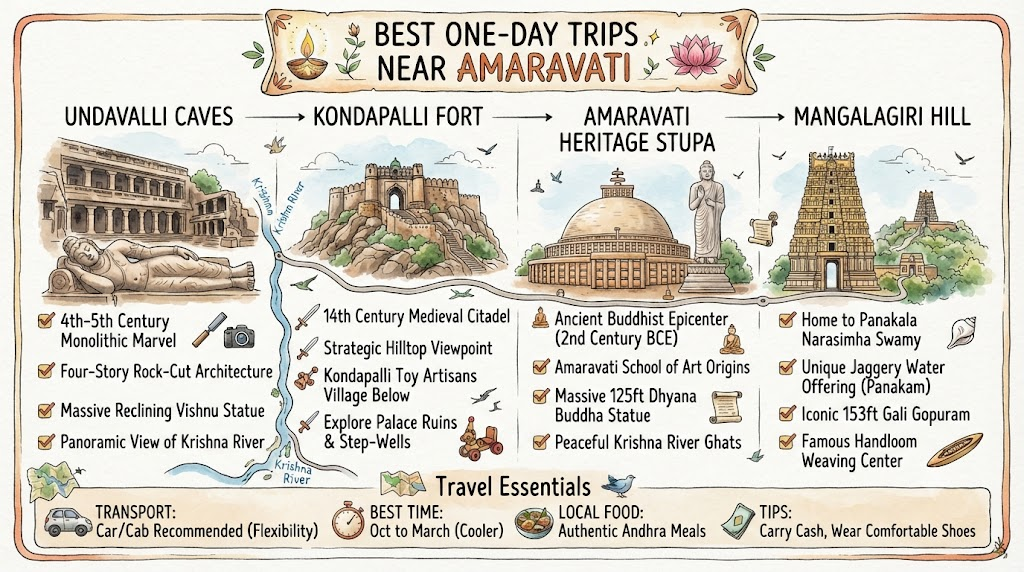
The Undavalli Caves stand as an astonishing testament to solid-rock engineering, carved directly out of a sandstone hillside in the 4th and 5th centuries CE. Originally associated with Buddhist monks before being adapted into a majestic Hindu sanctuary, this four-storied monolithic marvel showcases the incredible transition of Indian rock-cut architecture. As you climb its stone steps, the wind carrying cool mist from the nearby Krishna River sweeps through the open-pillared halls.
The crown jewel of this complex rests securely on the third floor: a colossal, 5-meter-long monolithic statue of Lord Anantha Padmanabha Swamy (Vishnu in a reclining posture), carved out of a single granite block. The precise craftsmanship of the pillars, combined with historic rock inscriptions and hidden chambers, leaves visitors mesmerized by the ancient engineering skills on display.
- Location: Guntur District, approximately 22 km from Amaravati core.
- Why it is worth visiting: It is one of the finest surviving examples of early rock-cut architecture in Southern India, featuring a rare four-story layout.
- Best things to do: Marvel at the massive reclining Vishnu sculpture, photograph the panoramic view of the Krishna River from the top floor, and hunt for ancient script carvings on the pillars.
- Best time to visit: 3:30 PM to 5:30 PM, when the golden hour light softly illuminates the western sandstone facade.
- Ideal for whom: History buffs, architecture lovers, and photography enthusiasts.
- Travel tip: The ancient stone steps lack modern handrails and can get slippery; wear sturdy footwear with excellent grip.
Kondapalli Fort
Perched commandingly atop the rocky ridges of the Eastern Ghats, Kondapalli Fort is a sprawling medieval citadel built by Prolaya Vema Reddy in the 14th century. The fort has borne silent witness to the rise and fall of major ruling dynasties, including the Gajapatis of Odisha, the Vijayanagara Empire, the Golconda Sultans, and eventually the British East India Company. Passing through its massive gateway, known as the Dargah Darwaza, feels like entering an entirely different century.
Inside, the ruins contain the remnants of a three-storied residential palace, market squares, prison cells, and deep stone step-wells. Below the fort hills lies the legendary Kondapalli village, world-renowned for its artisanal heritage of crafting Kondapalli Bommalu—lightweight wooden toys carved from the local Tella Poniki wood.
- Location: NTR District, roughly 35 km north-west of Amaravati via Ibrahimpatnam.
- Why it is worth visiting: A massive hill fortress offering a window into medieval military architecture and panoramic views of the dense forest reserve below.
- Best things to do: Explore the ancient granaries and the Gajapati palace ruins, hike up to the highest viewpoint, and watch artisans assemble toys in the village below.
- Best time to visit: Early morning (6:30 AM to 9:30 AM) to catch the mountain mist and beat the midday tropical heat.
- Ideal for whom: Trekkers, historical explorers, and family road-trippers.
- Travel tip: Pack your own water and light snacks, as there are no functional shops or amenities up on the hill fort ruins.
Amaravati Heritage Stupa & Dhyana Buddha
The spiritual core of the region resides at the Amaravati Maha Stupa, an ancient Buddhist monument established during the reign of Emperor Ashoka. Though much of the original, intricately carved marble railings are now housed in global museums, the sacred layout still holds profound peaceful energy. Directly adjacent to this archaeological site sits the majestic Dhyana Buddha Statue, a towering 125-foot-tall monument seated on a massive lotus structure facing the Krishna River.
The interior base of the Dhyana Buddha contains a multi-level museum lined with high-relief sculptures depicting scenes from the life of Gautama Buddha and the Jataka tales. It serves as a quiet space for contemplation, perfectly preserving the Buddhist heritage that shaped early Asian civilization.
- Location: Palnadu District, located right within the historic Amaravati town.
- Why it is worth visiting: It is the ancient cradle of the Amaravati school of art, complemented by one of the tallest meditative Buddha structures in the world.
- Best things to do: Walk through the peaceful archaeological park ruins, explore the reliefs inside the Dhyana Buddha museum, and sit by the river ghats.
- Best time to visit: 4:00 PM to 6:30 PM, to experience the sunset behind the giant monument.
- Ideal for whom: Spiritual seekers, peace lovers, and art historians.
- Travel tip: Ensure you dress respectfully (shoulders and knees covered) to enter the sacred meditative and religious premises.
Mangalagiri Lakshmi Narasimha Temple
Mangalagiri, which translates literally to “The Auspicious Hill,” is an ancient volcano that has served as a powerful spiritual center for thousands of years. The mountain is home to the unique temple of Panakala Narasimha Swamy, where the deity is offered sweet jaggery water (Panakam). Mysteriously, when this liquid is poured into the mouth of the conch-shaped rock deity, a distinct gurgling sound is heard, and exactly half of the liquid is pushed back out as a blessing.
At the base of the hill sits the main shrine, featuring an imposing 11-storied Gali Gopuram (temple tower) that pierces the sky at a height of 153 feet. The surrounding narrow lanes are filled with traditional weaving communities spinning the iconic, vibrant Mangalagiri cotton and silk sarees.
- Location: Guntur District, 15 km from the capital city center along the Chennai highway.
- Why it is worth visiting: To witness the inexplicable jaggery-water phenomenon and admire one of the tallest traditional temple towers in South India.
- Best things to do: Participate in the morning Panakam ritual, climb the steps to the hilltop cave shrine, and visit a live handloom weaving cooperative.
- Best time to visit: 7:00 AM to 11:00 AM, as the hilltop shrine closes to visitors precisely at noon.
- Ideal for whom: Religious pilgrims, cultural explorers, and handloom textile collectors.
- Travel tip: Beware of the large resident monkey population on the hill steps; keep all food items, bags, and loose glasses safely concealed.
Offbeat Exploration: Hidden Gems Tourists Miss
The Weaving Hamlets of Mori & Mangalagiri Backstreets
While tourists crowd the commercial showrooms along the highways, the real magic happens in the dusty, residential backlanes of old Mangalagiri town. Here, entire families operate heavy pit-looms inside their living rooms, creating fine cotton fabrics with stunning golden Zari borders. Walking through these lanes offers an immersive sensory experience of rhythmic clacking looms and vibrant dyeing vats that have sustained the local economy for generations.
Bhavani Island’s Quiet Northern Tip
Most visitors take the standard tourist boats to the main commercial zone of Bhavani Island for water sports. However, renting a local fisherman’s rowboat to reach the unpaved, northern sandbanks reveals a completely isolated ecosystem. This quiet expanse of riverine forest is an incredible sanctuary for migratory birds like pelicans and river terns, offering total solitude far away from the city noise.
Detailed Practical Guidance for Travelers
| Destination | Standard Entry Fee | General Timings | Best Local Food Options Nearby | Recommended Nearby Attractions |
| Undavalli Caves | ₹25 (ASI Charge) | 9:00 AM – 6:00 PM | Traditional Filter Coffee & Idli at local stalls | Prakasam Barrage, Penumaka Village |
| Kondapalli Fort | ₹20 per adult | 10:00 AM – 5:00 PM | Spicy Andhra Country Chicken (Kodi Kura) | Kondapalli Toy Artisans Colony |
| Amaravati Stupa | Free (Museum ₹5) | 10:00 AM – 5:00 PM | Classic Andhra Meals served on banana leaves | Amaralingeswara Temple, River Ghats |
| Mangalagiri Hill | Free entry | 5:00 AM – 12:00 PM | Hot Puri-Chana and local Panakam drinks | Haailand Theme Park (for families) |
Logistics & On-Ground Navigation
Local Transport Options
- Car Rentals: Booking a private air-conditioned cab for the entire day is highly recommended if you are traveling with family. It gives you the freedom to move easily between geographically separated destinations like Kondapalli and Undavalli.
- Auto-Rickshaws: Readily available at all transit points. It is standard practice to negotiate a fixed, round-trip price before stepping into the vehicle for semi-rural locations.
- Public Buses: APSRTC operates regular, budget-friendly commuter buses connecting Vijayawada and Guntur to Amaravati town and Mangalagiri.
Budget Planning
- Backpacker Tier (₹800 – ₹1,200 per day): Utilizes public state buses or shared autos for transit, eats delicious meals at local street-side Tiffin centers, and focuses primarily on public heritage structures.
- Comfort Tier (₹3,500 – ₹5,000 per day): Includes a private rental sedan for seamless door-to-door transit, dining at air-conditioned heritage restaurants, and hiring local guides at historical sites.
Safety and Inclusivity Tips
- For Families: The steep climbs at Kondapalli Fort and Mangalagiri Hill lack standard safety railings in several sections. Keep young children close at all times and carry sufficient hydration packs.
- For Couples: The quieter, isolated areas around the ruins of Kondapalli Fort can get completely deserted after 4:30 PM. It is best to stick to the main structural pathways and clear view-points.
- General Safety: Keep a small amount of cash on hand, as cellular data networks can become unstable around the deep rock cuts of Undavalli and the hill forests of Kondapalli.
Strategic Travel Planning Guardrails
Travel Planning Tips for the Region
- Pack a light cotton umbrella and polarized sunglasses; the tropical sun reflecting off the sandstone and water surfaces can be incredibly intense.
- Always carry some physical cash, as small village toy artisans and remote temple stalls rarely accept digital UPI payments due to network issues.
- Start your exploration no later than 7:00 AM to make the most of the cooler morning hours before temperatures rise.
- Wear easy-to-remove slip-on shoes or sandals, as you will need to take off your footwear frequently at active cave shrines and temple complexes.
- Try the locally grown seasonal watermelons and fresh palm fruit (Munjalu) sold along the highways to stay naturally hydrated.
Common Mistakes to Avoid
- Do not attempt to explore Kondapalli Fort and the Amaravati Heritage Stupa on the same afternoon; they are located in completely opposite geographical directions across the river.
- Avoid buying cheap, mass-produced plastic toys from commercial highway stalls; walk directly into the artisan villages to support the genuine creators.
- Never schedule your visit to the hilltop temple of Mangalagiri after 12:00 PM, as religious protocols require the gates to close strictly at noon.
- Avoid wearing delicate, expensive footwear when exploring the ancient, unpaved terrain of the rock caves and hill ruins.
- Do not skip the small, authentic village eateries in favor of modern highway fast-food chains; you will miss out on the incredible, true flavors of regional Andhra cuisine.
Suggested Itinerary Blueprints
1. The Quick Heritage Dash (The Monolithic Loop)
Designed specifically for travelers with limited time who want to experience the core architecture within a tight 6-hour window.
- 08:00 AM: Arrive at the spectacular Undavalli Caves to catch the soft morning light filtering through the rock pillars.
- 10:30 AM: Drive across the historic Prakasam Barrage directly to the base of Mangalagiri Hill.
- 11:15 AM: Participate in the ancient Panakam ritual at the hilltop cave shrine before the midday closure.
- 01:00 PM: Enjoy an authentic, fiery Andhra lunch at a traditional local dining hall in town.
2. The Deep-Dive Cultural Circuit (The Artisanal Trail)
A comprehensive 12-hour itinerary perfect for history enthusiasts and collectors looking to connect deeply with local communities.
- 07:00 AM: Beat the heat with an early morning hike up the historic ramparts of Kondapalli Fort.
- 10:30 AM: Walk down to the foothills into the Toy Artisan Colony to witness the traditional woodcraft.
- 01:00 PM: Take a relaxing lunch break featuring authentic regional delicacies near Ibrahimpatnam.
- 03:00 PM: Cross over the river to explore the four floors of the ancient Undavalli Caves.
- 05:30 PM: Spend your evening winding down with a relaxing boat ride along the peaceful waters of the Krishna River.
3. The Complete Weekend Travel Plan (The Grand Amaravati Loop)
An immersive, multi-day loop designed for travelers who want to fully experience the spiritual and historical transition of the entire capital region.
- Saturday – Day 1: Devote your morning entirely to the ancient Buddhist ruins at the Amaravati Heritage Stupa. Spend the afternoon inside the museum at the base of the massive Dhyana Buddha Statue, and conclude your evening watching the sunset at the river ghats.
- Sunday – Day 2: Begin your morning observing the traditional handloom weavers in the backlanes of Mangalagiri. Spend the afternoon exploring the grand rock architecture of Undavalli Caves, and wrap up your weekend with a scenic drive to the historic ruins of Kondapalli Fort.
Common Tourist Mistakes to Avoid
- Geographic Blunders: Many tourists mistakenly try to group Kondapalli Fort and the Amaravati Heritage Stupa into a single afternoon. These locations sit on opposite sides of the massive Krishna River without a direct bridge connecting them, leading to hours wasted in heavy transit traffic.
- Commercial Traps: Do not spend your limited day-trip time wandering through the modern shopping malls of central Vijayawada. These spaces look identical to urban centers anywhere else and completely detach you from the atmospheric, authentic local culture.
- Neglecting Modern/Alternative Zones: Visitors often miss out by failing to explore the beautifully planned, peaceful riverfront walking tracks and quiet artistic installations winding through the new capital design spaces.
- Transport Overpayment: Always check and cross-reference prices on ride-hailing apps before getting into unmetered auto-rickshaws at major train stations to avoid paying inflated tourist rates.
- Luxury Dining Bias: Sticking exclusively to fine-dining hotels means missing the legendary street-level Tiffin stalls, which serve some of the crispest Guntur Ghee Karam Dosas and freshest filter coffee in the entire state.
Frequently Asked Questions
1. Is it safe to hike up to Kondapalli Fort during the monsoon season?
The stone steps and jungle paths become exceptionally slick and muddy during the rains. While the surrounding hills look beautiful in the monsoon, it is best to avoid climbing late in the afternoon due to the risk of sudden downpours and low visibility.
2. Are cameras and photography equipment allowed inside the Undavalli Caves?
Yes, standard photography is permitted, but you must obtain an ASI entry ticket. Tripods and professional filmmaking equipment require special prior permission from the archaeological department.
3. What makes Mangalagiri cotton fabric different from other regional textiles?
Mangalagiri fabrics are world-renowned for their fine, tightly woven texture created using characteristic pit-looms. They feature striking, dense golden Zari borders inspired by traditional temple architecture.
4. Can we easily get public transport back from Amaravati town late at night?
Public bus frequencies drop significantly after 8:30 PM. If you plan to stay by the river ghats for sunset, it is highly recommended to book a private taxi or have a vehicle arranged in advance.
5. Are there any specific dress codes to enter the main Dhyana Buddha site?
While there isn’t a rigid institutional dress code, it is a revered spiritual space. Visitors should dress modestly, keeping their shoulders and knees fully covered.
6. Where can I buy authentic, genuine Kondapalli toys without middleman markups?
Avoid the souvenir shops on the national highways. Instead, drive directly to the workshops in the artisan colony located at the base of Kondapalli hill to buy directly from the craftsmen.
7. Is the jaggery water offered at Mangalagiri temple safe for consumption?
The jaggery water (Panakam) is prepared daily using clean, traditional methods and is perfectly safe. However, travelers with sensitive stomachs may want to consume it in small, symbolic quantities.
8. How much time should we ideally allocate to explore the Undavalli Caves?
A thorough exploration of all four structural levels, including reading the informational signs and taking photographs, takes about 1.5 to 2 hours.
9. Are there clean, western-style public restrooms available at the historical fort ruins?
Facilities up at the Kondapalli Fort ruins are extremely basic. It is highly recommended to use the modern restrooms available at restaurants along the main highway before heading up the hill.
10. Do local tour guides at the archaeological sites speak English?
Most authorized ASI guides speak fluent Telugu and Hindi, and many have a good working command of English to explain the history to travelers.
11. Can we take our own private car all the way up to the Kondapalli Fort entrance?
Yes, a well-paved, winding ghat road goes directly to the main entrance gateway, making it easily accessible for private cars and two-wheelers.
12. What is the signature local dish that we absolutely must try on this day trip?
You must try the iconic Andhra Bhojanom (meals) served on a traditional banana leaf, featuring fresh Gongura chutney, piping hot rice, and pure local ghee.
Conclusion
Choosing to explore the ancient corridors around Amaravati over a predictable, commercialized resort vacation offers a profoundly rewarding travel experience. Standing within the silent, cool chambers of the Undavalli rock-cut caves or watching a master weaver spin shimmering gold thread into vibrant silk transforms your journey from a simple day trip into a true connection with living history. These spaces challenge us to slow down, listen to the timeless flow of the Krishna River, and discover an authentic cultural legacy that modern cities simply cannot replicate.
