Introduction
When most people think of a getaway in Southern India, their minds immediately drift to the bustling tech hubs of Hyderabad or the heavily commercialized beaches of Visakhapatnam. But if you are a traveler who craves deep cultural roots, unhurried authenticity, and places where history breathes through the soil, there is an ancient-meets-modern frontier waiting for you. Welcome to Amaravati, the rising heart of Andhra Pradesh, situated beautifully along the sweeping curves of the sacred Krishna River.
Unlike typical, overcrowded mainstream vacation spots where you have to fight through a sea of selfie sticks just to see the view, twilight in Amaravati offers a spiritual experience. As the blazing sun dips below the horizon, it bathes ancient Buddhist stupas, towering medieval hill forts, and futuristic riverfront paths in shades of molten gold and deep amber. It is a destination where the sunsets do not just mark the end of a day; they connect you directly to thousands of years of human history.
Why Amaravati is a must visit city
Amaravati represents a fascinating chapter in India’s regional travel landscape. Geographically, it sits on the fertile banks of the lower Krishna River, serving as a natural crossroads where empires have risen and fallen for over two millennia. Culturally, it holds massive weight; this was the ancient capital of the Satavahana dynasty back in the 2nd Century BCE and a world-renowned seat of Mahayana Buddhism that drew scholars from all across Asia. Today, it is undergoing a monumental transformation as India’s newest, meticulously planned greenfield capital city, seamlessly blending this deep heritage with visionary modern architecture.
For travelers, the region forms an accessible and incredibly diverse travel circuit. It links the ancient spiritual heritage of Amaravati village with the bustling commercial and culinary energy of nearby Vijayawada and Guntur. The entire zone is exceptionally well-connected by excellent multi-lane highways, an extensive railway network centered around Vijayawada Junction, and regional air connectivity via Vijayawada International Airport (Gannavaram). Whether you are an independent backpacker, a family on a road trip, or a heritage enthusiast, the hospitality infrastructure ranges from budget-friendly local guest houses to premium business hotels.
| Feature | Key Regional Information |
| Primary Airport | Vijayawada International Airport (Gannavaram – approx. 35 km away) |
| Major Rail Hub | Vijayawada Junction (BZA) — one of India’s busiest railway stations |
| Core River System | The sacred Krishna River |
| Historical Legacy | Satavahana Dynasty Capital, Ancient Mahayana Buddhist Global Center |
| Best Travel Circuit | Amaravati Heritage Village – Prakasam Barrage – Undavalli Caves – Kondapalli |
Best Places or Experiences
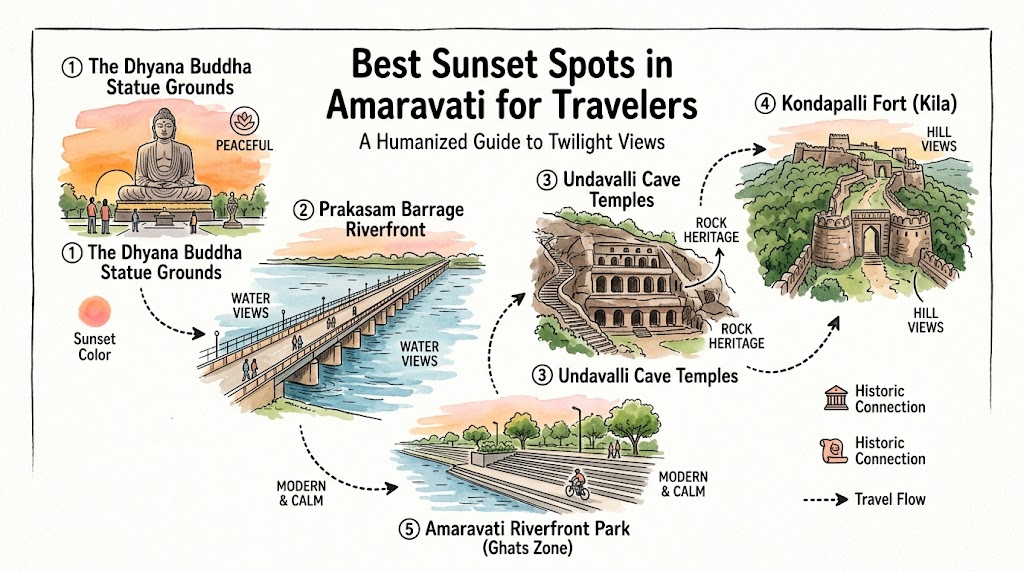
1. The Dhyana Buddha Statue Grounds
The Dhyana Buddha Statue stands as a massive, breathtaking tribute to Amaravati’s profound spiritual heritage. Towering at an incredible 125 feet on the banks of the Krishna River, this magnificent structure depicts Lord Buddha in a meditative posture, seated atop a beautifully sculpted lotus pandal. The monument is layers deep with meaning, as the structure houses a three-story museum underneath detailing the history of Buddhist art, featuring replicas of the famous Amaravati Amaravati sculptures that are now scattered in museums worldwide.
When the evening sun begins its descent, the entire white-concrete monument absorbs the warm, changing colors of the sky. The sight of the massive silhouette casting its peaceful shadow over manicured lawns while the sky turns a brilliant orange is deeply humbling. It provides a rare moment of absolute stillness, far away from the chaotic pace of typical tourist destinations.
- Location: Amaravati Village, approximately 32 km west of Vijayawada city center.
- Why it is worth visiting: It is one of the tallest meditative Buddha statues in the world, embodying the ancient spiritual soul of the region.
- Best things to do: Explore the subterranean museum containing ancient reliefs, walk along the peaceful pradakshina path, and sit on the western lawns for a clear view of the sun setting behind the distant hills.
- Best time to visit: October to March; arrive by 4:30 PM to explore the interiors before catching the sunset.
- Ideal for whom: Spiritual seekers, photography enthusiasts, history buffs, and families seeking peace.
- Travel tip: Remember to wear footwear that is easy to remove, as shoes are strictly prohibited on the main upper platform steps out of respect.
2. Prakasam Barrage Riverfront
Spanning over 1.2 kilometers across the mighty Krishna River, the Prakasam Barrage is an engineering marvel that connects the Krishna and Guntur districts. First conceptualized during the British era by Sir Arthur Cotton and completed in the 1950s, this historic structure creates a vast, lake-like expanse of water right at the edge of the city. The barrage features a sweeping roadway flanked by pedestrian walkways, offering panoramic views of the water and the distant, jagged hills.
As sunset approaches, the Prakasam Barrage transforms into a lively social hub. The massive body of water acts as a perfect mirror, reflecting the deep purples, fiery reds, and soft pinks of the sky. Watch the local fishermen paddle their small boats across the golden ripples while the historic structure illuminates its yellow lights, creating a spectacular view that bridges old-world utility with natural beauty.
- Location: Connecting Vijayawada city with Guntur district across the Krishna River.
- Why it is worth visiting: It offers the most expansive, unobstructed water-level sunset view in the entire region, showcasing the sheer scale of the Krishna River.
- Best things to do: Stroll along the pedestrian walkway, enjoy a traditional boat ride from the nearby Durga Ghat, and capture the reflection of the illuminated lights on the dark water.
- Best time to visit: Year-round, but evenings between 5:30 PM and 6:30 PM provide the most dramatic sky changes.
- Ideal for whom: Couples looking for a romantic walk, street photographers, and local food lovers.
- Travel tip: Parking on the bridge itself is strictly prohibited and can be dangerous due to fast traffic; park your vehicle at the designated spaces near Durga Ghat and walk up.
3. Undavalli Cave Temples
Carved out of a solid sandstone hillside in the 4th and 5th centuries CE, the Undavalli Caves are a stellar example of rock-cut monolithic architecture in India. This four-story cave complex was originally associated with Buddhist monks before being converted into a Hindu shrine, housing a massive, 5-meter-long reclining statue of Lord Vishnu carved out of a single block of granite on the third floor. The skillfully cut pillars, ancient inscriptions, and green lawns surrounding the caves make it an architectural treasure.
Watching the sunset from the higher levels of the Undavalli Caves is an unforgettable experience. As you look out from the stone rock-cut balconies, you are treated to a sweeping view of emerald-green paddy fields, coconut groves, and canal streams winding towards the Krishna River. The golden hour light floods directly into the ancient chambers, illuminating the ancient rock faces with a warm, mystical glow.
- Location: Tadepalle Municipality, Guntur District, roughly 6 km from Vijayawada.
- Why it is worth visiting: It offers a magnificent blend of 1,500-year-old rock-cut heritage and a high viewpoint overlooking traditional rural delta landscapes.
- Best things to do: Climb to the top floor to view the massive reclining Vishnu deity, photograph the green valley from the stone balconies, and study the detailed carvings of lions and elephants.
- Best time to visit: November to February, specifically around 4:00 PM to explore the caves thoroughly before golden hour.
- Ideal for whom: Architecture geeks, archaeology lovers, and landscape photographers.
- Travel tip: The rock steps inside can be narrow, smooth, and slippery; wear shoes with excellent grip and keep an eye on your belongings as local monkeys frequent the upper ledges.
4. Kondapalli Fort (Kila)
Perched high up on the forested ridges of the Eastern Ghats, the 14th-century Kondapalli Fort was built by Prolaya Vema Reddi and later reinforced by the Qutb Shahis and the British. The fort complex spreads across a massive hill range, featuring ancient granite gateways (such as the Dargah Darwaza), ruined granaries, barracks, and an impressive multi-story palace called the Tanisha Mahal. The surrounding hills are also famous for the light wood used to craft the world-famous, GI-tagged Kondapalli toys.
Because of its high elevation, Kondapalli Fort offers a dramatic, mountain-top sunset experience. Standing on the crumbling stone ramparts of the Tanisha Mahal, you can watch the sun disappear behind the rolling, misty hills of the Eastern Ghats. The entire valley below, including the faraway highway lines and small villages, slows down as twilight settles over the ancient ruins.
- Location: Kondapalli Village, NTR District, roughly 25 km from the core capital zone.
- Why it is worth visiting: It provides a historic hill-fort setting with a commanding, high-altitude view of the landscape and the Eastern Ghats.
- Best things to do: Explore the arched corridors of the Tanisha Mahal, hike to the Gajashala (elephant stables), and purchase authentic wooden toys directly from artisans at the base village.
- Best time to visit: Monsoon and winter seasons (July to February) for cool breezes and clear evening skies.
- Ideal for whom: Adventure hikers, history enthusiasts, and travelers looking to escape the city heat.
- Travel tip: The winding hill road leading up to the fort closes to incoming vehicles by 4:30 PM, so make sure you start your drive up well in advance to catch the sunset.
5. Amaravati Riverfront Park (Ghats Zone)
The Amaravati Riverfront Park represents the modern, visionary side of the new capital project. Designed as an eco-friendly recreational space along the banks of the Krishna River, this beautifully landscaped park features smooth walking trails, open-air plazas, cycling tracks, and steps that lead directly down to the water’s edge. It is an intentional effort to preserve the natural beauty of the riverbank while providing a clean space for relaxation.
The sunset here is all about openness and quiet reflection. Sitting on the concrete steps as the cool river breeze kicks up, you can watch the sun drop cleanly into the open horizon where the water meets the sky. The lack of commercial noise allows you to hear the gentle lapping of the river water against the steps, making it an incredibly soothing place to end your day.
- Location: Central Capital Region, along the designated riverfront boulevard of Amaravati.
- Why it is worth visiting: It is a pristine, uncrowded modern public park that offers clean seating spaces right at the edge of the water.
- Best things to do: Rent a local bicycle to ride along the river paths, sit quietly on the steps leading down to the water, and enjoy a family picnic on the lawns.
- Best time to visit: September to April; ideal for a relaxed evening stroll starting from 5:00 PM.
- Ideal for whom: Families with young kids, fitness enthusiasts, and travelers looking for clean, open spaces.
- Travel tip: There are very few food stalls allowed inside the park to keep it clean, so it is smart to carry your own water bottle and snacks.
Offbeat Exploration: Hidden Gems Tourists Miss
Moghalrajpuram Caves Viewpoint
Tucked away inside a bustling residential neighborhood right in the middle of Vijayawada are the ancient Moghalrajpuram Caves. While most tourists head to the famous Undavalli Caves across the river, this small, 5th-century rock-cut site is usually completely empty. If you climb up the rocky hill path just behind the fenced cave site, you will reach a secret rocky outcrop. From this hidden ledge, you can watch the sunset right against the city skyline, offering a spectacular contrast where ancient stone columns overlook a sea of modern buildings and twinkling evening lights.
Seethanagaram Hill Top
Located near the southern end of the Prakasam Barrage, the hill climb near the ancient Seethanagaram Vedic University is a hidden treasure known mostly to locals. A narrow, steep road snakes its way up to a quiet plateau that overlooks the entire curve of the Krishna River. Standing up here at sunset gives you an incredible bird’s-eye view: you can see the massive iron gates of the barrage, the historical Kanaka Durga Temple illuminated on the opposite hill, and the vast river splitting into delta canals, all under a brilliant, glowing sky.
Detailed Practical Guidance for Travelers
The landmarks across this heritage and sunset circuit operate on different schedules and offer varied amenities. Use this logistically verified matrix to plan your itinerary routing:
| Destination | Standard Entry Fee | General Timings | Best Local Food Options Nearby | Recommended Nearby Attractions |
| Dhyana Buddha Statue | Free (Museum: ₹20) | 7:30 AM – 6:30 PM | Traditional South Indian tiffins at local village mess stalls | Amaravati Maha Stupa Ruins, Amaravati Museum |
| Prakasam Barrage | Free | Open 24 Hours | Punugulu street food stalls, Babai Hotel (Vijayawada) | Kanaka Durga Temple, Bhavani Island Ghats |
| Undavalli Caves | ₹25 (ASI Ticket) | 8:00 AM – 6:00 PM | Coconut water vendors, local dhabas along Penumaka Road | Penumaka Village Organic Farms, Amaravati Ghats |
| Kondapalli Fort | ₹20 per person | 10:00 AM – 5:00 PM | Local spicy country chicken (Natu Kodi) curry joints at base | Kondapalli Toy Artisan Colony, Forest Trails |
| Riverfront Park | Free | 5:00 AM – 8:30 PM | Light snacks and juices at entry points | Sakhamuru Park, Central Secretariat Buildings |
Logistics & On-Ground Navigation
Local Transport Options
- Railways: Vijayawada Junction (BZA) is the primary entry point. From there, local passenger trains connect to peripheral stations like Guntur and Kondapalli frequently.
- Auto-Rickshaws: These are the absolute lifelines of regional travel. You can hail shared autos for short hops between villages, but for historic sites, it is best to negotiate a fixed, round-trip rate for the afternoon.
- E-Rickshaws: Increasingly common around the flat terrains of the core capital city area and the immediate vicinity of major temples, offering an eco-friendly, budget-friendly option for short trips.
- Car Rentals & Cabs: App-based cabs like Ola and Uber operate reliably within Vijayawada and Guntur urban areas. However, for a full day out to places like Kondapalli Fort or the Dhyana Buddha Statue, renting a private taxi for the day is highly recommended to avoid getting stranded.
Budget Planning
- Budget / Backpacking Tier: Expect to spend around ₹1,200 to ₹1,800 per day. This covers using public buses and shared autos, staying in local budget lodges or homestays near the railway station, and enjoying authentic street food like idli, dosa, and punugulu at local stalls.
- Mid-Range / Comfort Tier: Expect to spend around ₹3,500 to ₹6,000 per day. This covers booking an air-conditioned private cab for seamless travel, staying in a comfortable 3-star business hotel in urban Vijayawada, and dining at established regional restaurants.
Safety and Inclusivity Tips
- For Families: Most sunset spots, especially the Dhyana Buddha grounds and Riverfront Park, have wide open spaces and are very safe for children. However, keep a close eye on kids near the open steps at the river ghats and on the steep rock ledges at Undavalli.
- For Couples: The Prakasam Barrage walkways and Undavalli gardens are popular evening hangouts. Stick to well-lit public zones and try to head back toward the main roads by 7:30 PM, as some rural approach roads can get dark and lonely.
- General Safety: The coastal Andhra region can get quite hot and humid even in the winter months. Always carry a water bottle to stay hydrated, keep a small umbrella handy, and ensure your mobile phone is charged, as digital network connectivity can vary slightly around the deep fort ruins of Kondapalli.
Strategic Travel Planning Guardrails
Travel Planning Tips for Amaravati
- Time Your Season Wisely: Avoid visiting between April and June, as temperatures can soar past 40°C. Plan your trip during the pleasant winter months from November to February instead.
- Embrace Digital but Keep Cash: While UPI digital payments work at almost every small tea stall, some remote entry counters (like at Kondapalli Fort) or rural auto drivers prefer cash due to occasional mobile network drops.
- Dress Culturally Appropriately: When visiting sites that double as spiritual monuments (like the Dhyana Buddha Statue), dress modestly. Avoid swimwear or overly revealing clothes out of respect for local traditions.
- Start Your Afternoons Early: Sunset happens relatively early here, usually between 5:30 PM and 6:15 PM depending on the season. Start your afternoon excursions by 3:00 PM so you have plenty of time to explore before the sun goes down.
- Stay Hydrated & Sun-Protected: The afternoon sun can be intense even in December. Always carry a wide-brimmed hat, wear sunscreen, and bring plenty of drinking water when exploring outdoor ruins.
Common Mistakes to Avoid
- Over-Packing Your Daily Schedule: Do not try to visit Kondapalli Fort and the Dhyana Buddha Statue on the same afternoon; they are located in opposite directions and you will end up spending your sunset stuck in traffic.
- Ignoring the Rural Sub-Regions: Don’t just stay inside the modern hotel zones of Vijayawada. Head out into the surrounding villages to experience the beautiful pottery cultures and lush banana plantations that give the region its true charm.
- Assuming Public Buses Travel Everywhere: While local buses run frequently between major cities, they do not go directly up to hill sites like Kondapalli Fort or deep inside cave locations.
- Skipping the Regional Street Cuisine: Don’t rely solely on room service or familiar chain restaurants. Missing out on hot, fresh street food like Mirchi Bajji by the riverbank means missing out on the culinary soul of Andhra Pradesh.
- Overpaying for Transport: Never jump into a local auto-rickshaw without confirming the final price beforehand. Always cross-reference the rate with online ride-sharing apps to ensure you are getting a fair price.
Suggested Itinerary Blueprints
1-Day Quick Dash (The Classic River & Heritage Loop)
- Target Audience: Business travelers, short-stay visitors, or anyone with just 24 hours to spare.
- Morning (8:00 AM – 11:30 AM): Start early with a visit to the historic Kanaka Durga Temple on Indrakeeladri Hill, then grab a traditional South Indian breakfast of Ghee Karam Dosa at a local eatery.
- Afternoon (1:00 PM – 3:30 PM): Cross the river to explore the four-story rock-cut Undavalli Caves, marveling at the massive stone-carved reclining deity.
- Sunset Finale (4:30 PM – 6:30 PM): Drive straight down to the 125-foot Dhyana Buddha Statue in Amaravati village to watch the sun set peacefully over the ancient landscape.
2-Day Deep-Dive (History, Art & Elevated Viewpoints)
- Day 1: Ancient Roots & River Views
- Morning: Explore the ancient ruins of the Amaravati Maha Stupa and the nearby Archaeological Museum to learn about the region’s 2,000-year-old Buddhist history.
- Afternoon: Enjoy a relaxing lunch in the city, then head down to the newly developed Amaravati Riverfront Park.
- Sunset: Walk along the expansive pathways of the Prakasam Barrage, watching the sky reflect beautifully across the wide Krishna River.
- Day 2: Wilderness, Crafts & Hill Forts
- Morning: Visit the local artisan colony at the base of Kondapalli village to see master craftsmen carving traditional wooden toys.
- Afternoon: Pack a light picnic lunch and make the scenic drive up the winding jungle roads of the Eastern Ghats.
- Sunset: Explore the ruins of Kondapalli Fort, standing on the high stone ramparts of the Tanisha Mahal to watch the sun drop behind the rolling hills.
Complete Weekend Travel Plan (The Ultimate Capital Circuit)
- Friday: Arrival & Skyline Sunsets
- Arrive by afternoon and check into your hotel. At 4:00 PM, take a short hike up to the hidden Moghalrajpuram Caves viewpoint to watch the golden hour light up the city skyline.
- Saturday: Rock-Cut Architecture & River Crossings
- Spend the morning exploring the magnificent Undavalli Caves. In the afternoon, take a boat ride to Bhavani Island, and spend your evening watching a dramatic sunset from the walkways of the Prakasam Barrage. Conclude with a spicy Andhra dinner.
- Sunday: Deep Spiritual Heritage Loop
- Drive out to the historic Amaravati Heritage Village. Spend the day visiting the ancient Amaralingeswara Temple and the majestic 125-foot Dhyana Buddha Statue, staying until twilight to catch the perfect, peaceful end to your weekend journey.
Common Tourist Mistakes to Avoid
- Geographic Blunders: Trying to combine geographically opposed zones or circuits on the exact same day. For example, trying to visit Kondapalli Fort (which sits far to the northwest) and the Dhyana Buddha Statue (located far to the west across the river) in a single afternoon will leave you exhausted and stuck in heavy traffic during the best sunset hours.
- Commercial Traps: Spending excessive vacation time in modernized shopping hubs rather than authentic, atmospheric local spaces. Avoid spending your precious evenings inside generic air-conditioned malls in downtown Vijayawada when you could be out on the historic river ghats enjoying the cool breeze and watching local fishermen.
- Neglecting Modern/Alternative Zones: Forgetting to explore the quieter, residential, artistic, or cafe-centric modern expansions of the region. The newly laid out boulevard spaces and eco-parks in the rising core capital zone offer wide-open, uncrowded vistas that present a fascinating contrast to the older, crowded parts of the city.
- Transport Overpayment: Actionable advice on using official meters or cross-referencing ride-sharing apps to avoid price gouging. Local auto drivers near major transit hubs like the Vijayawada Railway Station often quote highly inflated prices to tourists. Always check rates on app-based services first to know the fair baseline price before negotiating.
- Luxury Dining Bias: Explaining why missing street-level culinary vendors deprives the traveler of the destination’s true soul. The real culinary magic of this region lives in its street-side food stalls. Skipping the freshly fried, spicy Mirchi Bajji (chili fritters) served with chopped onions at the river ghats or the famous fluffy Idlis at local breakfast carts means missing out on the authentic flavors of Andhra culture.
Frequently Asked Questions
1. What is the absolute best month to visit Amaravati for clear sunset photography?
The absolute best window is between November and February. During these winter months, the monsoon clouds have cleared out, the humidity drops significantly, and the evening skies are incredibly clear, offering deep, rich orange and purple colors without the hazy summer dust.
2. Is there an entry fee for the Dhyana Buddha Statue grounds?
Entry to the main landscaped gardens and the outer viewing platforms of the Dhyana Buddha Statue is completely free. There is only a small fee of ₹20 if you wish to enter the air-conditioned museum located directly underneath the statue structure.
3. Can we hire a local boat for a private sunset cruise near Prakasam Barrage?
Yes, you can hire private speedboats or traditional motorboats from the Durga Ghat area or the AP Tourism lounge at Bhavani Island. It is highly recommended to book these rides by 5:15 PM so you are out on the open water exactly as the sun begins to set.
4. Are drone cameras allowed for capturing sunset views at Kondapalli Fort?
No, flying drones at Kondapalli Fort is generally restricted without prior written permission from the State Archaeology and Forest Departments. Since the fort sits on a protected forest ridge, unauthorized drone use can disturb local wildlife and carry strict penalties.
5. How far is the ancient Amaravati village from Vijayawada railway station?
The ancient Amaravati Heritage Village (where the Dhyana Buddha Statue and Maha Stupa are located) is approximately 32 to 35 kilometers west of the main Vijayawada Junction railway station, taking about an hour to reach by road via the Amaravati Karakatta road.
6. Is it safe for solo female travelers to watch the sunset at Kondapalli Fort?
While the fort is perfectly safe during the bustling daytime hours, it is a large, isolated hill ruin surrounded by thick forest. Solo female travelers should plan to head down the hill road by 5:00 PM, as the area becomes very quiet and lonely after dark.
7. What is the signature street food item we must try while watching the sunset at the riverfront?
You absolutely must try Mirchi Bajji—large, mild green chilies stuffed with a tangy lemon-onion mixture, dipped in gram flour batter, deep-fried until crisp, and served hot right by the riverbank stalls.
8. Do the Undavalli Caves stay open after sunset?
No, the Undavalli Caves are an internationally protected Archaeological Survey of India (ASI) site and strictly follow “sunrise to sunset” operational hours. Visitors are asked to exit the main cave chambers by 6:00 PM.
9. Are there any luxury resort options available right next to the Dhyana Buddha Statue?
Currently, the immediate vicinity around the ancient Amaravati village features comfortable, mid-range local guest houses and spiritual retreats. For premium 4-star and 5-star luxury accommodations, it is best to stay in nearby Vijayawada city.
10. Can we easily get app-based cabs like Uber or Ola for a return journey from Amaravati village after sunset?
It can be difficult to find app-based cabs out in rural Amaravati village late in the evening. It is highly recommended to book a round-trip private taxi for the day or secure a local auto-rickshaw driver to wait for your return journey.
11. Which sunset spot is most accessible for elderly travelers with limited mobility?
The Dhyana Buddha Statue grounds and the Amaravati Riverfront Park are the most accessible. They feature flat, well-paved walking paths and plenty of seating areas close to the parking zones, unlike the steep, uneven stone steps of the hill forts and caves.
12. Do we need to purchase entry tickets online in advance for the Undavalli Cave Temples?
While you can purchase physical tickets at the entry gate, you can easily skip the weekend queues by scanning the official ASI QR codes available at the entrance to pay digitally via your smartphone.
Conclusion
Choosing to travel through the sunset circuits of Amaravati is far more than an ordinary vacation; it is a journey that rewards you emotionally, spiritually, and intellectually. Long after you return home, the memories that stick with you won’t be from crowded souvenir shops or commercialized boardwalks. Instead, you’ll remember the deep sense of peace you felt while standing before the silent, glowing silhouette of the 125-foot Buddha as the sun dipped below the horizon, or looking out over the timeless green fields from the stone balconies of a 1,500-year-old cave. Amaravati teaches us to slow down, giving every traveler a rare chance to watch the sun set over a landscape where the ancient past and a bold future meet in perfect harmony.
