Introduction
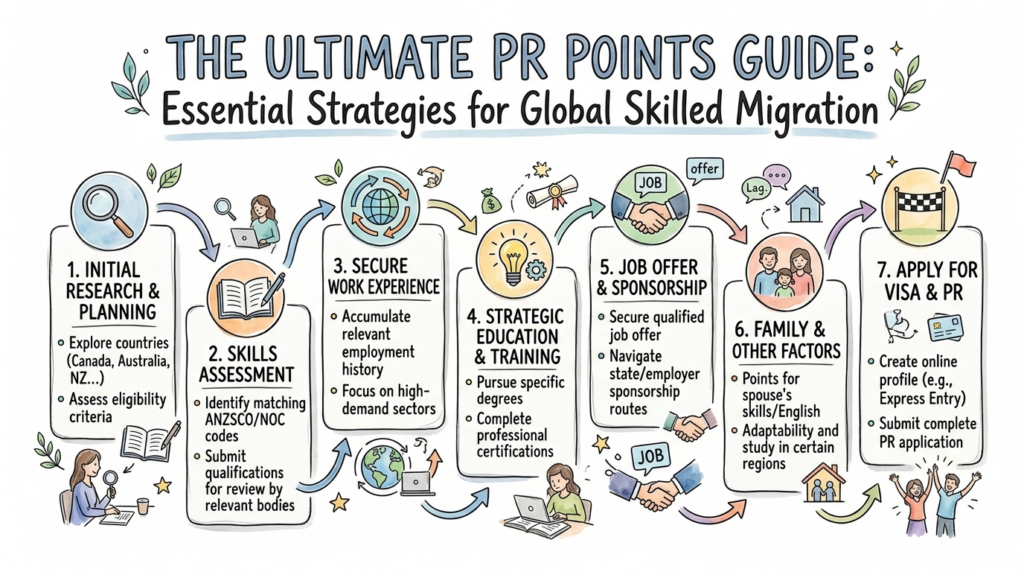
Moving to a new country is perhaps one of the most significant decisions you will ever make. It is a dream fueled by the desire for a better quality of life, higher salaries, safer environments, and world-class education for your children. However, before you pack your bags or book a flight, there is a technical hurdle every aspirant must clear: the points system.
If you have ever researched moving to Canada, Australia, or New Zealand, you have likely come across the term “Points-Based Immigration.” But what does it actually mean? How do you know if you have “enough” points? This is where a PR points calculator becomes your most valuable tool.
Checking your eligibility is the first real step in your immigration journey. It saves you from wasting thousands of dollars on applications that might get rejected and helps you create a roadmap to success. In this guide, we will break down everything you need to know about points calculators, how to use them, and how to maximize your score to turn your immigration dream into a reality.
What Is a PR Points Calculator?
At its core, a PR points calculator is a digital tool designed to simulate the official ranking systems used by immigration departments worldwide.
The Definition
Most modern, high-demand countries use a “Points-Based System” (PBS) to manage migration. Instead of a “first-come, first-served” model, they use a merit-based model. A PR points calculator asks you questions about your life—your age, your schooling, your jobs—and gives you a numerical score.
The Purpose
The primary purpose is filtering. Countries like Canada and Australia receive millions of inquiries. They use these points to identify the “highest-value” immigrants—those most likely to find a job quickly and contribute to the economy.
How It Works
The calculator assigns specific values to different “human capital” factors:
- Age: Usually, younger applicants get more points.
- Education: Higher degrees (Masters/PhD) yield higher scores.
- Language: Your ability to speak English or French is tested and scored.
- Experience: The number of years you have worked in a skilled role.
Eligibility Score vs. Invitation Score
This is a crucial distinction for beginners:
- Eligibility Score: This is the minimum “entry ticket” to get into the pool (e.g., 67 points for Canada’s FSWP).
- Invitation Score: This is the actual competitive score needed to be selected from the pool (e.g., the CRS cut-off).
Think of it like an exam: the eligibility score is the “passing mark,” but the invitation score is the “merit list” rank you need to actually get a seat.
How PR Points Systems Work: The Core Pillars
Every country has its own flavor of the points system, but they all share the same foundation. Here is a breakdown of the common factors you will see in any Skilled migration points calculator.
1. Age (The “Prime Years” Factor)
Immigration systems prefer younger individuals because they can contribute to the local workforce for a longer period before retiring.
- Peak Points: Usually between ages 25 and 32.
- The Decline: Points typically start to drop once you hit 35 or 40.
2. Education (The “Knowledge” Factor)
The more you have studied, the more points you earn.
- Diploma: Basic points.
- Bachelor’s Degree: Standard points.
- Double Credentials: (e.g., a Bachelor’s + a 1-year PG diploma) provides a significant boost in Canada.
- Master’s/PhD: The highest tier of points.
3. Language Proficiency
This is often the “make or break” factor. Most countries require IELTS, PTE, or TOEFL scores.
- CLB 9/10: In Canada, reaching a high level in all four abilities (Listening, Reading, Writing, Speaking) can jump your score by 50+ points.
4. Work Experience
Points are awarded based on the number of years of “Skilled” experience.
- Note: The experience usually needs to fall under specific codes (like NOC in Canada or ANZSCO in Australia).
5. Spouse/Partner Factors
If you are applying with a spouse, their education and language skills can either add to or slightly decrease your total score depending on the country’s logic.
6. Adaptability
Points are given if you have:
- Family living in the country.
- Previous study in the country.
- Previous work experience in the country.
| Factor | Typical Max Impact | Why it matters |
| Age | High | Economic longevity |
| Language | Very High | Integration capability |
| Education | High | Professional Versatility |
| Work Experience | Medium | Immediate job readiness |
Canada PR Points Calculator: The Express Entry Era
Canada is the most popular destination for skilled workers, and its system is famous for being fast but competitive.
The Express Entry System
Express Entry is not a visa; it is an online management system for three programs:
- Federal Skilled Worker (FSW)
- Federal Skilled Trades (FST)
- Canadian Experience Class (CEC)
What is the CRS Score?
The Comprehensive Ranking System (CRS) is the Canada PR points calculator used to rank candidates in the pool. Every few weeks, the Canadian government holds a “draw” and invites those with the highest CRS scores to apply for PR.
CRS Score Breakdown (Simple Version)
- Core Human Capital: Up to 500 points (Age, Education, Language, Experience).
- Spouse Factors: Up to 40 points.
- Skill Transferability: Up to 100 points (Combinations of education and language).
- Additional Points: Up to 600 points (Provincial Nomination, Job Offer, French skills).
Improving Your CRS Score
If your score is low, don’t panic. You can improve it by:
- Retaking the IELTS: Moving from a CLB 8 to a CLB 9 is the fastest way to gain points.
- Learning French: Canada offers massive bonus points for French speakers.
- Provincial Nominee Programs (PNP): If a province nominates you, you get an automatic 600 points, guaranteeing an invitation.
Australia PR Points Calculator: The SkillSelect System
Australia uses the SkillSelect system. Unlike Canada, which focuses heavily on the CRS score for invitations, Australia has a stricter “Minimum 65 points” threshold for even submitting an Expression of Interest (EOI).
Common Visa Subclasses
- Subclass 189: Skilled Independent (Points-tested).
- Subclass 190: Skilled Nominated (Requires state nomination).
- Subclass 491: Skilled Work Regional (Provisional visa for regional areas).
Australia Points Table (General Estimate)
| Factor | Criteria | Points |
| Age | 25–32 years | 30 points |
| English | Superior (IELTS 8/PTE 79) | 20 points |
| Education | Bachelor/Master | 15 points |
| Experience | 8+ years (Overseas) | 15 points |
| Partner | Skilled + English | 10 points |
Example Calculation:
- Age (30): 30 points
- English (PTE 79+): 20 points
- Experience (5 years): 10 points
- Education (Bachelor): 15 points
- Total: 75 points. (A strong score for many occupations).
New Zealand PR Points Calculator
New Zealand’s Skilled Migrant Category (SMC) recently moved to a simplified 6-point system.
To be eligible, you need 6 points from:
- Skilled work experience in New Zealand.
- Qualifications (Bachelor, Master, PhD).
- Income (Earning a certain percentage above the median wage).
New Zealand focuses heavily on whether you have a job offer from an “Accredited Employer.” If you have a PhD, you may already meet the 6-point requirement, but you still need a skilled job offer to qualify.
PR Systems in Other Countries
While the “Big Three” (Canada, Australia, NZ) dominate the conversation, other nations are adopting points-based models.
1. Germany Opportunity Card (Chancenkarte)
Germany recently launched a points system to allow workers to come and look for jobs. You need 6 points, awarded for language skills (German or English), age, and professional recognition.
2. Japan Highly Skilled Professional Visa
Japan uses a points system to fast-track PR for researchers and business professionals. If you score 70–80 points, you can get PR in as little as 1 to 3 years.
3. United Kingdom
Post-Brexit, the UK moved to a points-based system. Most points come from having a job offer from an approved sponsor and meeting the salary threshold.
Benefits of Using a PR Points Calculator
Why should you use an online tool before talking to a lawyer?
- Immediate Reality Check: It tells you instantly if you are eligible or if you need to work on your profile.
- Country Comparison: You might score high for Canada but low for Australia. A calculator helps you choose the path of least resistance.
- Financial Safety: Don’t pay “Evaluation Fees” to agencies for something you can check for free in 5 minutes.
- Goal Setting: If you see that you need 20 more points, you know exactly what to do (e.g., “I need to score higher in my Speaking test”).
Step-by-Step Guide to Calculating Your PR Points
If you are ready to check your score, follow these steps to ensure accuracy:
Step 1: Gather Your Documents
Don’t guess. Look at your degree certificates and your passport for your exact age.
Step 2: Simulate Your Language Scores
Since you might not have taken the IELTS or PTE yet, look at the scoring charts. Most people should aim for a “Target Score” (e.g., 8777 in IELTS for Canada).
Step 3: Evaluate Your Education
If you studied outside the target country, you will eventually need an Educational Credential Assessment (ECA). For now, use your highest completed degree.
Step 4: Calculate Skilled Work Experience
Only count years where you worked in a professional, full-time role. Internships or casual jobs usually don’t count toward PR points.
Step 5: Add Spouse Points
If your partner has a degree or good English skills, calculate their contribution. In some cases, applying as a “Single” applicant actually yields a higher score in Canada.
Step 6: The Final Tally
Input all this into a reliable immigration eligibility calculator.
How to Increase Your PR Score
If your score is currently below the invitation threshold, do not give up. Many successful immigrants started with low scores.
- The “Language Leap”: This is the most effective strategy. In many systems, moving from “Advanced” to “Expert” in English/French gives you a disproportionate boost in points.
- Gain More Experience: Sometimes, just waiting one more year at your current job adds 5–10 crucial points.
- The Spouse Strategy: If your spouse has a higher education level or better language skills, consider making them the “Primary Applicant.”
- State/Provincial Nomination: Research which regions need your specific job. A nomination is a “golden ticket.”
- Sibling Bonus: Some systems (like Canada) give you small bonus points if you have a brother or sister already living there as a PR or citizen.
Common Mistakes to Avoid
- Overestimating Language Skills: Thinking “I speak English at work, so I’ll get full points” is a mistake. The exams (IELTS/PTE) are technical. Always calculate based on realistic scores.
- Miscounting Work Years: Ensure you only count experience after your degree was completed if the country requires it (like Australia’s ACS assessment).
- Using Outdated Calculators: Immigration rules change monthly. Ensure the PR points calculator you use is updated for the current year.
- Ignoring the “Small” Points: Forgetting to add points for a spouse’s English test or a sibling in the country can cost you the invitation.
Real-Life Case Studies
Case Study 1: The Young Techie (Canada)
- Profile: Ankit, 26, Software Engineer, 3 years experience, Bachelor’s Degree.
- Initial Score: 430 (Low English scores).
- The Change: Ankit retook the IELTS and achieved CLB 9. He also completed a 1-year online PG certificate.
- Final Score: 485.
- Result: Received an Invitation to Apply (ITA) in an Express Entry draw.
Case Study 2: The Experienced Couple (Australia)
- Profile: Maria (36) and her husband. Maria has 10 years of experience in Marketing.
- Initial Score: 60 (Below the 65 minimum).
- The Change: Maria applied for State Nomination (Subclass 190) and her husband took a PTE test to provide “Partner Points.”
- Final Score: 75 (65 + 5 for partner + 5 for state).
- Result: Successfully migrated to South Australia.
Case Study 3: The Healthcare Professional (New Zealand)
- Profile: David, Nurse, 5 years experience.
- Initial Score: Struggling with the old points system.
- The Change: New Zealand moved to the Green List system. Because David is a Nurse, his pathway became “Straight to Residence.”
- Final Score: Met the 6-point requirement instantly through professional registration and a job offer.
- Result: PR granted within 6 months.
Frequently Asked Questions (FAQs)
1. What is a PR points calculator?
It is a tool that mimics the official government scoring systems to help you estimate your chances of getting Permanent Residency.
2. Is a 65 score enough for Australia?
While 65 is the minimum to apply, most competitive occupations (like IT or Engineering) currently require 85 to 95 points for an invitation.
3. How accurate are online PR points calculators?
They are highly accurate for estimation, provided you input honest data. However, the final decision always rests with the immigration officer.
4. Does my age affect my PR points?
Yes. In most systems, points peak between ages 25 and 32 and gradually decrease after age 35.
5. Can I apply for PR without a job offer?
Yes! Programs like Canada’s Express Entry (FSW) and Australia’s Subclass 189 do not strictly require a job offer, though having one adds significant points.
6. What is a good CRS score for Canada right now?
While it fluctuates, a score above 500 is generally considered very strong. Scores between 470–490 are competitive for category-based draws (like Healthcare or STEM).
7. Should I take IELTS or PTE?
Both are widely accepted. Many find the PTE (computer-based) easier to score higher in, which is great for the Australia PR points calculator. Canada now also accepts the PTE Core.
8. Can I add points for my spouse?
Yes, if they complete a language test and have their education assessed, they can contribute to your total score.
9. What happens if my points drop while I’m in the pool?
In systems like Canada, if you have a birthday while waiting, your score will automatically update (and usually decrease), so it’s best to apply as early as possible.
10. How much does it cost to check my points?
Using a calculator should always be free. You only pay when you officially file your application or hire a consultant.
11. Does having a relative in the country help?
Yes, most systems offer “Adaptability” points if you have a close relative (parent, sibling, child) who is a citizen or PR.
12. Can I improve my score after submitting my profile?
Absolutely. You can update your profile with new test scores, higher education, or more work experience at any time before you receive an invitation.
Conclusion
The journey to a new life abroad begins with a single number. Whether it is a CRS score for Canada or a points tally for Australia, understanding where you stand is the key to success. A PR points calculator isn’t just a tool; it is your strategy map.
Don’t be discouraged if your initial score is low. Immigration is a marathon, not a sprint. By identifying your weak spots—whether it’s language proficiency or a lack of professional certification—you can take concrete steps to strengthen your profile.
The world is looking for skilled, motivated individuals just like you. Start calculating, start planning, and take that first step toward your global future today.The Ultimate PR Points Guide: Essential Strategies for Global Skilled Migration
