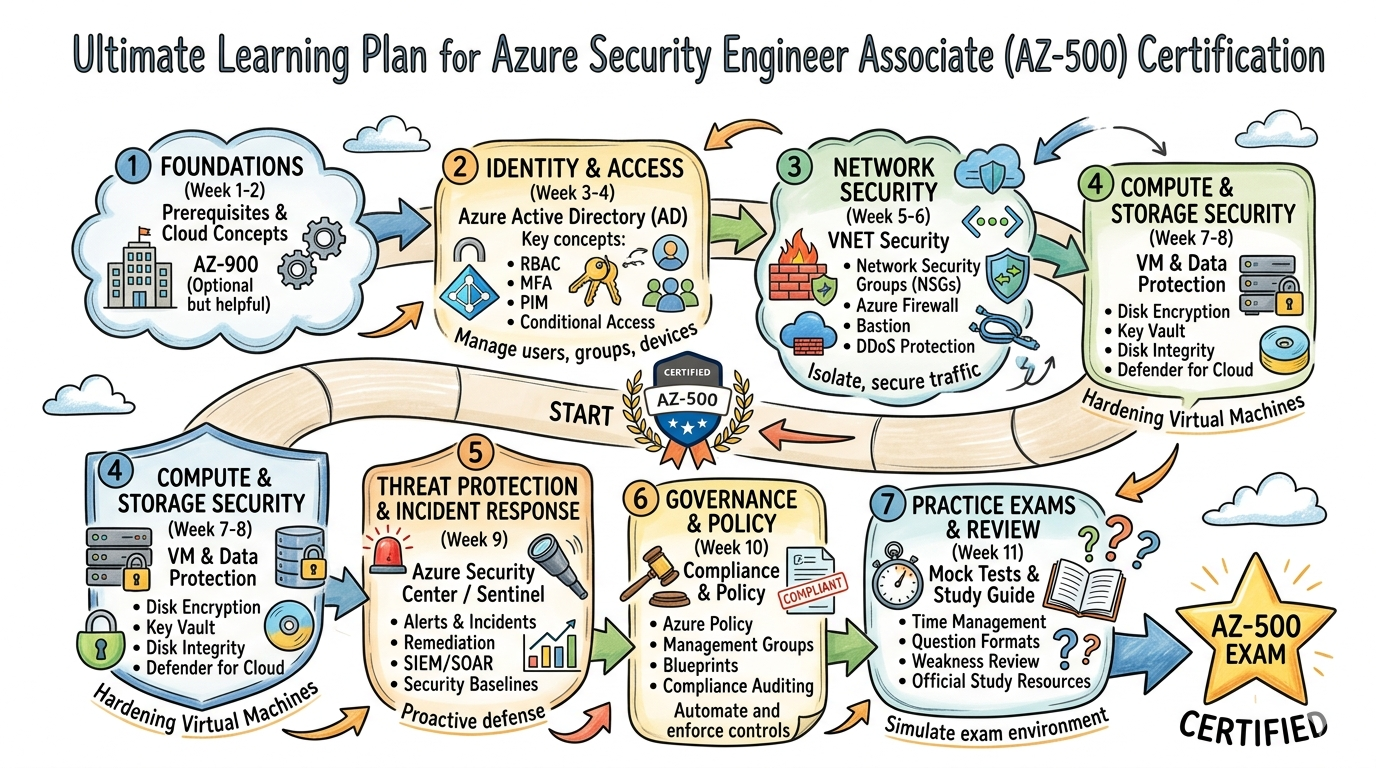
Introduction
Securing cloud infrastructure is no longer an optional task for specialized teams; it is a foundational requirement for modern engineering. The Azure Security Technologies AZ-500 Course provides professionals with the deep knowledge required to safeguard enterprise assets. This comprehensive guide is designed for systems engineers, cloud architects, and platform professionals who want to formalize their security expertise. By understanding the core tenets of this certification, engineering managers and technical leaders can build resilient architectures that withstand modern threats. Navigating the modern landscape requires a blend of security and advanced operations, a cross-disciplinary approach championed by platforms like aiopsschool for automation. This guide helps you evaluate the true career impact of this certification and chart an optimal path forward.
What is the Azure Security Engineer Associate (AZ-500)?
The Azure Security Engineer Associate (AZ-500) is a comprehensive professional validation focused on implementing security controls and threat protection. Rather than focusing purely on theoretical security concepts, this program demands hands-on proficiency in managing identity, access, data, and applications within cloud-native ecosystems. It directly aligns with modern enterprise practices by incorporating automated compliance, continuous monitoring, and infrastructure-as-code security paradigms. For organizations migrating to or operating within hybrid architectures, this certification represents the standard for production-grade security management. Engineers who achieve this status demonstrate the ability to remediate vulnerabilities and defend complex cloud workloads effectively.
Who Should Pursue Azure Security Engineer Associate (AZ-500)?
This certification is highly beneficial for cloud engineers, systems administrators, and DevOps practitioners who want to specialize in cloud security infrastructure. Security analysts and traditional cybersecurity professionals looking to transition into cloud-native architectures will find this program essential for validation. Furthermore, Site Reliability Engineers (SREs) and platform architects can leverage these skills to build automated, secure-by-default landing zones within enterprise environments. In major technology hubs globally and across India’s booming enterprise IT sector, professionals holding this credential are in high demand to bridge the gap between development and compliance. Engineering managers also benefit from this knowledge to oversee secure delivery pipelines and manage organizational risk profiles effectively.
Why Azure Security Engineer Associate (AZ-500)
As enterprise cloud adoption matures, security breaches and compliance violations carry increasingly severe financial and reputational consequences. The demand for qualified cloud security professionals consistently outpaces supply, ensuring long-term career longevity and excellent compensation. This certification equips you with core security design principles that remain highly relevant even as individual software tools and platforms evolve over time. Investing your time in mastering this domain yields a significant career return by positioning you as a critical gatekeeper for enterprise infrastructure. Ultimately, it shifts your professional profile from a general cloud administrator to a high-value security asset capable of protecting complex multi-tenant environments.
Azure Security Engineer Associate (AZ-500) Certification Overview
The Azure Security Engineer Associate (AZ-500) training program is delivered via the Microsoft Azure Security Technologies AZ-500 Course and hosted directly on the devopsschool platform. The assessment approach relies on a rigorous, performance-based examination containing case studies, multiple-choice options, and practical scenario questions. It tests an engineer’s ownership of security infrastructure, focusing heavily on real-world troubleshooting and practical configuration tasks. The structural breakdown of the domain ensures that candidates are thoroughly evaluated across identity management, platform protection, and operations. This structure guarantees that passing candidates possess the baseline competency required to manage live enterprise security environments independently.
Azure Security Engineer Associate (AZ-500) Certification Tracks & Levels
While the AZ-500 exam represents an intermediate associate-level validation, it serves as a critical bridge between foundational cloud knowledge and advanced specialty tracks. The certification architecture allows professionals to transition smoothly from a basic understanding of cloud administration into specialized security roles. For individuals tracking toward DevSecOps, SRE, or enterprise architecture roles, this certification serves as a formal milestone of technical competence. It sets up a structured progression path leading toward advanced expert-level certifications and specialized security governance roles. By aligning these levels with your actual job responsibilities, you can systematically elevate your engineering career and expand your architectural influence.
Complete Azure Security Engineer Associate (AZ-500) Certification Table
| Track | Level | Who it’s for | Prerequisites | Skills Covered | Recommended Order |
|---|---|---|---|---|---|
| Cloud Security | Associate | Cloud Engineers, Security Analysts | Azure Fundamentals | Identity Management, Platform Protection, Data Security | First Security Core |
| DevSecOps | Specialist | DevOps & Security Engineers | DevOps Fundamentals, AZ-500 | Pipeline Security, Automated Compliance, Vulnerability Scanning | Post-Associate Step |
| Security Operations | Advanced | SecOps Leads, Security Architects | Advanced Cloud Admin, AZ-500 | Threat Response, SIEM/SOAR Integration, Governance | Advanced Milestone |
Export to Sheets
Detailed Guide for Each Azure Security Engineer Associate (AZ-500) Certification
Azure Security Engineer Associate (AZ-500) – Core Certification
What it is
This certification validates an engineer’s ability to implement security controls, manage identity and access, protect platform infrastructure, and secure data and applications in an enterprise environment.
Who should take it
Cloud architects, systems administrators, security professionals, and DevOps engineers who want to specialize in safeguarding enterprise-grade cloud environments.
Skills you’ll gain
- Configure Microsoft Entra ID for secure corporate identity management and access control.
- Implement advanced perimeter security, network security groups, and Azure Firewall deployments.
- Configure data encryption at rest and in transit across storage accounts and databases.
- Manage security operations using Microsoft Defender for Cloud and Microsoft Sentinel monitoring solutions.
Real-world projects you should be able to do
- Design and deploy a zero-trust network architecture using enterprise virtual networks and application gateways.
- Build an automated secrets management workflow using Azure Key Vault integrated with containerized web applications.
- Establish a centralized security monitoring system with automated alerting for anomalous resource behavior.
Preparation plan
- 7–14 days: Focus entirely on reviewing the official exam blueprint, mapping core domains, and completing fundamental identity management modules.
- 30 days: Set up a dedicated sandbox environment to practice configuring firewalls, policy definitions, and role-based access controls hands-on.
- 60 days: Run full-length practice examinations, analyze weak topic areas, read whitepapers on complex enterprise deployment scenarios, and finalize compliance labs.
Common mistakes
- Memorizing theoretical questions without gaining sufficient hands-on experience in the actual management console interface.
- Overlooking the complexities of hybrid identity synchronization and advanced enterprise active directory configurations during study.
- Neglecting to study the specific pricing tiers and operational constraints of various cloud security tools.
Best next certification after this
- Same-track option: Microsoft Certified: Cybersecurity Architect Expert
- Cross-track option: Microsoft Certified: Azure DevOps Engineer Expert
- Leadership option: Certified Information Systems Security Professional (CISSP)
Choose Your Learning Path
DevOps Path
Integrating security directly into the software development lifecycle requires a clear understanding of infrastructure vulnerabilities and code isolation patterns. Engineers following this track leverage security certification insights to automate policy enforcement within continuous integration and continuous delivery pipelines. This path emphasizes infrastructure as code validation, scanning container images for security flaws, and managing service principals securely. Ultimately, it transforms standard deployment workflows into resilient configurations that prevent unauthorized alterations to production environments.
DevSecOps Path
This specialized path shifts security to the absolute left of the development pipeline by embedding compliance checking into early architecture stages. Professionals focus heavily on automated threat modeling, continuous vulnerability scanning, and implementing secret rotation mechanisms within application deployments. By mastering these skills, you ensure that security checks do not become operational bottlenecks for agile engineering squads. This career track bridges the historical gap between compliance officers and rapid engineering delivery models seamlessly.
SRE Path
Site Reliability Engineers focus on system availability, performance, and resilience, all of which are intrinsically tied to robust infrastructure security. Security flaws frequently manifest as reliability incidents, making threat mitigation a core component of production uptime strategies. This path utilizes secure infrastructure configurations to prevent denial of service attacks and unauthorized resource exhaustion on critical endpoints. SRE professionals master access governance and network isolation to guarantee systemic stability across complex distributed environments.
AIOps Path
Modern operations rely heavily on artificial intelligence to analyze massive telemetry streams and detect hidden infrastructure anomalies efficiently. Engineers on this path configure secure data ingestion pipelines that feed operational data into machine learning monitoring engines. Ensuring that these monitoring nodes have secure, restricted access to corporate logs prevents data leaks and maintains strict regulatory compliance. This trajectory focuses on automating incident response workflows using intelligent security baselines across enterprise systems.
MLOps Path
Securing machine learning workflows involves protecting valuable training datasets, model registries, and specialized computation pipelines from tampering. This career path applies strict identity management and data lifecycle encryption to prevent adversarial attacks on production models. Engineers learn to isolate high-performance computing clusters and secure the endpoints used for real-time inference delivery. This discipline guarantees that proprietary analytical models remain secure and fully compliant throughout their entire lifecycle.
DataOps Path
Data pipelines require strict governance to protect sensitive business intelligence and personal user information from unauthorized exposure. Professionals following this path implement granular role-based access controls, dynamic data masking, and comprehensive database auditing practices. This ensures that data engineers and analysts can access information safely without violating corporate governance mandates or international regulations. The focus remains on building automated, highly secure data pipelines that preserve data integrity at scale.
FinOps Path
Cloud financial management requires a secure operational framework to prevent unauthorized resource provisioning that drives up corporate cloud spend. This track focuses on using governance policies to restrict expensive resource allocations and monitor cost anomalies tied to security breaches. Security vulnerabilities can lead to unauthorized crypto-mining or resource hijacking, making secure guardrails an essential element of financial control. Engineers learn to align resource tracking with strict budget constraints and clear security ownership structures.
Role → Recommended (Topic name) Certifications
| Role | Recommended Certifications |
|---|---|
| DevOps Engineer | Azure Security Engineer Associate, Azure DevOps Engineer Expert |
| SRE | Azure Security Engineer Associate, Azure Administrator Associate |
| Platform Engineer | Azure Security Engineer Associate, Azure Solutions Architect Expert |
| Cloud Engineer | Azure Security Engineer Associate, Azure Administrator Associate |
| Security Engineer | Azure Security Engineer Associate, Cybersecurity Architect Expert |
| Data Engineer | Azure Security Engineer Associate, Azure Data Engineer Associate |
| FinOps Practitioner | Azure Security Engineer Associate, FinOps Certified Practitioner |
| Engineering Manager | Azure Security Engineer Associate, Azure Fundamentals |
Export to Sheets
Next Certifications to Take After Azure Security Engineer Associate (AZ-500)
Same Track Progression
Advancing further down the dedicated security engineering pathway requires moving into comprehensive architectural governance and enterprise risk management roles. The natural next step is to target expert-level security certifications that focus on designing holistic corporate defense strategies. This progression deepens your knowledge of security operations, compliance frameworks, and zero-trust hybrid architecture implementations across large organizations.
Cross-Track Expansion
Broadening your technical capabilities involves combining security expertise with advanced application delivery or multi-cloud platform management frameworks. Pursuing DevOps or solution architecture certifications allows you to embed security deeper into the core fabric of general enterprise engineering systems. This cross-functional expansion makes you an incredibly versatile professional capable of leading complex digital transformation initiatives safely.
Leadership & Management Track
Transitioning into engineering management or an executive security role requires a shift from tactical configurations to strategic risk management. Professionals on this track focus on global security standards, team building, financial budgeting for security tools, and corporate compliance frameworks. Acquiring leadership credentials prepares you to communicate risk effectively to business executives and lead large-scale engineering departments successfully.
Training & Certification Support Providers for Azure Security Engineer Associate (AZ-500)
DevOpsSchool DevOpsSchool provides an exceptional enterprise-grade training framework tailored for professionals seeking to clear the AZ-500 exam with practical competence. Their curriculum emphasizes real-world deployment scenarios, going well beyond standard slide presentations to deliver immersive, laboratory-driven learning experiences. Instructors with deep industry experience guide students through complex configurations involving enterprise identity management, advanced network protection rules, and cloud monitoring tools. The program includes extensive support resources, continuous mentorship, and updated mock examinations that mirror production environments accurately. This comprehensive educational approach ensures that candidates build genuine operational confidence alongside their formal certification validation goals.
Cotocus Cotocus stands out as a premier technology training provider specializing in interactive, live instructor-led certification preparation programs for modern engineering teams. Their structured course delivery focuses intensely on bridging the gap between theoretical cloud security concepts and actual enterprise engineering requirements. Students gain access to highly optimized lab environments where they can safely configure firewalls, manage secrets, and analyze live system vulnerabilities. The training support team offers personalized feedback, detailed code reviews for infrastructure scripts, and tailored study schedules matching professional routines. This rigorous focus on high-quality technical education makes them a preferred choice for corporate upskilling initiatives.
Scmgalaxy Scmgalaxy offers a deep, community-driven educational platform designed to support engineers through difficult cloud security learning journeys. Their resource library features comprehensive study materials, step-by-step configuration guides, and expert articles detailing modern threat remediation workflows. The training programs emphasize the integration of security tools into continuous deployment pipelines, providing unique value for modern technical professionals. Through collaborative forums and expert-led webinars, students can easily clarify complex architectural concepts and share practical troubleshooting experiences. This emphasis on shared knowledge and extensive documentation creates an enriching environment for long-term professional skill development.
BestDevOps BestDevOps delivers highly focused, career-oriented training modules specifically designed to help professionals master enterprise cloud security engineering practices efficiently. Their course structures are regularly updated to reflect the latest changes in the cloud ecosystem, preventing outdated learning paths. Candidates benefit from realistic case studies, hands-on simulation labs, and interactive group mentoring sessions led by practicing principal engineers. The platform provides extensive post-training support, including interview preparation guidance, resume optimization tips, and continuous access to updated course learning assets. This holistic approach ensures that students achieve career advancement alongside passing their formal examinations.
devsecopsschool devsecopsschool focuses explicitly on the intersection of rapid software delivery pipelines and robust enterprise cloud security control architectures. Their specialized training curriculum ensures that engineers learn how to embed automated compliance and continuous vulnerability scanning seamlessly into workflows. The instructional methodology relies heavily on production-grade projects, requiring students to design secure architectures from the ground up manually. With dedicated mentors available to resolve complex technical blockages, learners receive immediate assistance during intensive hands-on lab sessions. This specialized educational model produces highly capable professionals ready to tackle modern cloud infrastructure challenges confidently.
sreschool sreschool provides a unique perspective on certification preparation by directly linking infrastructure security configurations with systemic reliability and uptime. Their training programs teach students how to treat security threats as potential system reliability incidents requiring automated remediation strategies. Through highly practical lab courses, learners master the art of configuring high-availability firewall layouts and robust access control matrices. The platform provides comprehensive learning trackers, interactive quizzes, and collaborative group assignments that foster deep problem-solving capabilities among engineering professionals. This focus ensures that graduates can build resilient, highly secure cloud systems that withstand modern operational pressures.
aiopsschool aiopsschool leads the industry in delivering advanced training paths that combine artificial intelligence automation concepts with core cloud infrastructure security. Their curriculum prepares professionals to manage massive logging architectures and secure the intelligence systems used for modern security monitoring. Students engage in practical exercises that involve configuring secure data ingestion pipelines and managing restricted access profiles for analytics engines. The support ecosystem includes expert mentoring, comprehensive architectural design reviews, and extensive mock testing focused on automated threat detection environments. This innovative training prepares engineers for the next generation of data-driven security operations roles.
dataopsschool dataopsschool addresses the critical need for robust data governance, access management, and lifecycle protection within enterprise cloud environments. Their specialized certification training ensures that engineers know exactly how to secure massive database clusters, storage systems, and analytics platforms. The courses feature intensive lab sessions focused on implementing dynamic data masking, granular role-based permissions, and end-to-end encryption frameworks. Students receive dedicated instructional support, comprehensive study materials, and access to a vibrant professional network focused on cloud-scale data protection. This ensures that technical professionals can confidently implement comprehensive data defense strategies across complex organizational landscapes.
finopsschool finopsschool provides an essential educational pathway that connects cloud security governance directly with financial accountability and resource management. Their training programs teach engineers how unauthorized infrastructure access or poor security configurations can lead to massive financial waste. Learners practice setting up automated governance policies that restrict costly resource provisions while maintaining strict enterprise compliance boundaries. The support infrastructure offers detailed financial case studies, interactive optimization workshops, and direct guidance from certified cloud financial management experts. This specialized training empowers professionals to build cloud strategies that are both structurally secure and financially optimized.
Frequently Asked Questions (General)
- What is the typical difficulty level of cloud security certifications for experienced administrators? Cloud security certifications generally present a moderate to high difficulty level because they require a deep understanding of networking, identity governance, and operational compliance. Candidates must go beyond basic administration to understand how various security services interact under stressful enterprise production conditions.
- How much time should a working professional allocate to clear this type of assessment? A working professional should ideally dedicate between six to eight weeks of consistent study, planning for roughly ten to twelve hours per week. This timeline allows sufficient room to balance intense hands-on laboratory practice with comprehensive theoretical blueprint reviews.
- Are there any mandatory prerequisites required before attempting an associate-level security exam? While there are no strict mandatory course prerequisites, having a foundational certification or equivalent hands-on experience in cloud administration is highly recommended. Attempting a security specialization without understanding basic cloud infrastructure components can make the learning curve significantly steeper.
- What is the expected return on investment for obtaining a professional security credential? Professionals frequently see immediate returns through increased career opportunities, accelerated promotions, and higher compensation packages across the technology sector. Organizations highly value verified security expertise, making credentialed engineers critical assets for high-stakes enterprise projects.
- Can passing this exam help an engineer transition from traditional IT into DevOps roles? Yes, obtaining a security validation is an excellent catalyst for moving into modern DevSecOps and automated platform engineering tracks. It proves you understand how to protect infrastructure, which is a vital skill when automating continuous delivery pipelines.
- Should I focus on multi-cloud security certifications or master a single platform first? It is highly recommended to master a single major cloud provider’s security ecosystem thoroughly before attempting to learn multi-cloud frameworks. Deep, specialized knowledge on one platform establishes a solid structural foundation that makes learning secondary platforms much easier later.
- How long does this specific type of cloud certification remain valid for professionals? Most major cloud security certifications remain valid for one year from the passing date, requiring free online renewal assessments to maintain active status. This regular cadence ensures that your technical skills keep pace with rapidly changing cloud tools and threat landscapes.
- What types of exam questions should candidates prepare for during the assessment? Candidates should prepare for a mix of traditional multiple-choice questions, detailed enterprise case studies, drag-and-drop architecture scenarios, and performance-based labs. This variety ensures that both theoretical design logic and practical configuration workflows are thoroughly evaluated.
- Is hands-on laboratory experience absolutely necessary to pass the final examination? Yes, hands-on laboratory experience is completely vital because the exam directly tests your ability to navigate configuration screens and troubleshoot deployment errors. Relying solely on textbooks or video lectures without actual console practice often leads to failure.
- How do enterprise organizations validate the authenticity of an engineering certification? Enterprises validate certifications through official digital credential platforms where they can view verified records provided directly by the issuing hosting site. Candidates typically share a unique verification link on professional resumes and networking profiles for immediate verification.
- Does this certification cover corporate regulatory compliance frameworks like GDPR or HIPAA? The exam covers the technical tools and monitoring systems used to enforce regulatory compliance, though it does not test deep legal definitions. You will learn to use built-in policy features to audit and enforce standards like GDPR across workloads.
- What should I do if I do not pass the examination on my first attempt? If you do not pass initially, carefully review the official score report breakdown to identify your weakest specific knowledge domains. Focus your subsequent study weeks on configuring those specific tools in a sandbox environment before scheduling your retake.
FAQs on Azure Security Engineer Associate (AZ-500)
- What core security components are tested most heavily within the AZ-500 blueprint? The exam places significant weight on identity management using Microsoft Entra ID, including conditional access policies, multi-factor authentication, and privileged identity management setup. Platform protection, which covers virtual network security, container security, and advanced firewall configurations, also represents a substantial portion of the scoring model.
- How does the AZ-500 exam compare in difficulty to the standard AZ-104 administration exam? The AZ-500 exam is widely considered more challenging than the AZ-104 because it requires a strict security-focused mindset and deep diagnostic capabilities. While AZ-104 focuses broadly on resource deployment, AZ-500 demands that you understand how to restrict, audit, and defend those exact same resources under threat.
- Can I use the skills gained from AZ-500 within a pure DevSecOps pipeline engineering role? Absolutely, the skills learned are highly applicable to DevSecOps because they teach you how to manage service principals, secure keys, and automate policy guardrails. These technical competencies allow you to configure automated security gates within continuous integration and continuous deployment pipelines effectively.
- What tools are covered for security monitoring and incident response in this certification? The certification heavily covers Microsoft Defender for Cloud and Microsoft Sentinel for centralized logging, security posture management, and real-time security alerts. You will learn how to configure log analytics workspaces, connect data connectors, and design automated playbooks to remediate active infrastructure threats.
- How does AZ-500 handle data protection and cryptographic encryption configurations? AZ-500 covers data protection extensively by testing your ability to manage Azure Key Vault, configure disk encryption, and set up storage account security. You must understand how to manage cryptographic keys, configure database transparent data encryption, and implement secure shared access signatures.
- Is knowledge of hybrid cloud connectivity and on-premises directory integration required for AZ-500? Yes, candidates must understand how to securely connect on-premises environments with cloud assets using secure VPN connections and ExpressRoute architectures. Additionally, integrating on-premises Active Directory with cloud-based identity solutions using synchronization tools is a core requirement tested during the assessment.
- How does mastering AZ-500 contribute to an organization’s overall Zero Trust cloud implementation? Mastering this course enables you to implement the three pillars of Zero Trust: verify explicitly, use least privileged access, and always assume breach. You will gain the practical configuration skills needed to enforce strict conditional access and isolate critical infrastructure components seamlessly.
- What is the best way to utilize mock exams during my AZ-500 preparation journey? Mock exams should be used during the final two weeks of preparation to test your time management and identify lingering knowledge gaps. Avoid simply memorizing the question answers; instead, thoroughly read the technical explanations provided for both correct and incorrect choices.
Final Thoughts: Is Azure Security Engineer Associate (AZ-500) Worth It?
As a principal engineer who has watched cloud architectures evolve over decades, I can confidently tell you that security expertise is the single best differentiator in today’s crowded job market. The Azure Security Engineer Associate (AZ-500) credential is not just another badge to add to your resume; it represents a rigorous validation of skills that directly impacts an enterprise’s risk posture. It shifts your professional identity from someone who simply spins up infrastructure to someone trusted to protect millions of dollars in corporate digital assets. If you are willing to invest the effort into mastering the hands-on configurations required, this path will provide exceptional career longevity and undeniable professional authority. Approach your preparation as an opportunity to build genuine engineering competence rather than just passing a test, and the industry rewards will follow naturally.
