Introduction
While most travelers flock to commercialized, overcrowded tourist hubs, Amaravati stands as a breath of fresh air for conscious explorers. Nestled along the sacred banks of the Krishna River in Andhra Pradesh, this ancient seat of power offers an authentic slice of Indian heritage without the steep price tag. Here, history is not preserved behind paywalls, but lives in the quiet whispers of two-millennia-old Buddhist stupas and grand Dravidian temples.
Choosing Amaravati means stepping away from commercial tourist traps into a landscape defined by deep spiritual roots, serene river bends, and warm local hospitality. It is a rare destination where pocket-friendly travel does not mean compromising on rich cultural experiences.
Why Amaravati is a must-visit city
Amaravati holds an extraordinary chapter in Indian history. Once the capital of the ancient Satavahana Dynasty during the 2nd and 3rd centuries BCE, it flourished as a major global center for Theravada Buddhism and artistic expression. Geographically positioned near Vijayawada and Guntur, it bridges the gap between historical antiquities and modern riverfront landscapes. It is remarkably accessible via the Vijayawada Railway Junction and Vijayawada International Airport (VGA), making it an easy add-on for backpackers, families, and culture enthusiasts alike.
The travel circuit seamlessly blends heritage, spirituality, and nature. You can start your morning exploring rock-cut caves, spend your afternoon reflecting beneath massive Buddha monuments, and wind down at sunset with a riverfront breeze.
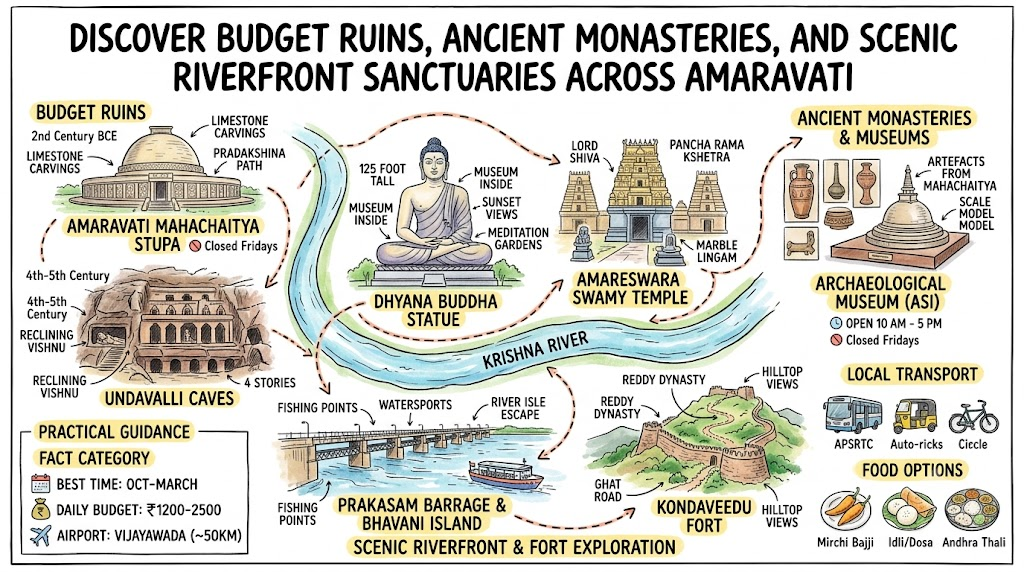
| Fact Category | Key Details |
| Location State | Andhra Pradesh, India |
| Best Time to Visit | October to March (Pleasant winter months) |
| Nearest Airport | Vijayawada International Airport (~50 km) |
| Nearest Major Railhead | Vijayawada Junction Railway Station (~35 km) |
| Primary Attractions | Ancient Buddhist Monuments, Dravidian Shrines, Rock-Cut Caves |
| Average Daily Budget | ₹1,200 – ₹2,500 per person (Budget to Mid-Range) |
Best Places or Experiences
Dhyana Buddha Statue
Rising dramatically against the skyline near the Krishna River, the 125-foot Dhyana Buddha Statue stands as a modern architectural homage to Amaravati’s ancient Buddhist legacy. Completed in 2015, the colossal monument depicts Lord Buddha seated in a serene meditative posture atop a sprawling two-story lotus pedestal.
The interior of the pedestal houses a multi-level museum lined with intricate relief sculptures detailing stories from the Jataka Tales. Walking through the quiet corridors before stepping onto the lush green outer lawns offers a soothing, reflective experience for visitors of all backgrounds.
- Location: Riverfront region, Amaravati town, ~35 km from Vijayawada city center.
- Why it is worth visiting: It is one of the tallest sitting Buddha statues in India, offering breathtaking views of the river plains.
- Best things to do: Explore the interior museum panels, meditate in the quiet outer gardens, and photograph the statue at golden hour.
- Best time to visit: 4:30 PM to 6:30 PM for sunset lighting and cooler breeze.
- Ideal for whom: Solo travelers, photography enthusiasts, families, and peace seekers.
- Travel tip: Wear slip-on shoes as footwear must be removed before ascending the main upper platform.
Amaravati Mahachaitya Stupa
The Amaravati Mahachaitya is a site of monumental archaeological significance, dating back to the 2nd century BCE under the Satavahana reign. Once larger than the famous Sanchi Stupa, this sacred site was historically adorned with limestone relief carvings depicting the life of the Buddha.
Though time and ancient plunder stripped away portions of its outer dome, the remaining carved foundation mounds, stone railings, and carved pillars still radiate immense historical gravitas. Walking around the ancient pradakshina path gives you an authentic connection to India’s deep antiquities.
- Location: Main Heritage Zone, Amaravati town, ~33 km from Guntur city center.
- Why it is worth visiting: It represents the pinnacle of ancient Andhra Buddhist art and monastic architecture.
- Best things to do: Inspect the surviving limestone bas-reliefs, take a quiet circumambulation around the mound, and read the informative ASI plaques.
- Best time to visit: 9:00 AM to 11:00 AM to avoid the midday sun.
- Ideal for whom: History buffs, archaeology students, and slow travelers.
- Travel tip: The main stupa complex is closed on Fridays; plan your week accordingly.
Amareswara Swamy Temple
Dedicated to Lord Shiva, the Amareswara Temple is one of the five sacred Pancharama Kshetras in Andhra Pradesh. Situated directly on the right bank of the Krishna River, the temple features classic Dravidian architecture with impressive gopurams and stone-carved halls.
The unique centerpiece of the sanctum is a 15-foot-tall white marble Shiva Lingam. Because of its height, priests must ascend a dedicated upper floor gallery to perform daily abhishekam rituals, creating a rare ritualistic sight for visitors.
- Location: Krishna Riverbank, Amaravati town center.
- Why it is worth visiting: It is a vital spiritual center combining ancient legend, unique marble architecture, and riverfront heritage.
- Best things to do: Witness the upper-deck morning abhishekam, admire the ancient inscriptions, and take a quiet walk along the adjacent river ghats.
- Best time to visit: Early morning between 6:00 AM and 8:00 AM for morning prayers.
- Ideal for whom: Cultural travelers, spiritual seekers, and architecture lovers.
- Travel tip: Dress conservatively (shoulders and knees covered) to comply with local temple customs.
Amaravati Archaeological Museum
Maintained by the Archaeological Survey of India (ASI), this compact museum serves as the treasure house for artifacts excavated from the nearby Mahachaitya stupa complex. It houses stunning limestone panels, intricate coin collections, and ancient terracotta statues spanning centuries of regional dynasties.
The highlight of the museum is the collection of carved narrative relief panels showing Buddha’s life events, alongside a detailed scale model of how the Mahachaitya stupa originally looked at its peak glory.
- Location: Near Amaravati Stupa site, Main Road, Amaravati.
- Why it is worth visiting: It holds world-renowned masterworks of the Amaravati School of Art for a nominal entry fee.
- Best things to do: View the preserved lotus-carved stone crossbars, study the stupa scale model, and examine 2nd-century Brahmi inscriptions.
- Best time to visit: Mid-day between 11:30 AM and 1:30 PM (fully air-conditioned respite from heat).
- Ideal for whom: Historians, scholars, and curious budget tourists.
- Travel tip: Photography inside the main display galleries requires adherence to posted ASI guidelines.
Undavalli Caves
Carved directly into a solid sandstone hillside, the 4th-to-5th century Undavalli Caves showcase breathtaking rock-cut Indian cave architecture. Originally excavated by Buddhist monks, the site was later expanded during the Vishnukundina dynasty to include Hindu shrines.
The crowning glory of this four-story monolithic structure is on the second floor: a massive 5-meter-long sculpture of Lord Vishnu in a reclining posture (Anantasayana Vishnu), meticulously carved out of a single block of sandstone.
- Location: Undavalli village, ~22 km east of Amaravati town towards Vijayawada.
- Why it is worth visiting: It is one of the finest surviving examples of rock-cut cave architecture in Central India.
- Best things to do: Climb to the top floor balcony for views of the surrounding green fields, inspect the reclining Vishnu statue, and explore the lower pillared halls.
- Best time to visit: 3:00 PM to 5:00 PM when soft light illuminates the cave façade.
- Ideal for whom: Adventure seekers, history lovers, and landscape photographers.
- Travel tip: The stone steps inside can be uneven; wear shoes with reliable grip.
Kondaveedu Fort
Perched atop a rugged mountain range, Kondaveedu Fort is an expansive hill fortress constructed during the 14th century by the Reddy Dynasty. The fort complex stretches across multiple hilltops, featuring ruined ramparts, ancient storehouses, and hilltop temples.
The newly developed ghat road offers a scenic drive up the winding hills, rewarding visitors with panoramic vistas of the surrounding agricultural plains and forest greenery below.
- Location: Kondaveedu, ~45 km south of Amaravati town via Guntur.
- Why it is worth visiting: It offers scenic hilltop views combined with rugged, authentic fort exploration.
- Best things to do: Trek along the fort walls, explore the ancient water reservoirs, and enjoy picnic spots at the hilltop deck.
- Best time to visit: 7:00 AM to 10:00 AM for morning mist and comfortable trekking weather.
- Ideal for whom: Trekkers, nature lovers, and group travelers.
- Travel tip: Bring adequate drinking water and snacks, as food stalls on the upper fort are sparse.
Prakasam Barrage & Bhavani Island
Stretching over 1.2 kilometers across the Krishna River, Prakasam Barrage serves as a lifeline for regional irrigation while doubling as a spectacular riverfront viewpoint. Located just nearby, Bhavani Island is one of the largest river islands in India, accessible via a short ferry ride.
It offers a green escape with shaded walking paths, watersport options, and simple riverfront cafes that suit travelers seeking relaxation after exploring historical sites.
- Location: Krishna River bank, entry near Vijayawada boundary (~30 km from central Amaravati).
- Why it is worth visiting: It offers an affordable combination of scenic river vistas, light adventure, and outdoor relaxing spots.
- Best things to do: Take the morning ferry to Bhavani Island, watch the barrage light up at dusk, and enjoy local spicy street food near the banks.
- Best time to visit: 5:00 PM to 8:00 PM for evening lights and cooler river breeze.
- Ideal for whom: Families, couples, and budget weekenders.
- Travel tip: Book state-run APTDC ferries to Bhavani Island for the safest and most economical boat trips.
Offbeat Exploration: Hidden Gems Tourists Miss
Kondapalli Craft Village
Located just across the river, the small hamlet of Kondapalli is world-renowned for its traditional wooden toys (Kondapalli Bommalu). Crafted using softwood called Tella Poniki, local artisan families have maintained this centuries-old carving tradition for generations. Walking through the quiet village lanes lets you watch master woodcarvers shape and paint these vibrant heritage toys directly outside their homes.
Uppalapadu Bird Sanctuary
Situated roughly 30 km from Amaravati near Guntur, Uppalapadu is a serene wetland haven that remains overlooked by mainstream travel circuits. During the winter migratory season, the village water tanks host thousands of spot-billed pelicans, painted storks, and cormorants flying in from Siberia and Australia. Simple watchtowers allow birdwatchers to observe nesting colonies up close for a nominal entry ticket.
Didugu River Viewpoint
For travelers seeking solitude away from structured monuments, Didugu offers an untouched, peaceful stretch along the Krishna River. Located upstream, this serene village setting features smooth river rocks, wide views of the calm water, and quiet rural scenery—perfect for an early morning walk or an off-grid sunset stop.
Detailed Practical Guidance for Travelers
| Destination | Standard Entry Fee | General Timings | Best Local Food Options Nearby | Recommended Nearby Attractions |
| Dhyana Buddha Statue | ₹20 per person | 8:00 AM – 6:00 PM | Riverfront tiffin stalls (Punti Kura dosa, Idli) | Amareswara Temple, Amaravati Museum |
| Amaravati Mahachaitya | ₹20 (Indians) / ₹250 (Foreigners) | 9:00 AM – 6:00 PM (Closed Fridays) | Heritage Canteen (Mirchi Bajji, Andhra Meals) | ASI Archaeological Museum |
| Amareswara Temple | Free Entry | 6:00 AM – 1:00 PM & 4:00 PM – 8:00 PM | Temple Street Mess (Traditional vegetarian thali) | Dhyana Buddha Statue, Krishna Ghats |
| Archaeological Museum | ₹5 per person | 10:00 AM – 5:00 PM (Closed Fridays) | Local tea stalls & south Indian breakfast joints | Amaravati Stupa Site |
| Undavalli Caves | ₹25 per person | 9:00 AM – 5:30 PM | Highway dhabas (Andhra meals, Biryani) | Prakasam Barrage, Krishna River Viewpoint |
| Kondaveedu Fort | ₹20 per person | 8:00 AM – 6:00 PM | Hilltop snack vendors, Guntur spice eateries | Pristine Hill Deck, Mangalagiri Forest |
Logistics & On-Ground Navigation
Local Transport Options
- APSRTC Public Buses: Regular, highly economical state buses run between Vijayawada Pandit Nehru Bus Station (PNBS), Guntur, and Amaravati town every 20-30 minutes.
- Auto-Rickshaws & E-Rickshaws: Ideal for short hops between the Stupa, Museum, and Dhyana Buddha. Always agree on a fixed rate before hopping in.
- Rental Two-Wheelers & Cars: Renting a scooter or cab from Vijayawada gives you maximum flexibility to explore spread-out spots like Undavalli Caves and Kondaveedu Fort.
Budget Planning
- Backpacker / Low-Budget Tier: ₹1,000 – ₹1,400 per day. Covers budget lodge stays, public bus transport, street food meals, and standard heritage entry fees.
- Mid-Range / Comfort Tier: ₹2,500 – ₹4,000 per day. Covers AC hotel stays in Vijayawada/Guntur, private auto/cab rentals, sit-down Andhra thali dining, and activity fees.
Safety and Inclusivity Tips
- For Families: The terrain around the Stupa and Dhyana Buddha is flat and easy to navigate with strollers or elderly family members.
- For Couples: Highly safe and welcoming; stick to public park hours at Dhyana Buddha and Bhavani Island for pleasant evening strolls.
- General Safety: Keep bottled water handy during afternoon exploration. Solar heat can build up quickly along open stone monuments even in winter.
Strategic Travel Planning Guardrails
Travel Planning Tips for Amaravati
- Optimal Season: Plan your visit between November and February to enjoy pleasant temperatures ranging from 18°C to 28°C.
- Digital & Cash Balance: Digital payments via UPI are widely accepted, but keep ₹500 in small cash notes for local auto drivers and rural vendors.
- Temple Etiquette: Remove shoes outside all temple complexes and wear modest clothing covering shoulders and knees.
- Friday Planning: Note that ASI-managed sites like the Stupa and Museum are closed on Fridays—plan around this gap.
- Hydration & Sun Prep: Carry an umbrella or wide-brim hat when exploring outdoor ruins during mid-day hours.
Common Mistakes to Avoid
- Assuming Amaravati is just one monument: Don’t rush through in two hours; leave enough time to explore both temple heritage and rock-cut cave circuits.
- Relying solely on rideshare apps in rural zones: Uber and Ola operate well in Vijayawada, but auto-rickshaws or rented bikes work better for rural monument hops.
- Skipping authentic street cuisine: Avoid sticking only to hotel dining—local roadside thalis offer rich, spicy flavors that reflect true regional soul.
- Overpacking the afternoon schedule: Avoid heavy outdoor walking between 12:30 PM and 3:00 PM during warmer months; use this time for museum visits.
Suggested Itinerary Blueprints
1-Day Quick Dash (The Heritage Core Loop)
- Target Audience: Travelers on a tight schedule or day-trippers from Vijayawada.
- Morning: Start at 8:00 AM at the Amareswara Temple, followed by a walk through the adjacent Amaravati Mahachaitya Stupa.
- Mid-day: Visit the ASI Archaeological Museum and enjoy a traditional vegetarian Andhra thali.
- Afternoon/Evening: Explore the Dhyana Buddha Statue lawns before heading to Undavalli Caves for sunset.
2-Day Deep-Dive (Culture & Nature Explorer)
- Day 1: Complete the Heritage Core Loop (Amareswara Temple, Stupa, Museum, and Dhyana Buddha). Enjoy a quiet evening riverwalk along the Krishna riverbanks.
- Day 2: Morning trek up Kondaveedu Fort. Afternoon visit to Kondapalli Village to watch toy artisans at work, finishing with an evening ferry ride to Bhavani Island.
Complete Weekend Travel Plan (The Definitive Regional Circuit)
- Friday Evening: Arrive in Vijayawada/Amaravati, check into your stay, and enjoy local evening street food near Prakasam Barrage.
- Saturday: Spend the full day immersed in Amaravati town—exploring the ancient Stupa, Museum, Amareswara Temple, and Dhyana Buddha.
- Sunday: Explore Undavalli Caves in the morning, head to Uppalapadu Bird Sanctuary for birdwatching, and wrap up your trip at Kondaveedu Fort.
Common Tourist Mistakes to Avoid
- Geographic Blunders: Trying to visit Kondaveedu Fort, Undavalli Caves, and central Amaravati monuments all on the same morning. Group them geographically to save travel time.
- Commercial Traps: Spending precious afternoon hours in city shopping malls instead of exploring authentic spaces like Kondapalli craft lanes.
- Neglecting Modern/Alternative Zones: Skipping the peaceful riverfront gardens near Dhyana Buddha or the scenic ghat roads leading up the nearby hills.
- Transport Overpayment: Hiring unmetered long-distance taxis without price comparison. Check local bus schedules or cross-reference auto rates first.
- Luxury Dining Bias: Eating exclusively in continental hotel restaurants. Skipping local tiffin centers deprives you of regional staples like Gongura pachadi, Punti Kura, and fresh Mirchi Bajji.
Frequently Asked Questions
1. Is Amaravati suitable for a budget travel itinerary?
Yes, Amaravati is one of the most budget-friendly cultural destinations in South India. Entry fees for historical sites range from free to just ₹25, while local bus transit and authentic thali meals are very economical.
2. What is the best time of year to visit Amaravati?
The ideal time to visit is during the winter months from October to March, when temperatures are pleasant for outdoor sightseeing and monument exploration.
3. How far is Amaravati from Vijayawada?
Amaravati town is located approximately 35 kilometers west of Vijayawada city center, making it easily accessible via a 45-minute drive or direct state bus ride.
4. Are the monuments in Amaravati open every day?
Most monuments are open daily, but note that the ASI Archaeological Museum and the main Mahachaitya Stupa complex remain closed on Fridays.
5. What is the significance of the Dhyana Buddha Statue?
The 125-foot statue honors Amaravati’s historical role as a major center of Buddhist learning. It features a multi-level museum inside its base showcasing Buddhist art and history.
6. Can I visit Amaravati in a single day?
Yes, a 1-day quick dash allows you to cover core sites like the Mahachaitya Stupa, Amareswara Temple, ASI Museum, and Dhyana Buddha Statue.
7. Is photography allowed at the heritage sites?
General photography is permitted at most outdoor sites including the Dhyana Buddha and Undavalli Caves. Flash photography inside specific museum galleries may be restricted.
8. What local food should I try in Amaravati?
Be sure to try authentic Andhra thalis served with Gongura chutney, spicy Mirchi Bajji, Punti Kura, and traditional South Indian tiffins like crispy dosas and idlis.
9. How do I get around Amaravati without a private vehicle?
APSRTC public buses frequently connect major towns, while auto-rickshaws and e-rickshaws are readily available for short trips between monuments.
10. What are the top places to visit near Amaravati for nature lovers?
Nature lovers can explore the scenic Krishna riverbank ghats, ferry over to Bhavani Island, or travel to the nearby Uppalapadu Bird Sanctuary.
11. Is Amaravati safe for solo female travelers?
Yes, Amaravati is a welcoming, peaceful pilgrimage and heritage town. Standard travel safety practices—such as avoiding dark, unlit roads late at night—apply.
12. What dress code should be followed at local attractions?
Comfortable cotton clothing is ideal. Modest dress covering shoulders and knees is required when entering religious sites like the Amareswara Temple.
Conclusion
Choosing to explore Amaravati is more than taking a typical vacation—it is an enriching journey into the deep soul of Indian history. Standing beneath the ancient stupa mounds, listening to the gentle flow of the Krishna River, and walking through centuries-old rock-cut halls offers a rare sense of quiet wonder. Far away from artificial tourist hubs, Amaravati rewards the thoughtful traveler with timeless heritage, peaceful riverfront views, and authentic cultural connections that stay with you long after the journey ends.\
