Introduction
While search engines direct millions of travelers toward overcrowded hill stations and commercialized coastal escapes, Amaravati offers something far more profound. Situated peacefully along the banks of the mighty Krishna River, this ancient cultural realm is a living canvas where deep history and future-forward vision converge.
Unlike generic tourist hubs with cookie-cutter resorts, Amaravati invites you into a landscape shaped by Satavahana kings, Buddhist philosophers, and centuries of artistic genius. To walk through its sun-dappled ruins, rock-cut sanctuaries, and sacred riverside ghats is to forge an authentic connection with India’s rich spiritual heritage.
Why Amaravati is a must-visit city
Amaravati is an irreplaceable chapter in South Asian history. Serving as the imperial seat of the Satavahana Dynasty over two millennia ago, it grew into a global beacon of Mahayana Buddhism, drawing scholars from across ancient Asia. Architecturally, it gave birth to the famed Amaravati School of Art, characterized by intricate limestone carvings that influenced art across Sri Lanka and Southeast Asia.
Strategically situated between Vijayawada and Guntur, the region is exceptionally accessible. Connected by multi-lane expressways, direct railway lines, and regional airports, it accommodates every traveler archetype—from solitary backpackers seeking ancient lore to families embarking on a seamless weekend road trip.
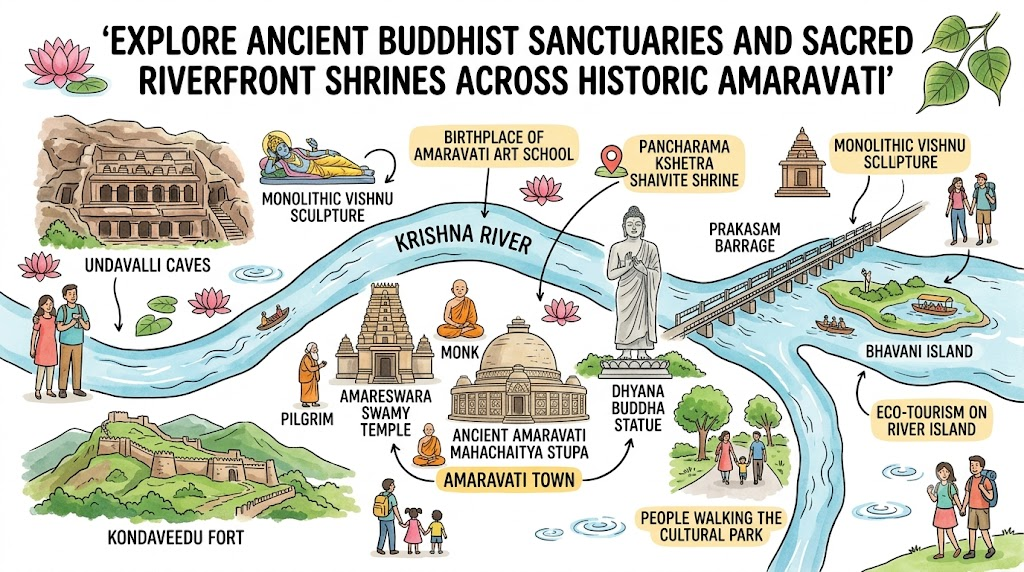
The primary travel circuit loops gracefully along the Krishna River basin, linking ancient Buddhist stupas, rock-cut monoliths, and sacred Shaivite shrines in a single, well-paved corridor.
| Key Fact Category | Destination Profile & Details |
|---|---|
| Geographic Location | Palnadu/Guntur district, Andhra Pradesh (Krishna River Basin) |
| Nearest Airport | Vijayawada International Airport (VGA) – ~55 km away |
| Nearest Major Railway Junction | Vijayawada Junction (BZA) – ~35 km; Guntur Junction – ~32 km |
| Primary Cultural Identity | Ancient Satavahana Capital, Mahayana Buddhist Hub, Shaivite Pilgrimage |
| Ideal Trip Duration | 1 Full Day (Express) to 3 Days (Regional Circuit) |
| Peak Season | October to March (Pleasant winter, mild river breezes) |
Amaravati Mahachaitya Stupa Site.
Best Places or Experiences
Amaravati Mahachaitya Stupa and Archaeological Museum
Dating back to the 3rd century BCE, the Amaravati Mahachaitya was once a monumental Buddhist stupa larger than the famous dome at Sanchi. Constructed during Ashoka’s reign and expanded under the Satavahanas, this sacred relic mound stood adorned with brilliant marble-like Palnad limestone panels depicting jataka tales.
Though time and colonial excavations altered its physical structure, the surviving foundation mound radiates an undeniable spiritual calm. Directly adjacent lies the Archaeological Museum, housing a world-class collection of carved limestone slabs, ancient coins, relic caskets, and stone statues recovered from the immediate vicinity.
- Location: Heart of Amaravati Town, ~35 km northwest of Vijayawada city center.
- Why it is worth visiting: It is the birthplace of the revolutionary Amaravati School of Sculptural Art and one of India’s most important ancient Buddhist pilgrimage sites.
- Best things to do: Trace the ancient circumambulation path (Pradakshina Patha), admire the limestone reliefs inside the museum, and photograph the lotus motifs carved into stone railing posts.
- Best time to visit: Early morning between 8:00 AM and 10:30 AM for quiet contemplation and soft light.
- Ideal for whom: History buffs, archaeology enthusiasts, spiritual seekers, and quiet explorers.
- Travel tip: The museum remains closed on Fridays; plan your day itinerary around this schedule to avoid missing the artifact galleries.
Dhyana Buddha Statue and Cultural Park
Rising majestically to a height of 125 feet along the banks of the Krishna River, the Dhyana Buddha Statue is a modern architectural wonder built on traditional Buddhist aesthetic principles. Sitting atop a massive two-story lotus pedestal, the giant statue depicts Lord Buddha in a deep meditative posture.
Inside the hollow pedestal structure lies an expansive three-level museum gallery detailing the history of Buddhism in Andhra Pradesh. The surrounding landscaped gardens feature carved stone pillars, shaded pavilions, and calm walking paths overlooking the river.
- Location: Amaravati Town edge, ~1.5 km from the main Amaravati Stupa.
- Why it is worth visiting: It seamlessly bridges ancient art with modern grandeur, offering sweeping panoramic vistas of the Krishna River.
- Best things to do: Explore the interior museum panels, relax in the riverfront garden lawns, and capture wide-angle sunset photographs.
- Best time to visit: Late afternoon around 4:30 PM to experience sunset over the river and see the statue illuminated at dusk.
- Ideal for whom: Families, photography enthusiasts, architecture lovers, and couples.
- Travel tip: Wear slip-on shoes as you will need to remove footwear before climbing the main museum pedestal stairs.
Dhyana Buddha Statue along Krishna River.
Amareswara Swamy Temple
Standing as one of the revered Pancharama Kshetras dedicated to Lord Shiva, the Amareswara Swamy Temple gives the region its name—Amaravati. Located directly on the riverbank, the temple complex features a towering nine-foot-tall white marble Shiva Lingam that spans two architectural stories inside the inner sanctum.
According to ancient local lore, the Lingam grew continuously until a marble peg was driven into its crest, which left a faint red mark visible to worshippers today. The temple displays distinct Dravidian architecture with towering gopurams and intricate pillar halls.
- Location: Riverbank zone of Amaravati Town, ~1 km from the Stupa complex.
- Why it is worth visiting: It is one of the five most sacred Shaivite shrines in Andhra Pradesh, buzzing with authentic local rituals and traditional music.
- Best things to do: Witness the morning Abhishekam ritual, walk down the historic stone steps (ghats) to the Krishna River, and observe traditional temple architecture.
- Best time to visit: Early morning (6:00 AM – 8:00 AM) to experience morning prayers and cooler temperatures.
- Ideal for whom: Cultural travelers, spiritual pilgrims, and lovers of traditional architecture.
- Travel tip: Traditional conservative attire is strictly required—men should wear trousers or dhotis, while women should wear sarees or salwar kameez.
Undavalli Caves
Carved into a sandstone hillside during the 4th to 5th centuries CE, the Undavalli Caves stand as a fine example of Indian rock-cut architecture. Originally carved by Buddhist monks, the complex was later transformed under the Vishnukundina dynasty into a stunning multi-tiered Hindu cave temple.
The crowning highlight sits on the grand third floor: a massive 20-foot-long monolithic sculpture of Lord Vishnu in a reclining posture (Anantasayana Vishnu), meticulously carved out of a single sandstone block. The upper balconies offer dramatic, framed vistas across green agricultural fields toward the Krishna River.
- Location: Undavalli Village, ~22 km east of Amaravati Town, near Vijayawada.
- Why it is worth visiting: A multi-layered monolithic masterpiece showcasing the seamless artistic transition from Buddhist to Hindu cave architecture.
- Best things to do: Climb to the top floor to examine the reclining Vishnu monolith, study the cave pillar carvings, and photograph the surrounding greenery from the rock balconies.
- Best time to visit: Morning between 9:00 AM and 11:30 AM when sunlight directly illuminates the multi-tiered cave facade.
- Ideal for whom: Heritage travelers, sculptors, architectural photographers, and curious backpackers.
- Travel tip: The rock-cut stairs can be steep and slick; wear shoes with good traction and carry a water bottle.
Multi-tiered Undavalli Rock-Cut Caves.
Kondaveedu Fort
Spanning across a rugged, green hill range, Kondaveedu Fort was built in the 14th century by the Reddy Dynasty and later expanded by the Gajapatis and Vijayanagara emperors. The complex features fortified ramparts, ancient grain granaries, hilltop water reservoirs, and stone temple ruins.
A newly paved ghat road makes the climb up the mountain hill easy, offering driving vistas and crisp, fresh air. It is a favorite destination for heritage explorers and nature enthusiasts looking to step away from the urban plains.
- Location: Kondaveedu, Palnadu District, ~45 km southwest of Amaravati Town.
- Why it is worth visiting: It blends military hill-fort architecture with lush natural surroundings and panoramic scenic viewpoints.
- Best things to do: Drive up the scenic ghat road, explore the ancient stone ramparts, and picnic near the hilltop water tanks.
- Best time to visit: Late afternoon between 3:30 PM and 6:00 PM for pleasant temperatures and sunset views.
- Ideal for whom: Road-trippers, adventure lovers, trekkers, and history enthusiasts.
- Travel tip: Drive cautiously along the winding ghat curves and pack your own snacks, as commercial stalls on the hilltop are minimal.
Kondaveedu Fort Entrance Ramparts.
Prakasam Barrage and Bhavani Island
Extending over 1.2 kilometers across the Krishna River, Prakasam Barrage is an engineering landmark that creates an expansive lake-like water body. Floating gently in the middle of this water body is Bhavani Island, one of India’s largest river islands.
Reachable via quick motorboat shuttles, the island offers a calm escape with wooden boardwalks, riverfront dining options, and adventure sports, making it a great place to unwind after exploring local heritage sites.
- Location: Connecting Vijayawada to the Amaravati capital zone, ~28 km east of main Amaravati town.
- Why it is worth visiting: It provides a refreshing eco-tourism break with boating activities directly on the Krishna River.
- Best things to do: Take a speed-boat ride to Bhavani Island, walk along the shaded island pathways, and watch the evening floodlights turn on over Prakasam Barrage.
- Best time to visit: 4:00 PM to 7:30 PM for sunset boating and evening lights.
- Ideal for whom: Families with kids, leisure travelers, groups of friends, and couples.
- Travel tip: Book official AP Tourism motorboats at the Bermudagrass jetty to ensure standard pricing and verified safety gear.
Offbeat Exploration: Hidden Gems Tourists Miss
Dharanikota Ancient Fort Enclosure
Just two kilometers west of the main Amaravati stupa lies Dharanikota, the actual fortified citadel of the ancient Satavahana Empire. While most tourists stick exclusively to the stupa grounds, walking through Dharanikota reveals overgrown mud ramparts, ancient brickwork foundations, and quiet agricultural fields that once served as a thriving international inland port connecting India to Rome.
Vaikuntapuram Venkateswara Swamy Hill Temple
Perched on a hillock right on the bank of the Krishna River, Vaikuntapuram is a serene, lesser-known temple site. The unique aspect here is that the sun rays illuminate the deity’s feet during specific seasonal alignments. The hilltop offers unhindered, breezy views of the winding river minus the typical temple crowds.
Neerukonda Hill Viewpoint
Located near the emerging educational district of the new capital region, Neerukonda Hill is a secluded granite outcrop surrounded by green valleys. Local college students and photography enthusiasts know it as the finest place to capture sunrise fog rolling over the Krishna river basin.
Detailed Practical Guidance for Travelers
| Destination | Standard Entry Fee | General Timings | Best Local Food Options Nearby | Recommended Nearby Attractions |
|---|---|---|---|---|
| Amaravati Stupa & Museum | ₹25 (Indians), ₹300 (Foreigners) | 9:00 AM – 5:00 PM (Museum closed Fridays) | Traditional Andhra Meals at local thali messes near Stupa Road | Amareswara Swamy Temple (1 km) |
| Dhyana Buddha Statue | ₹20 per adult | 8:00 AM – 6:00 PM | Mirchi Bajji & Punugulu stalls near entrance park | Krishna Riverfront Ghats (500 m) |
| Amareswara Temple | Free (VIP Darshan ₹50–₹100) | 6:00 AM – 1:00 PM, 4:00 PM – 8:00 PM | Fresh hot Idli and Dibba Rotti at temple lane eateries | Amaravati Archaeological Museum (1.2 km) |
| Undavalli Caves | ₹25 per adult | 9:00 AM – 5:30 PM | Gongura Tiffins and Filter Coffee near Undavalli Junction | Prakasam Barrage (4 km) |
| Kondaveedu Fort | ₹30 per person (Ghat toll extra) | 9:00 AM – 5:00 PM | Local spiced buttermilk and sweet corn stalls at base | Kotappakonda Hill Shrine (25 km) |
| Bhavani Island | ₹60 Boat Transfer | 9:30 AM – 5:30 PM | Riverfront fish fry and Andhra thali at Haritha Resort | Prakasam Barrage viewpoint (1.5 km) |
Logistics & On-Ground Navigation
Local Transport Options
Navigating the Amaravati travel circuit is straightforward once you understand the regional transit hubs.
- Public Buses (APSRTC): Frequent suburban buses connect Vijayawada Pandit Nehru Bus Station (PNBS) and Guntur Bus Stand to Amaravati town every 20 minutes.
- Auto-Rickshaws & E-Rickshaws: Ideal for short hops within Amaravati town (e.g., Stupa to Dhyana Buddha). Always negotiate a fixed price before boarding.
- Private Cab Rentals: Renting a taxi for a full day (8 hours/80 km) from Vijayawada or Guntur is the most comfortable choice for covering distant sites like Undavalli and Kondaveedu.
- Two-Wheeler Rentals: Available in Vijayawada city; great for budget travelers who want the freedom to explore backroads at their own pace.
Budget Planning
- Backpacker / Budget Tier: ₹1,000 – ₹1,500 per day. Covers public bus transit, local street food meals (idli, tiffins, thalis), basic guesthouse stay, and standard monument entrance tickets.
- Mid-Range / Comfort Tier: ₹3,500 – ₹5,500 per day. Includes a private air-conditioned cab rental for the full day, sit-down dining at heritage-style Andhra restaurants, mid-tier hotel stay in Vijayawada/Guntur, and express entry passes.
Safety and Inclusivity Tips
- For Families: The terrain around temples and parks is flat and paved, making it easy for children and seniors. Stick to bottled water and carry sun umbrellas during afternoon outings.
- For Couples: Respect local cultural norms by dressing modestly near sacred shrines and avoiding overly overt public displays of affection around rural temple precincts.
- General Safety: The entire region has a low crime rate and welcoming locals. Hydration is key; summer temperatures can rise quickly, so carry electrolyte powders during outdoor hikes.
Local Secret: Try the local Gongura Pachadi (sorrel leaves chutney) paired with steaming hot rice and ghee at small home-style messes (Bhojanashalas) near Amaravati temple street for an authentic culinary experience.
Strategic Travel Planning Guardrails
Travel Planning Tips for Amaravati
- Plan Around Seasonal Weather: Visit exclusively between October and March to enjoy mild temperatures and pleasant river breezes.
- Carry Cash Reserve: Digital UPI payments work widely, but small rickshaw drivers and rural fruit vendors often prefer cash notes.
- Dress Mindfully: Pack lightweight cotton clothes for daytime heat, along with scarves or shawls required for temple entry.
- Start Days Early: Ancient sites like Undavalli Caves and the Stupa grounds are best explored early before the midday sun sets in.
- Combine Vijayawada and Amaravati: Treat Vijayawada as your evening base for hotels and dining, using daytime hours to explore Amaravati’s historical circuit.
Common Mistakes to Avoid
- Over-packing Itineraries: Don’t attempt to squeeze Kondaveedu Fort, Undavalli, and full Amaravati heritage sites into a half-day trip.
- Ignoring the Museum Schedule: Visiting Amaravati Stupa on a Friday without realizing the Archaeological Museum is closed.
- Assuming Amaravati is Just a Capital: Treating the region merely as a modern government seat while missing its 2,000-year-old heritage.
- Skipping Regional Street Eats: Sticking exclusively to hotel buffets instead of trying local Pesarattu or Punugulu from street vendors.
- Relying Solely on Rideshare Apps: Expecting app-based cabs to be readily available for return trips from remote spots like Kondaveedu Fort—always pre-arrange your return ride.
Suggested Itinerary Blueprints
Day Quick Dash (The Express Heritage Loop)
Target Audience: Time-strapped business travelers or day-trippers based in Vijayawada.
- 08:00 AM – 10:00 AM: Morning drive from Vijayawada to Undavalli Caves; explore the multi-tiered rock architecture.
- 10:30 AM – 01:00 PM: Proceed to Amaravati Town; visit the Amaravati Stupa and Archaeological Museum.
- 01:00 PM – 02:30 PM: Authentic South Indian banana-leaf meal near the temple street.
- 02:30 PM – 04:30 PM: Visit Amareswara Swamy Temple and walk along the river ghats.
- 05:00 PM – 06:30 PM: Relax at the Dhyana Buddha Statue park for sunset views over the Krishna River before returning.
Day Deep-Dive (Heritage & Nature Fusion)
Target Audience: Culture enthusiasts, slow travelers, and photography hobbyists.
- Day 1 (Buddhist & Shaivite Trail): Focus entirely on Amaravati Town—explore the Stupa, Museum, Amareswara Temple, Dharanikota fort ruins, and end with dusk photography at the Dhyana Buddha park.
- Day 2 (Caves, Forts & River Islands): Morning exploration at Undavalli Caves, afternoon drive up to Kondaveedu Fort, and evening boat ride to Bhavani Island for dinner.
Complete Weekend Travel Plan (The Grand Krishna Circuit)
Target Audience: Families and road-trippers seeking a complete weekend escape.
- Friday Evening: Arrive in Vijayawada/Amaravati, check into your hotel, and enjoy evening strolls along Prakasam Barrage.
- Saturday: Execute the full Amaravati heritage loop (Stupa, Museum, Amareswara Temple, and Vaikuntapuram hilltop).
- Sunday: Hike up Kondaveedu Fort, explore Undavalli Caves, enjoy lunch at a traditional Andhra restaurant, and shop for local Kondapalli wooden toys before departing.
Common Tourist Mistakes to Avoid
- Geographic Blunders: Trying to combine Kondaveedu Fort and distant regional sanctuaries on the same morning. Map out your travel route linearly along the river corridor.
- Commercial Traps: Spending afternoon hours in modern Vijayawada malls instead of enjoying the peaceful riverbank paths and ancient rock-cut caves.
- Neglecting Modern/Alternative Zones: Missing out on driving through the new capital layout roads, which offer wide, scenic perspectives of the surrounding green farmland.
- Transport Overpayment: Agreeing to unmetered auto-rickshaw fares without cross-checking distance rates on ride-sharing apps first.
- Luxury Dining Bias: Eating only inside hotel dining rooms and missing out on authentic regional specialties like Gongura Mutton or Pesarattu Upma from established local eateries.
Frequently Asked Questions
1. What is the best time of year to visit Amaravati?
The ideal window to explore Amaravati is from October through March. Winter temperatures remain pleasant (ranging between 18°C and 30°C), making outdoor exploration of open-air ruins and hill forts very comfortable.
2. How far is Amaravati from Vijayawada, and how do I commute between them?
Amaravati Town sits approximately 35 kilometers northwest of Vijayawada. You can travel easily via frequent APSRTC public buses, hire an auto-rickshaw for a day, or book a private taxi ride, which takes around 45 to 60 minutes.
3. Is one day sufficient to cover Amaravati?
Yes, a well-planned one-day trip is enough to visit key highlights including the Amaravati Stupa, Museum, Amareswara Temple, Dhyana Buddha Statue, and Undavalli Caves.
4. Are there stay options available directly in Amaravati Town?
Accommodation options within core Amaravati town are primarily basic guesthouses and pilgrim choultries. For star hotels and mid-range accommodation, staying in nearby Vijayawada or Guntur is recommended.
5. What are the key temple rules at Amareswara Swamy Temple?
Visitors must follow a modest dress code (no shorts or sleeveless shirts). Footwear must be deposited at the outer entrance counter, and photography inside the main sanctum is strictly prohibited.
6. Is the Amaravati Archaeological Museum open every day?
No, the Archaeological Museum is closed every Friday. Plan your trip itinerary accordingly to ensure you can view the ancient sculpture collections.
7. Can we combine Undavalli Caves and Amaravati Stupa on the same day?
Yes, they lie along the same travel corridor connecting Vijayawada to Amaravati, making it easy to visit both on a single day trip.
8. Is Amaravati suitable for family travel with young children and seniors?
Yes, most heritage sites feature accessible, level walking paths. Seniors can comfortably explore the grounds, though caution is advised on steep steps at Undavalli Caves and Kondaveedu Fort.
9. What local food dishes should every traveler try in this region?
Be sure to sample authentic Andhra meals served on banana leaves featuring Gongura Pachadi, Pappu, fresh Avakaya pickle, Dibba Rotti, and hot crispy Punugulu from evening snack stalls.
10. Are photography and videography permitted at the heritage monuments?
Still photography is generally allowed across the monument grounds, though flash photography and tripod usage may be restricted inside museum halls and temple sanctums.
11. What souvenirs should I buy when visiting the region?
Look for handcrafted Kondapalli Toys (traditional wooden painted figures), authentic regional pickles (Gongura and Avakaya), and local handloom brassware from nearby artisan markets.
12. What is the historical connection between Amaravati and Mahayana Buddhism?
Amaravati was a primary center for Mahayana Buddhism under Satavahana patronage. Great Buddhist philosopher Acharya Nagarjuna resided in this region, guiding monks and scholars from across Asia.
Conclusion
Choosing Amaravati over an ordinary, commercialized holiday destination is a choice to slow down and connect with deep history. Walking among two-thousand-year-old stone carved reliefs, standing before giant meditative sculptures, and listening to temple bells along the Krishna River offers a deeply rewarding travel experience. Amaravati is not merely a place you glance at through a camera lens—it is a timeless cultural journey that stays with you long after you return home.
