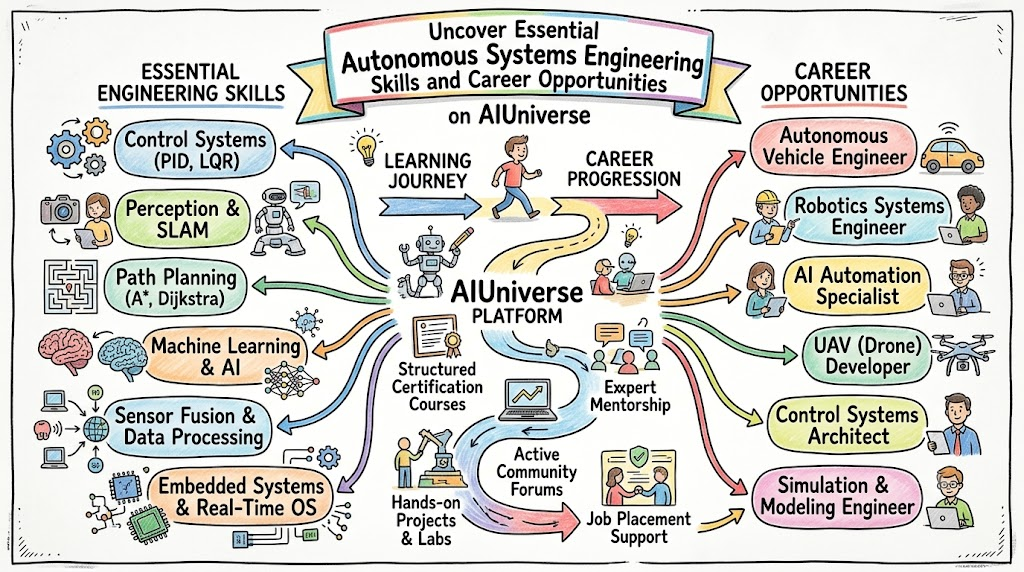
Introduction
Artificial intelligence is rapidly evolving beyond standard conversational chatbots and static text generators toward dynamic system architectures. Modern enterprises are actively deploying autonomous agents that reason through complex problems, plan sequential steps, execute external API tools, and self-correct based on feedback. Understanding these autonomous capabilities requires moving beyond basic prompt engineering into structured architectural paradigms. Gaining mastery over these systems allows professionals to design resilient workflows that handle enterprise data securely and efficiently. By enrolling in targeted learning programs on platform like AIUniverse, engineers and business leaders gain actionable insights into production deployment, vector database integration, and tool orchestration. This guide covers essential concepts, architectural patterns, security controls, and practical implementation roadmaps to help you build reliable, production-ready AI agent systems.
What Is Agentic AI?
Agentic AI represents a paradigm shift from reactive generation to proactive execution, where systems autonomous evaluate goals and determine the optimal path toward completion. Unlike traditional software that follows rigid conditional branches, an AI agent leverages large language models as reasoning engines to break down high-level user instructions into sequential action steps. These agents maintain state through short-term and long-term memory systems, reflect on intermediate execution errors, and select dynamic tools such as web search, mathematical calculators, or database queries to resolve complex tasks. A typical business scenario involves an agent receiving a customer refund request; it autonomously queries the order database, verifies return policy criteria, evaluates transaction risk, processes the payment gateway action, and drafts a personalized confirmation email while waiting for human oversight on edge cases.
How Agentic AI Differs from Traditional AI and Generative AI
Traditional AI operates primarily on explicit rule-based algorithms or statistical classification models designed for highly specific, predefined tasks without broader contextual awareness. Generative AI elevated these capabilities by producing complex text, code, or images based on prompt instructions, yet standard models remain fundamentally passive and stateless during interaction cycles. Conversational AI introduces dialogue management to guide user interactions, but it still relies heavily on pre-planned dialogue flows and rigid backend APIs. Agentic AI unifies these concepts by introducing multi-step planning, reflection, memory persistence, and dynamic tool invocation, granting the system operational autonomy to resolve unpredictable environments without requiring explicit hardcoded logic for every permutation.
| Technology Type | Main Capability | Level of Autonomy | Common Example |
| Traditional AI | Pattern recognition & rules | Low (Deterministic execution) | Spam email filter |
| Generative AI | Content & text generation | Medium (Prompt-dependent output) | Writing a blog draft |
| Conversational AI | Dialogue & intent matching | Medium (Scripted responses) | Customer service FAQ chatbot |
| Agentic AI | Goal-driven multi-step execution | High (Autonomous tool usage) | Autonomous IT incident resolution |
Why Agentic AI Skills Matter for Working Professionals
Mastering agentic architecture allows software developers, DevOps engineers, and cloud specialists to build self-healing infrastructure, dynamic code generation pipelines, and automated monitoring systems that go far beyond static scripts. Data scientists and business analysts leverage these autonomous frameworks to orchestrate advanced analytics pipelines, automatically querying databases and visualizing complex trends without manual intervention. Professionals in sales, customer service, finance, and human resources benefit by offloading tedious multi-step operational workflows to digital agents, allowing teams to focus on strategic execution. Embracing these advanced engineering principles transforms standard operational workflows into resilient systems, giving working professionals a distinct operational advantage across modern, software-driven industries.
What Is an Agentic AI Certification Course?
An Agentic AI certification course provides structured technical instruction on designing, implementing, evaluating, and governing autonomous software agents in production environments. Participants engage with instructor-led lectures, interactive code notebooks, and practical architecture labs that demonstrate how to link large language models with external APIs, vector databases, and memory stores. Beyond mere coding, these programs emphasize rigorous evaluation methodologies, safety guardrails, rate limiting, and prompt injection mitigation required for real-world enterprise deployment. However, professionals must recognize that earning a digital credential serves only as validation; genuine mastery stems from building, testing, and debugging production-grade projects that solve actual enterprise operational bottlenecks.
Who Should Take an Agentic AI Certification Course?
- Working Professionals: Career-focused individuals looking to integrate autonomous systems into existing enterprise infrastructure while modernizing daily operational workflows.
- AI Beginners: Newcomers who possess foundational programming skills and wish to systematically build expertise in large language models, tool binding, and system evaluation.
- Developers and Engineers: Software architects seeking hands-on mastery over framework orchestration, custom tool integration, API handshakes, and production MLOps pipelines.
- Managers and Business Leaders: Executives focusing on enterprise strategy, ROI evaluation, use-case selection, agent safety guardrails, and compliance governance.
- Enterprise Teams: Cross-functional technical groups aiming to align on standardized agent design patterns, security protocols, shared code bases, and deployment scaling.
Skills Covered in an Agentic AI Certification Program
Artificial Intelligence Fundamentals
Understanding basic machine learning algorithms, deep learning architecture, supervised neural networks, and statistical models provides the foundational logic required to grasp how modern agentic systems process, classify, and predict complex data inputs effectively.
Python Programming
Mastering core Python syntax, asynchronous execution, object-oriented design patterns, REST API communication, error handling, and package management ensures developers can seamlessly construct, test, and maintain robust agent orchestration scripts across scalable cloud software environments.
Large Language Model Fundamentals
Grasping tokenization mechanics, context window constraints, dense embedding projections, structured JSON outputs, temperature controls, and hallucination triggers allows system designers to select and configure the optimal base model for dynamic multi-step reasoning tasks.
Prompt Engineering
Crafting explicit role definitions, clear instruction framing, system constraints, few-shot examples, and formatted output schemas minimizes model drift and maximizes predictable execution when instructing base language models to complete multi-step tasks.
Prompt Management
Organizing prompt assets using top-tier prompt management solutions allows engineering teams to implement version control, run comparative output regression tests, facilitate continuous collaboration, track performance metrics, and monitor API cost efficiency across production deployments.
API and Tool Integration
Connecting agents to external SQL databases, customer relationship platforms, cloud services, service management tickets, and custom REST APIs enables base language models to interact dynamically with enterprise software assets safely and reliably.
Retrieval-Augmented Generation
Combining vector search, dense document embeddings, semantic retrieval, and hybrid re-ranking ensures agents query trusted knowledge databases accurately, supplying precise contextual background while reducing false information generation during runtime.
Agent Memory
Implementing short-term conversational buffers, key-value session stores, vector-based long-term semantic storage, and contextual user preference structures allows dynamic agents to retain crucial state details, past interaction logs, and continuous environmental awareness across complex multi-step user tasks.
Planning and Reasoning
Designing deliberate decision-making strategies such as ReAct frameworks, tree-of-thought exploration, task decomposition trees, and step-by-step reflection cycles empowers software agents to break down massive operational goals into controllable, sequential sub-actions.
Agent Evaluation
Systematically assessing performance using task completion rate, tool call precision, latency, token cost, output accuracy, and human oversight frequency guarantees that agents meet operational benchmarks reliably before graduating to production infrastructure deployment.
Security and Governance
Establishing strict user permission boundaries, API token encryption, automated audit trail logs, human-in-the-loop verification gates, input prompt injection filters, and role-based access limits protects enterprise software environments against malicious exploits and operational failures.
Agentic AI Learning Roadmap for Beginners
| Learning Stage | Main Topics | Practical Outcome |
| Stage 1: AI & Python Foundations | Python syntax, REST APIs, JSON parsing, basic ML models | Ability to fetch API data and write data scripts |
| Stage 2: LLMs & Prompting | Tokenization, context windows, prompt formatting, system instructions | Configured base model prompts with structured JSON output |
| Stage 3: Retrieval Systems | Embeddings, vector storage, chunking strategies, hybrid RAG | Functional semantic search engine over private documents |
| Stage 4: Single-Agent Design | Tool binding, function calling, ReAct planning, memory persistence | Autonomous agent executing single-step database actions |
| Stage 5: Multi-Agent Workflows | Agent orchestration, specialized roles, message passing, routing | Collaborative system resolving complex multi-role workflows |
| Stage 6: MLOps & Production Safety | Model monitoring, evaluation benchmarks, guardrails, API security | Secure, observable agent deployed to enterprise cloud |
Single-Agent and Multi-Agent Systems
Single-agent architectures rely on a unified model instance executing tools sequentially through a central reasoning loop, offering simple setup, lower latency, and easy debugging for straightforward procedural tasks. However, single agents often struggle with broad instruction sets, context overload, and complex goal switching. Multi-agent systems address these bottlenecks by establishing specialized agent roles that divide labor, communicate across structured message buses, pass task states dynamically, and cross-evaluate intermediate outputs. For instance, a multi-agent software delivery workflow utilizes a product owner agent to draft specifications, a developer agent to generate code, a reviewer agent to audit security vulnerabilities, and a DevOps agent to execute CI/CD pipelines. AI beginners should always start by mastering single-agent tool integration before attempting to design complex, distributed multi-agent systems.
Connection Between Agentic AI and MLOps
Deploying dynamic agents into production demands rigorous MLOps practices to maintain systemic stability, version consistency, and operational observability across constantly shifting language model outputs. A comprehensive MLOps certification course trains engineers to establish automated CI/CD deployment pipelines, manage prompt and embedding version control, execute continuous integration testing, and monitor model drift over time. Leveraging leading MLOps software platforms enables engineering teams to track experiment metrics, log token latencies, manage fallback model routing, evaluate tool execution success, and trigger automated rollbacks when performance drops below acceptable baselines. Selecting the right operational framework depends on your specific cloud architecture, data residency standards, budget constraints, security compliance needs, and current developer tooling ecosystems.
Connection Between Agentic AI and AIOps
Modern IT infrastructure management heavily relies on artificial intelligence to simplify system monitoring, automate incident response, and manage complex cloud environments seamlessly. Completing a structured AIOps certification course equips engineers with the skills needed to implement intelligent monitoring tools that analyze telemetry, correlate telemetry logs, detect operational anomalies, and execute automated root-cause analysis. For example, when an enterprise application experiences a sudden database connection spike, an AIOps agent can automatically detect the anomaly, query server performance metrics, isolate a memory leak in a recent code commit, draft an incident ticket, and notify on-call engineers with actionable remediation steps. To prevent widespread system outages, automated agent remediations must always enforce role-based access limits, execution rate limits, mandatory human approval gates, and step-by-step audit logging.
Role of Federated Learning Platforms
Federated learning offers a decentralized training framework that allows machine learning models to train across distributed edge devices or isolated database servers without centralizing raw, sensitive data. Leveraging advanced federated learning platforms allows enterprises to compute local model updates individually and aggregate only cryptographically secure model weights back to a central server. This privacy-preserving design offers massive compliance benefits for highly regulated industries like healthcare, banking, telecommunications, and cross-border enterprise operations where strict data sovereignty policies apply. Despite these architectural security advantages, federated learning implementations face real-world deployment challenges including network communication latency, non-identical data distribution across nodes, vulnerability to model-poisoning security attacks, and complex governance overhead across decentralized administrative domains.
Practical Agentic AI Use Cases Across Industries
Customer Service
Agents parse customer support tickets autonomously, search internal knowledge bases, resolve billing inquiries, initiate policy-compliant returns via order APIs, and escalate disputed edge cases to human representatives with complete context summaries.
Software Development
Agents receive high-level product feature specs, generate component code, run automated unit tests within sandbox environments, fix syntax errors based on compiler outputs, and submit pull requests for peer engineering review.
IT Operations
Agents monitor cloud server metrics, detect memory spikes, correlate system logs across microservices, isolate root causes during outages, execute predefined restart scripts, and draft incident summary reports for technical lead review.
Sales and Marketing
Agents analyze incoming marketing leads, cross-reference corporate CRM records, search public web signals for company size, score lead potential dynamically, draft customized outreach emails, and schedule qualified product demos directly onto sales calendars.
Finance and Accounting
Agents scan vendor invoices, extract structured line items, reconcile transactions against purchase orders, flag fraudulent billing anomalies, initiate approval workflows, and post verified entries into enterprise resource planning software automatically.
Human Resources
Agents screen incoming resume files against job descriptions, schedule interview times with prospective candidates across multiple calendars, answer benefits questions using internal policy manuals, and automate preliminary employee onboarding tasks efficiently.
Cybersecurity
Agents correlate network traffic alerts, aggregate threat intelligence indicators, isolate compromised endpoints, revoke compromised user access keys, collect forensic telemetry logs, and present formatted threat analysis summaries to security operation analysts.
Manufacturing
Agents process factory floor IoT sensor telemetry, predict component maintenance failures, auto-order replacement parts from suppliers via procurement systems, update shift schedules, and log maintenance events directly into enterprise asset management platforms.
Healthcare
Agents summarize patient medical history records from electronic health databases, organize clinical trial notes, cross-reference drug interaction risks, and draft preliminary clinical summaries for mandatory physician review before patient visits.
Business Analytics
Agents query distributed SQL databases based on plain English management questions, execute statistically rigorous data aggregations, generate informative visual chart graphics, and draft executive narrative reports summarizing critical performance metrics.
Best AI Tools for Business Evaluation Guide
Selecting top-rated enterprise AI software tools requires a systematic evaluation process focused on long-term scalability, technical interoperability, security standards, and clear return on investment. Decision-makers must evaluate solutions beyond basic vendor claims by asking hard questions about system architecture, licensing models, compliance frameworks, data handling policies, and customization flexibility. Organizations should always conduct small, controlled proof-of-concept pilot projects to validate vendor capabilities, test API integration ease, and measure user adoption before committing enterprise capital to large-scale operational deployments.
| Evaluation Area | Questions Businesses Should Ask |
| Business Fit | Does this tool address our specific operational bottleneck and deliver quantifiable workflow efficiency? |
| Data Privacy | Is customer data encrypted in transit and at rest, and is it excluded from vendor base model training? |
| Security | Does the software support single sign-on, role-based access control, SOC2 compliance, and audit logging? |
| Integration | Does the platform offer pre-built connectors and robust REST APIs compatible with our technology stack? |
| Accuracy | What is the observed output precision, hallucination frequency, and tool invocation error rate under load? |
| Scalability | Can the system handle peak API request volumes without significant latency spikes or performance drops? |
| Governance | Are there adequate human-in-the-loop review controls, policy enforcement guardrails, and rollback systems? |
| Cost | What are the recurring licensing tiers, API execution costs, storage fees, and hidden setup costs? |
| Customization | Can we fine-tune prompts, adjust model hyper-parameters, and construct custom tool extensions easily? |
| Technical Support | What are the vendor’s service level agreements, support ticket response times, and developer documentation quality? |
| Exit Strategy | Can we export our data, custom prompts, and historical logs cleanly if we transition away from the platform? |
Practical Agentic AI Project Ideas
Beginner Projects
- Document Question-Answering Agent: A basic semantic search tool that reads local PDF documents using vector embeddings and answers natural language user queries accurately.
- Meeting Summary Agent: An automated utility that ingests audio transcriptions, extracts key discussion points, identifies decisions, and formats assigned action items into clear structured lists.
- Personal Task-Planning Agent: A personal assistant that takes high-level user goals, breaks them into daily actionable tasks, and orders them based on personal priority rules.
- FAQ Assistant: A customer-facing chatbot that answers store policy questions by fetching verified information from an online knowledge base.
- Product Information Assistant: An agent that searches catalog spreadsheets to provide users with precise product specifications, stock status, and feature comparisons instantly.
Intermediate Projects
- Customer Support Ticket Agent: An automated workspace assistant that parses incoming customer support emails, categorizes problem urgency, searches backend databases for solutions, and drafts policy-compliant responses for agent review.
- Sales Lead Qualification Agent: A prospecting utility that accepts incoming contact submissions, queries public web APIs to gather missing company details, scores lead alignment, and populates CRM profiles automatically.
- Employee Onboarding Assistant: An HR agent that guides new hires through documentation requirements, sets up account access, and answers benefit questions using internal policy manuals.
- IT Incident Analysis Agent: An operations helper that continuously monitors system log files, groups error codes, identifies potential failure points, and drafts detailed incident tickets for the on-call team.
- Testing Assistant: A developer tool that reads Python source code files, identifies missing test assertions, writes comprehensive unit tests, and validates syntax automatically.
Advanced Projects
- Multi-Agent Software Delivery System: A multi-role software agent team where a coordinator breaks down user stories, a developer writes code, a tester runs automated units, and a security agent audits code for vulnerabilities.
- Cloud Operations Agent: An autonomous infrastructure management system that monitors server loads, auto-scales cloud instances, terminates idle microservices, and flags abnormal infrastructure spending spikes in real time.
- Enterprise Knowledge Agent: A high-scale enterprise search system combining multi-source hybrid RAG retrieval, document access permission enforcement, user role filtering, and dynamic content synthesis.
- Security Investigation Agent: A cybersecurity threat analysis workflow that intercepts network security alerts, cross-references internal log repositories, isolates infected cloud endpoints, and constructs incident response timelines.
- Supply-Chain Decision-Support System: An operational planning network that predicts inventory shortages, balances warehouse storage limits, compares freight vendor quotes dynamically, and recommends optimized shipping routes.
For every project built, developers must thoroughly document the target problem statement, system architecture diagram, incoming data pipelines, external tool APIs bound, permission security limits, evaluation test benchmarks, latency monitoring setup, known edge-case limitations, and verified ROI business metrics.
Common Challenges in Agentic AI Development
Hallucinated Information
Base language models frequently generate confident but factually incorrect assertions when context is missing, severely damaging system trustworthiness and operational safety. Implementing strict grounding techniques through hybrid RAG retrieval, explicit system boundaries, temperature reductions, and factual output validation checkers significantly reduces hallucination occurrences in production.
Incorrect Tool Usage
Agents often pass improperly formatted arguments, confuse API parameter definitions, or invoke wrong external utilities entirely when executing multi-step reasoning plans. Developers must implement explicit JSON Schema parameter validation, supply clear usage examples within tool definitions, and add retry handlers to correct malformed call attempts.
Prompt Injection
Malicious users attempt to manipulate agent execution by embedding hidden system instructions inside uploaded files or incoming input fields to bypass safety guardrails. Mitigate these injection vulnerabilities by strictly separating untrusted user data from system prompts, applying dedicated input sanitizer models, and executing agent actions within sandboxed environments.
Data Leakage
Agents handling multi-tenant enterprise data risk exposing confidential internal records or private customer information to unauthorized users during conversational cycles. Systems must enforce dynamic data masking, enforce tenant-isolated database context pipelines, and execute strict role-based access control filtering before delivering final context updates to the language model.
Unlimited Action Loops
Flawed reasoning frameworks can cause agents to enter infinite tool invocation loops when tasks fail, consuming massive API budgets without reaching task resolution. Establishing explicit step-count execution limits, maximum budget caps per session, cycle detection algorithms, and mandatory task timeouts prevents software engines from executing uncontrolled repetitive calls.
High API Costs
Executing complex ReAct planning loops across large commercial models causes rapid token accumulation, leading to unsustainable cloud billing expenses for high-volume enterprise software operations. Systems should route basic classification tasks to smaller fine-tuned open-source models, leverage semantic caching for duplicate queries, and truncate contextual message histories aggressively.
Slow Response Time
Chaining multiple sequential LLM calls and tool API handshakes introduces significant execution latency, resulting in poor user experience across real-time application interfaces. System designers can improve response speed by running independent task branches in parallel, utilizing asynchronous streaming responses, and selecting fast specialized model endpoints for simple intermediate processing steps.
Difficult Evaluation
Evaluating non-deterministic software agent execution across dynamic multi-step paths presents far greater complexity than testing standard deterministic computer programs. Engineering teams should establish automated benchmark suites using framework evaluation rubrics, combined with golden-dataset test collections and periodic human expert quality spot-checks.
Weak Monitoring
Failing to maintain granular visibility into intermediate reasoning steps, tool usage latencies, prompt costs, and system failures leads to unexplainable production outages. Enterprise deployments must implement robust LLMOps tracing frameworks that log every model interaction step, parameter output, tool status payload, and system latency metric comprehensively.
Lack of Human Control
Granting full operational autonomy to autonomous software systems without oversight mechanisms exposes enterprises to severe operational failures, reputation damage, and liability risks. System architectures must integrate explicit human-in-the-loop review gates for high-impact actions, such as money transfers, database deletions, and external communications.
Integration Problems
Connecting modern language model frameworks to legacy enterprise software platforms often surfaces severe API incompatibility, authorization failures, and schema mismatches. System integration teams must construct clean wrapper services, standardize data serialization interfaces, and establish robust error-handling protocols around all underlying software integrations.
Regulatory and Compliance Issues
Deploying autonomous systems across regulated sectors without adequate tracking risks violating data protection laws, privacy mandates, and corporate compliance frameworks. Organizations must implement persistent, audit logging of all system actions, ensure strict algorithmic transparency, maintain dynamic user consent trackers, and enforce clear data retention rules.
Responsible Agentic AI Practices
- Implement minimum required system permissions across all external tools and database API connections.
- Enforce human-in-the-loop approval gates for high-risk transactional, administrative, or financial actions.
- Encrypt all sensitive enterprise data and user telemetry both in transit and at rest using modern algorithms.
- Maintain complete environment isolation between development, staging, testing, and production application stacks.
- Implement structured, immutable audit logging for every intermediate decision step, tool input, and output parameter.
- Conduct regular prompt injection penetration testing to locate and patch system jailbreak vulnerabilities continuously.
- Define strict execution action limits, maximum step constraints, and absolute task timeout parameters per session.
- Set hard daily and monthly API spending limits across model endpoints to prevent unexpected cost spikes.
- Restrict dynamic agent retrieval tools exclusively to verified, policy-approved domain knowledge databases.
- Validate all model generation outputs against strict schema validators before passing payload data to backend APIs.
- Maintain clean rollback procedures to restore prior application code versions and prompt configurations instantly.
- Conduct regular reviews of saved memory context stores to remove outdated, inaccurate, or sensitive user records.
- Assign explicit human accountability and operational ownership for every deployed autonomous agent system.
- Monitor live application outputs continuous for dynamic model drift, toxicity, and bias patterns.
- Document system capabilities, operational boundaries, known edge-case failures, and safe usage guidelines transparently.
Career Opportunities After Agentic AI Certification
- Agentic AI Developer: Software specialist who designs, builds, and maintains custom multi-step software agents, API integration tool suites, and dynamic task orchestration loops.
- Generative AI Engineer: AI practitioner focusing on fine-tuning base models, crafting dynamic context management pipelines, and orchestrating scalable generative applications.
- AI Application Developer: Full-stack engineer responsible for integrating advanced AI services, vector databases, and model endpoints into commercial user applications.
- MLOps Engineer: Systems professional managing CI/CD deployment pipelines, model monitoring infrastructure, continuous testing suites, and scalability frameworks.
- LLMOps Engineer: Operational specialist dedicated to optimizing prompt versioning systems, tracking token execution costs, reducing latency, and monitoring model drift.
- AIOps Engineer: Infrastructure specialist leveraging artificial intelligence solutions to automate enterprise server telemetry monitoring, incident correlation, and auto-remediation.
- AI Automation Specialist: Operational consultant focused on identifying manual business workflows and replacing them with autonomous digital multi-agent process automation.
- AI Solutions Architect: Senior system designer responsible for defining enterprise platform architecture, vector search infrastructure, data privacy controls, and security standards.
- Prompt Engineer: System specialist crafting, testing, versioning, and continuously optimizing natural language instruction templates and structured system output schemas.
- AI Consultant: Enterprise advisor helping business leaders conduct readiness assessments, identify high-value AI use cases, evaluate software vendors, and manage technology adoption.
- AI Product Manager: Product strategist defining functional feature roadmaps, tracking operational success metrics, coordinating development, and ensuring safe deployment.
- AI Governance Analyst: Compliance professional evaluating system safety, enforcing regulatory data protection rules, managing risk audits, and monitoring ethical standards.
How to Build a Strong Agentic AI Portfolio
Building a impactful professional portfolio requires showcasing production-grade engineering practices rather than hosting basic, unmaintained repository scripts copied from simple online tutorials. Each project featured in your portfolio should solve a tangible business problem and highlight complete end-to-end implementation details, including source code, clear architecture diagrams, dynamic tool integration scripts, and semantic RAG pipelines. Candidates must explicitly demonstrate their attention to enterprise deployment needs by highlighting robust security controls, token budget limits, automated evaluation testing suites, observability tracing setups, and comprehensive cost analysis breakdowns. Presenting two or three highly polished, well-documented, production-ready application repositories demonstrates far greater mastery to technical hiring teams than compiling dozens of superficial, incomplete code snippets.
How to Choose AI Certification Courses Online
Evaluating online AI certification courses requires carefully auditing the program curriculum to ensure it balances theoretical computer science concepts with hands-on enterprise application development. Prospective students should prioritize programs that feature experienced industry practitioners, practical interactive coding labs, real-world project portfolios, continuous curriculum updates, and comprehensive instruction on MLOps, LLMOps, and security frameworks. Avoid platforms that make unrealistic career promises, rely on outdated video libraries, offer no instructor support, or lack rigorous project grading standards.
       [ Course Evaluation Framework ]
                     │
    ┌────────────────┴────────────────┐
    ▼                                 ▼
[ Green Flags ]                [ Red Flags ]
 ├─ Hands-on coding labs        ├─ Job guarantees
 ├─ MLOps & security focus      ├─ Pure video lectures
 ├─ Experienced mentors         ├─ Outdated concepts
 └─ Real-world projects         └─ No code reviews
Weekly Learning Plan for Working Professionals
Week 1-2: Core Python & REST APIs
 └─ 5 hrs/wk: Syntax, Async, JSON handling

Week 3-4: LLM Mechanics & Prompting
 └─ 6 hrs/wk: Tokenization, Prompt Engineering, Structured Outputs

Week 5-6: Embeddings & RAG Systems
 └─ 6 hrs/wk: Vector Databases, Chunking, Hybrid Search

Week 7-8: Single-Agent Systems & Tools
 └─ 8 hrs/wk: Function Calling, Memory Stores, ReAct Loops

Week 9-10: Multi-Agent Orchestration
 └─ 8 hrs/wk: Role Delegation, Message Buses, State Machines

Week 11-12: MLOps, Safety & Capstone Project
 └─ 10 hrs/wk: Tracing, Guardrails, Deployment, Documentation
Beginner Roadmap for Starting Agentic AI
Step 1: Learn Basic Python
Master core programming fundamentals including variable scope, conditional logic structures, dictionary data handling, asynchronous execution functions, error trapping, and external library package management.
Step 2: Understand APIs and JSON
Learn how to query REST API endpoints, send HTTP requests asynchronously, pass authorization tokens securely, and parse complex nested JSON responses cleanly.
Step 3: Study AI Fundamentals
Grasp core machine learning principles, neural network concepts, supervised training mechanics, dense vector spaces, and standard statistical data evaluation metrics.
Step 4: Learn Large Language Model Basics
Understand transformer architectures, context window boundaries, tokenization mechanisms, structured output generation, temperature hyper-parameters, and hallucination factors.
Step 5: Practice Prompt Engineering
Master structured instruction framing, explicit constraint definitions, system role definitions, few-shot contextual formatting, and robust JSON schema enforcement patterns.
Step 6: Build a Chatbot
Construct a standard conversational state application that persists user interaction logs, handles session tokens, and streams response strings smoothly to user interfaces.
Step 7: Add Document Retrieval
Integrate vector embedding models and vector database engines to build semantic document retrieval pipelines that pull private context into conversational loops dynamically.
Step 8: Connect an External Tool
Bind standard external utilities, such as a web search API or database query module, to your language model using structured function calling interfaces.
Step 9: Add Memory and Planning
Implement short-term state stores, persistent long-term vector memory stores, dynamic ReAct execution frameworks, and step-by-step task decomposition routines.
Step 10: Test the Agent
Execute comparative evaluation test sets to benchmark system accuracy, tool call precision, latency metrics, execution budget efficiency, and edge-case handling.
Step 11: Deploy a Basic Project
Containerize your application using modern software deployment practices, host it on cloud infrastructure, configure environment variables, and open secure API endpoints.
Step 12: Learn Monitoring and Governance
Integrate complete observability tracing platforms, configure prompt guardrails, set system action execution boundaries, enforce API budget limits, and maintain immutable action logs.
Corporate AI Training for Enterprise Teams
Customized corporate AI training programs help enterprise organizations bridge critical technical skill gaps, modernize operational software workflows, and accelerate production technology deployments safely. Effective corporate training initiatives must be customized to fit an organization’s specific technical architecture, industry compliance standards, data privacy protocols, and immediate project goals.
Executive AI Training
Focuses on strategic decision-making, ROI evaluation frameworks, AI investment prioritization, vendor selection strategies, corporate risk management, and safe enterprise adoption.
Developer and Engineering Training
Provides deep-dive technical instruction on framework orchestration, vector database integration, function calling, custom tool development, testing, and cloud application deployment.
Operations and MLOps Training
Equips IT systems leads, DevOps managers, and cloud engineers with skills to manage CI/CD deployment pipelines, trace model latency, control API budgets, and enforce uptime SLAs.
Business User Training
Teaches non-technical staff how to safely interact with deployed AI tools, write effective instructions, streamline daily administrative workflows, and double-check outputs accurately.
AI Governance Training
Trains legal, compliance, risk, and security teams on data protection policies, audit trail requirements, prompt injection mitigation, and safe algorithmic handling guidelines.
How AI Consulting Services Support Implementation
Expert AI consulting services help organizations evaluate technical readiness, pinpoint high-impact operational use cases, select software tools, and design resilient system architectures aligned with business goals. Experienced consultants guide businesses through vector search selection, retrieval augmented generation setup, MLOps orchestration pipeline construction, and enterprise safety governance configuration. By starting with clearly defined business problems and measurable outcome benchmarks, consulting engagements help enterprises build reliable proof-of-concept pilot systems that scale seamlessly into secure production environments.
How AIUniverse Supports Agentic AI Learning and Implementation
AIUniverse serves as a comprehensive educational and implementation ecosystem designed to help working professionals, AI beginners, developers, technology managers, and enterprise organizations navigate the complexities of modern artificial intelligence. The platform offers meticulously structured learning paths, including an intensive Agentic AI certification course, a practical MLOps certification course, and an enterprise-grade AIOps certification course, along with a wide library of AI certification courses online. For businesses seeking tailored technical upskilling, AIUniverse delivers flexible corporate AI training programs designed around specific enterprise tech stacks, alongside specialized AI consulting services to help organizations design, deploy, and govern production systems safely. Furthermore, AIUniverse regularly publishes deep technical software comparisons, offering impartial buyer guides on the best prompt management tools, privacy-preserving federated learning platforms, top-tier best MLOps tools, and leading best AI tools for business evaluation matrices. Through hands-on coding labs, real-world project portfolios, and continuous instructor guidance, AIUniverse ensures learners and organizations develop production-grade skills focused heavily on software engineering rigor, operational observability, and responsible governance.
Expert Tips for Agentic AI Learners
- Focus on solving one specific operational bottleneck before attempting to build complex multi-purpose systems.
- Construct single-agent tool architectures and master function calling mechanics before attempting multi-agent frameworks.
- Enforce strict role-based access permissions and API token limits across all external tool integrations.
- Require structured JSON Schema outputs to ensure intermediate outputs parse reliably across application code.
- Unit test every external tool extension independently using standard software testing suites before binding to agents.
- Implement human approval steps before executing irreversible actions, such as database updates or external payments.
- Monitor token execution costs and latency metrics continuously on every intermediate task execution loop.
- Maintain structured, immutable system logs tracking every user input, agent decision step, tool call, and model response.
- Constrain document retrieval pipelines exclusively to verified, internal enterprise knowledge stores.
- Test agent resilience continuously using unusual, edge-case user inputs and malicious prompt injection attacks.
- Master traditional MLOps, deployment pipelines, and tracing frameworks alongside language model application development.
- Document system boundaries, tool limitations, failure modes, and security controls clearly across every repository project.
- Align personal portfolio projects with your existing industry experience to demonstrate domain expertise.
- Prioritize hands-on coding, debugging, and system evaluation practice over theoretical concepts alone.
- Continuously update live deployed agents based on real-world user feedback and operational tracing logs.
Frequently Asked Questions
1. What is the main difference between Generative AI and Agentic AI?
Generative AI focuses primarily on producing content like text, code, or images based directly on static user prompts within a passive interaction cycle. In contrast, Agentic AI uses language models as dynamic reasoning engines to independently evaluate complex goals, create multi-step plans, execute external software tools through APIs, maintain persistent memory state, and reflect on intermediate execution errors to complete tasks autonomously with minimal human intervention.
2. Do I need advanced Python skills to learn Agentic AI development?
You need a solid grasp of foundational Python programming concepts rather than advanced data science mastery. Essential prerequisites include understanding object-oriented programming, asynchronous function execution, error handling, package management, dynamic dictionary parsing, and making asynchronous REST API requests. Mastering these core software development skills ensures you can successfully build, debug, and connect dynamic multi-step autonomous agents to external tools, databases, and third-party software services cleanly.
3. Is an online AI certification enough to land a specialist job role?
A digital certification validates structured learning, but it is rarely enough on its own to secure a specialist job role without supporting proof of practical capability. Professional technical recruiters look for hands-on proof of skill demonstrated through functional, well-documented portfolio projects hosted on code repositories. Showing clear code architecture, real-world tool integrations, security controls, automated testing benchmarks, and observable deployment tracing will significantly strengthen your job candidate profile.
4. How long does it take to learn Agentic AI engineering from scratch?
A motivated learner with basic Python knowledge can build functional single-agent systems within six to eight weeks of dedicated study. Reaching complete production-level engineering proficiency—which includes mastering multi-agent orchestration, vector search RAG systems, MLOps deployment pipelines, security guardrails, cost optimization, and governance frameworks—typically requires three to six months of consistent study, practical coding lab work, and real-world project building.
5. Why are MLOps and LLMOps essential for autonomous agent development?
Deploying non-deterministic language models that make dynamic real-world decisions introduces unpredictable performance shifts, potential execution loops, latency delays, and unexpected API cost spikes. MLOps and LLMOps practices supply the crucial software infrastructure needed to monitor live application performance, track system execution traces, run output evaluations, manage prompt versions, implement automatic failover routing, control API budgets, and safely deploy code updates into enterprise production environments.
6. What are the biggest security risks when deploying AI agents in production?
The primary security vulnerabilities include prompt injection attacks that alter agent instructions, unauthorized data access across multi-tenant context buffers, and unvalidated tool parameter execution. Unbounded execution loops can also exhaust API budgets quickly. Developers must enforce strict minimum-privilege API access limits, isolate user inputs from system prompts, sanitize parameters using explicit schema validators, run tool calls inside sandboxed software environments, and require human approval gates for critical actions.
7. How do multi-agent systems communicate with each other effectively?
Multi-agent architectures establish clear communication by utilizing structured message-passing buses, shared state context objects, or specialized routing brokers. Individual agents are assigned distinct roles, instruction boundaries, and functional tools. When a lead orchestrator agent breaks a complex task into sub-goals, it passes structured JSON tasks to specific secondary agents. These agents process their assigned work independently and return clear execution summaries back to the central system context.
8. Can non-technical managers and business leaders take Agentic AI courses?
Yes, non-technical managers and business executives can benefit significantly from taking structured AI courses tailored to strategic operational leadership. These specialized programs focus on high-level system capabilities, identifying practical enterprise use cases, calculating return on technology investments, evaluating vendor platforms, establishing safety guardrails, and managing organizational change, equipping business leaders to guide team implementations effectively without needing to write application source code directly.
9. What is Retrieval-Augmented Generation and why do agents rely on it?
Retrieval-Augmented Generation is a software pattern that connects base language models to external, trusted knowledge databases using vector search algorithms. Base models can lack private contextual background and occasionally generate plausible but incorrect answers. By retrieving precise context chunks from verified documents based on semantic similarity, RAG provides agents with ground-truth facts, allowing them to formulate accurate, factual responses without relying on public model parameter memory alone.
10. How do businesses manage the API costs of multi-step agent executions?
Businesses manage execution costs by setting strict token budget caps, enforcing maximum step limits per session, and implementing aggressive caching layer utilities for frequent queries. Engineering teams also optimize operational expenses by routing simple data classification or extraction sub-tasks to smaller, specialized fine-tuned open-source models, reserving larger, expensive commercial language model endpoints exclusively for high-complexity planning, multi-step reasoning, and final synthesis tasks across application workflows.
11. What is the role of human-in-the-loop oversight in autonomous agent workflows?
Human-in-the-loop oversight introduces deliberate manual approval checkpoints into agent execution loops before high-impact or irreversible operational actions occur. While agents process data, gather contextual details, and draft execution steps autonomously, human oversight requires authorized staff to verify and approve actions like sending client payments, running database updates, or deleting server files. This balance ensures operational speed while preventing costly automated system errors.
12. How do I choose between single-agent and multi-agent system designs?
Choose a single-agent system when your target task is procedural, well-defined, requires a limited set of tools, and operates within a narrow contextual scope, as single agents offer lower execution latency, simple setups, and lower API costs. Choose a multi-agent system when the overall problem involves distinct domain roles, complex decision trees, high context volume, or parallel execution tracks that benefit from task division and peer cross-evaluation loops.
Conclusion
Agentic AI represents a fundamental evolution in software architecture, transitioning systems from simple conversational text generators into dynamic, autonomous agents capable of dynamic reasoning, multi-step planning, precise tool execution, and contextual self-correction. Successfully engineering and deploying these advanced systems requires looking beyond basic prompt templates to build production-grade architectures that integrate vector-based RAG retrieval, robust memory stores, secure API handshakes, disciplined MLOps practices, comprehensive observability tracing, and strict safety guardrails. Earning a professional certification validates your foundational technical knowledge, but long-term engineering success depends on building real-world software projects, continuously testing edge-case resilience, and enforcing responsible human-in-the-loop controls. Dedicated platforms like AIUniverse provide working professionals, software developers, and enterprise leadership teams with the structured learning pathways, corporate training, hands-on labs, and impartial tool evaluations needed to design and scale production-ready AI agent systems securely and effectively. Emphasizing practical software engineering rigor, continuous hands-on practice, and clear operational governance will ensure your deployed agent systems deliver consistent, secure, and measurable business value across continuously evolving enterprise environments.
